
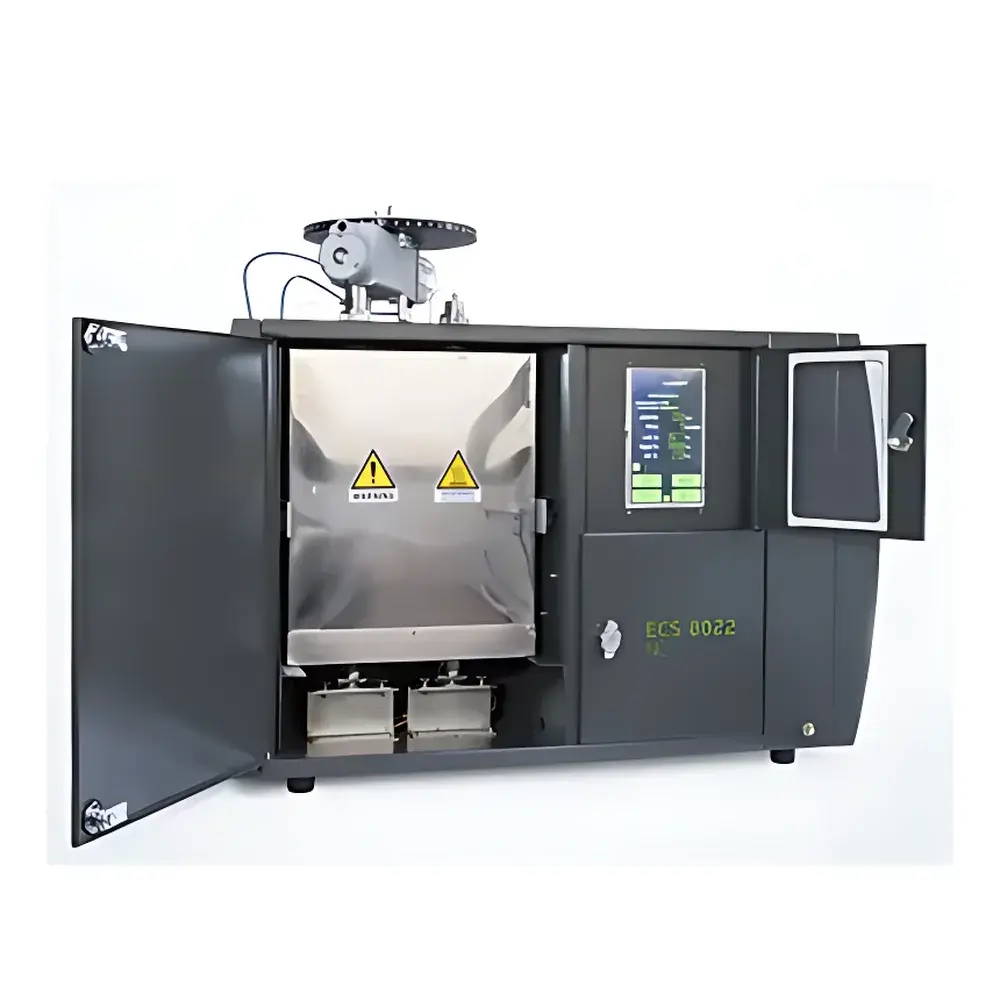
NC Technologies ECS 8022 Carbon-Nitrogen Elemental Analyzer
| Brand | NC Technologies |
|---|---|
| Origin | Italy |
| Model | ECS 8022 |
| Measured Elements | C, N |
| Sample Forms | Solid and Liquid |
| Detection Principle | Dumas Combustion Coupled with Gas Chromatography–Thermal Conductivity Detection (GC-TCD) |
| Measurement Range | C/N: 0.002–20 mg |
| Accuracy | <0.2% (vs. certified reference materials, purity >99.9%) |
| Precision | <0.1% RSD (vs. certified reference materials, purity >99.9%) |
| Analysis Time | ~5 min per CN determination |
| Furnace System | Dual-zone high-temperature combustion furnaces (up to 1100 °C each) |
| Separation Column | 3 m GC column |
| Detector | Self-calibrating high-resolution TCD (no reference gas required) |
| Carrier Gas | Ultra-high-purity helium (99.999%, 3–5 bar) |
| Oxidant | Ultra-high-purity oxygen (99.999%, 3–5 bar) |
| Autosamplers | Pneumatic (147-position), Electromechanical (32/50/100-position), Manual |
| Software | EAS Clarity™ with linear/quadratic/cubic calibration, real-time process monitoring, catalyst consumption tracking, and audit-ready data logging |
| Compliance | Designed for GLP/GMP environments |
| Dimensions | 81 × 50 × 37 cm |
| Weight | 68 kg |
| Power | 230 V, 50/60 Hz, 5 A, 1100 W max |
Overview
The NC Technologies ECS 8022 Carbon-Nitrogen Elemental Analyzer is a high-performance, fully automated Dumas combustion-based instrument engineered for precise quantification of total carbon (C) and nitrogen (N) in organic matrices. It implements the classical Dumas method—rapid flash combustion in an oxygen-rich environment at up to 1100 °C—followed by selective separation of CO2 and N2 combustion products via a dedicated 3-meter gas chromatographic column and detection using a self-calibrating, high-resolution thermal conductivity detector (TCD). Unlike conventional Kjeldahl or wet-chemistry methods, the ECS 8022 eliminates acid digestion, hazardous reagents, and lengthy sample preparation, delivering robust, trace-level accuracy across heterogeneous sample types without matrix-specific method development. Its dual-furnace architecture ensures complete oxidation of refractory organics while optimizing catalyst lifetime through intelligent oxygen dosing and real-time consumables monitoring.
Key Features
- Fully automated operation with three interchangeable autosampler options: pneumatic (147-position), electromechanical (configurable 32/50/100-position), and manual—enabling unattended batch analysis of up to 147 samples.
- Dual independent high-temperature furnaces (each rated to 1100 °C) with programmable ramp profiles ensure complete combustion of diverse organic materials—including soils, pharmaceuticals, polymers, foodstuffs, and environmental samples—without charring or incomplete oxidation.
- Self-calibrating TCD detector requires no external reference gas; baseline stability and sensitivity are maintained automatically through internal thermal compensation and zero-point validation routines.
- Integrated electronic flow control and dynamic oxygen metering system adjust oxidant delivery in real time based on sample mass and elemental load—minimizing O2 consumption and extending catalyst service intervals.
- Touchscreen interface with EAS Clarity™ software provides intuitive method setup, live reaction monitoring (including furnace temperature, carrier flow, and detector response), and catalyst usage analytics.
- Modular design supports seamless coupling to external isotope-ratio mass spectrometers (IRMS) or cavity ring-down spectrometers (e.g., Picarro) for δ13C and δ15N stable isotope ratio analysis.
Sample Compatibility & Compliance
The ECS 8022 accepts solid and liquid samples ranging from 0.1 mg to 500 mg, encapsulated in high-purity tin or silver boats. Its wide dynamic range (0.002–20 mg C or N per analysis) accommodates applications from ultra-trace nutrient profiling in plant tissue to high-loading polymer characterization. The system complies with ASTM D5373 (standard test method for instrumental determination of carbon, hydrogen, and nitrogen in petroleum products and lubricants), ISO 16968 (determination of carbon and nitrogen in soils), and USP & EP general chapters on elemental impurities (e.g., USP /). When configured with secure user authentication, electronic signatures, and full audit trail functionality, it meets FDA 21 CFR Part 11 requirements for regulated laboratories operating under GLP or GMP frameworks.
Software & Data Management
EAS Clarity™ is a dedicated, Windows-based analytical platform offering multi-point calibration (linear, quadratic, or cubic), automatic peak integration, drift correction, and customizable reporting templates. All raw chromatograms, calibration curves, and instrument logs are timestamped and stored with metadata (operator ID, sample ID, method version, hardware status). Data export supports CSV, PDF, and LIMS-compatible formats. Optional 21 CFR Part 11 add-ons provide role-based access control, electronic signatures, and immutable audit trails—ensuring full traceability from sample injection to final report generation.
Applications
- Pharmaceutical QA/QC: Quantification of C/N content in active pharmaceutical ingredients (APIs), excipients, and drug substances per ICH Q5C and regulatory stability protocols.
- Agricultural & Environmental Science: Total organic carbon (TOC) and total Kjeldahl nitrogen (TKN) equivalents in soils, sediments, composts, and wastewater sludge.
- Food & Feed Analysis: Protein estimation (via N content), authenticity verification, and nutritional labeling compliance (e.g., EU Regulation No. 1169/2011).
- Materials Science: Elemental composition verification of synthetic polymers, carbon blacks, graphene derivatives, and battery electrode materials.
- Isotope Geochemistry: Preparatory combustion module for offline δ13C and δ15N analysis when interfaced with IRMS or laser-absorption spectrometers.
FAQ
What combustion principle does the ECS 8022 employ?
It uses the Dumas method: flash combustion in pure oxygen at up to 1100 °C, followed by catalytic reduction and GC–TCD separation of CO2 and N2.
Does the TCD require periodic recalibration with reference gases?
No—the detector features an embedded self-calibration routine and does not rely on external reference standards.
Can the ECS 8022 analyze sulfur or hydrogen?
No; the ECS 8022 is specifically configured for C and N only. NC Technologies offers separate models (e.g., ECS 8024) for CHNS or CHNOS analysis.
Is helium the only acceptable carrier gas?
Yes—ultra-high-purity helium (99.999%) is mandatory for optimal GC resolution and TCD stability; argon or nitrogen are incompatible.
How is catalyst lifetime monitored?
The system tracks cumulative oxygen consumption, combustion efficiency metrics, and peak shape degradation to predict catalyst replacement needs and trigger maintenance alerts.
What safety certifications does the instrument hold?
It conforms to IEC 61010-1 (Safety Requirements for Electrical Equipment for Measurement, Control, and Laboratory Use) and carries CE marking for EMC and Low Voltage Directive compliance.
Related Products





