
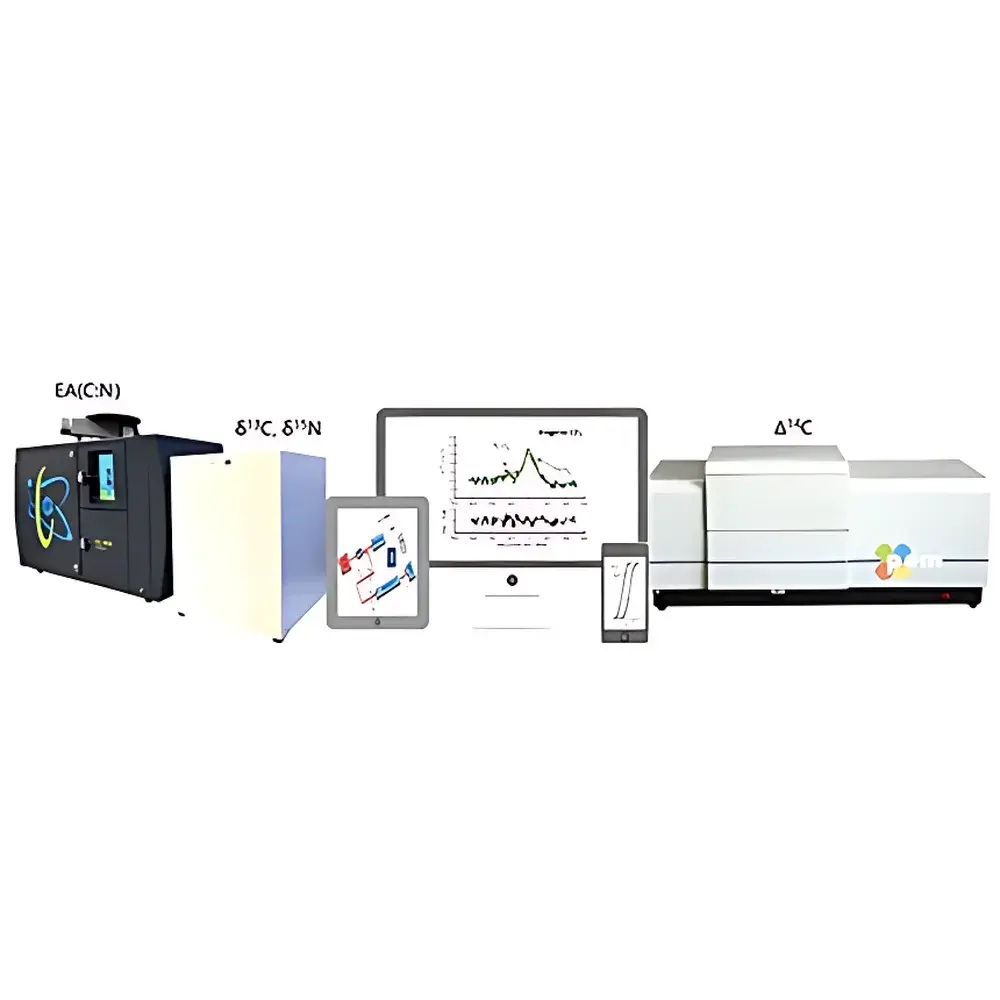
NC Technologies ECS 8070-IRMS-iRIS Atmospheric ¹³C/¹⁴C Isotope Monitoring System
| Brand | NC Technologies |
|---|---|
| Origin | Italy |
| Model | ECS 8070-IRMS-iRIS |
| Sample Throughput | 10–60 min (CO₂ prep), 10 min (δ¹³C via ID Micro), 30–60 min (¹⁴C via PEM iRIS) |
| CO₂ Capture Capacity | 10–100 mg per sample |
| δ¹³C Precision | ±0.083–±0.152 ‰ (1σ, n=6) |
| ¹⁴C Accuracy | <1% pMC |
| Detection Medium | Pure CO₂ gas (≥10 mg C) |
| Compliance | Designed for ISO/IEC 17025-aligned workflows, compatible with GLP/GMP data integrity requirements |
Overview
The NC Technologies ECS 8070-IRMS-iRIS Atmospheric ¹³C/¹⁴C Isotope Monitoring System is an integrated, field-deployable analytical platform engineered for high-fidelity, real-time isotopic characterization of atmospheric carbon dioxide. It addresses two persistent bottlenecks in environmental radiocarbon science: the prohibitive cost and infrastructure dependency of accelerator mass spectrometry (AMS), and the analytical uncertainty introduced by offline sample collection, transport, and graphitization. By combining on-site CO₂ capture, automated cryo-focusing and purification, and dual-path isotopic detection—stable isotope ratio mass spectrometry (IRMS) for δ¹³C and cavity ring-down spectroscopy (CRDS) for ¹⁴C—the system enables quantitative apportionment of fossil versus biogenic carbon sources directly from ambient air. Its operational principle relies on selective infrared absorption at precisely tuned quantum-cascade laser wavelengths (for ¹⁴CO₂) and high-resolution mass separation of ¹²C¹⁶O₂, ¹³C¹⁶O₂, and ¹⁴C¹⁶O₂ ion beams (via ID Micro), all calibrated against internationally traceable reference materials (e.g., NIST SRM 1610, IAEA-C1, OxII). The system is not a standalone detector but a complete measurement chain—from air intake to isotopic ratio output—designed for compliance with climate monitoring networks, urban emission inventories, and regulatory carbon accounting frameworks.
Key Features
- Field-deployable Air CO₂-PSM sampler: 3 kg portable unit with rechargeable Li-ion battery (20 samples/charge), integrated H₂O/VOC/NOₓ scrubbers, and rapid CO₂ adsorption (<5 min/sample) using proprietary C-Quantum traps.
- ECS 8070 CO₂ pre-concentration module: Dual-furnace thermal desorption system with programmable trap temperature (−40 °C to +200 °C), carrier gas pressure control (0.1–1.0 bar), and auto-leak verification; delivers >99.99% CO₂ purity (residual H₂O <1 ppmv, NOₓ <0.1 ppbv).
- ID Micro desktop isotope ratio mass spectrometer: Compact benchtop IRMS (70 × 30 × 47 cm) featuring plug-and-play ion source exchange, selectable turbomolecular pump speed (70 or 250 L/s), and software-controlled peak-jumping for δ¹³C determination with ≤0.08 ‰ long-term reproducibility (n=6, 1σ).
- PEM iRIS ¹⁴C analyzer: CRDS-based module utilizing distributed-feedback quantum cascade laser (DFB-QCL) at 4.5 µm; measures ¹⁴CO₂ in pure CO₂ gas phase with 0.3 ppb.
- Unified software architecture: Cross-platform control suite supporting method scripting, real-time spectral visualization, audit-trail logging, and export to CSV/NetCDF formats compliant with FAIR data principles.
Sample Compatibility & Compliance
The ECS 8070-IRMS-iRIS accepts ambient air across diverse environmental matrices—including urban street canyons, forest canopies, industrial perimeters, and background monitoring stations—without pre-filtration beyond standard particulate removal (PM₁₀). It requires no chemical derivatization or graphite target fabrication. All CO₂ processing occurs in sealed, electropolished stainless-steel flow paths meeting ASTM E260-21 criteria for inert gas handling. The system’s calibration traceability aligns with SI units via certified reference gases (NIST SRM 1610 for δ¹³C; IAEA C2 and ANU sucrose for ¹⁴C), and its data management architecture supports 21 CFR Part 11-compliant electronic signatures, user access controls, and immutable audit trails—making it suitable for EPA Method TO-15 adjunct studies, EU MRV (Monitoring, Reporting, Verification) protocols, and IPCC Tier 3 source attribution modeling.
Software & Data Management
The integrated ControlSuite v3.2 software provides unified instrument orchestration: synchronized triggering between Air CO₂-PSM sampling, ECS 8070 desorption cycles, ID Micro ion beam acquisition, and PEM iRIS CRDS integration. Raw spectra and mass chromatograms are time-stamped, geotagged (via optional GNSS module), and stored in encrypted SQLite databases. Processing algorithms apply non-linear baseline correction, isobaric interference subtraction (e.g., ¹⁷O effects on m/z 45), and multi-point normalization against bracketing standards. Export modules generate ISO/IEC 17025-required reports—including uncertainty budgets per GUM (JCGM 100:2008), detection limit calculations (3σ), and inter-laboratory comparison readiness files (ICP-MS-style). All software updates undergo version-controlled validation documented per ICH Q9 guidelines.
Applications
- Fossil fuel CO₂ attribution in urban airsheds for policy-relevant emission factor refinement (e.g., aligning with UNFCCC BUR reporting requirements).
- Validation of atmospheric transport models (e.g., WRF-Chem, STILT) using spatially resolved δ¹³C/¹⁴C gradients.
- Biogenic VOC oxidation product tracing via ¹³C-enriched precursor labeling experiments.
- Long-term trend analysis of atmospheric Δ¹⁴C for carbon cycle science (e.g., supporting NOAA Global Monitoring Laboratory objectives).
- Point-source verification for CCS (Carbon Capture and Storage) facilities under ISO 27916:2019.
FAQ
Does the system require external laboratory infrastructure (e.g., clean room, liquid nitrogen)?
No. All modules operate on standard 120/240 V AC power; the PEM iRIS uses closed-cycle Stirling cooling, and the ID Micro employs dry vacuum pumping—eliminating LN₂ dependency and Class 1000 cleanroom requirements.
Can the ECS 8070 process air samples containing high particulate or sulfur content?
Yes. The Air CO₂-PSM includes replaceable halogen-resistant scrubbers; for high-SO₂ environments (>1 ppm), optional stainless-steel catalytic converters (ASTM D5502-compliant) can be installed upstream.
How is data integrity ensured during unattended operation?
ControlSuite enforces automatic calibration checks every 5 samples, records hardware diagnostics (pressure, temperature, voltage), and writes SHA-256 hashes to blockchain-anchored log files—meeting ALCOA+ (Attributable, Legible, Contemporaneous, Original, Accurate, Complete, Consistent, Enduring, Available) principles.
Is the system compatible with existing IRMS or CRDS infrastructure?
Yes. ECS 8070 outputs standardized CO₂ pulses (1–5 mL, 1 atm) compatible with Thermo Delta series, Picarro G2131-i, or Los Gatos RMT-200 interfaces via ISO-KF 16 vacuum flanges and analog/digital trigger I/O.
What maintenance intervals are recommended for routine field deployment?
C-Quantum traps: 200 cycles or 6 months (whichever comes first); ID Micro ion source: 12 months or 500 analyses; PEM iRIS laser diode: 10,000 hours MTBF; all consumables include RFID-tagged lifecycle tracking within ControlSuite.
Related Products







