
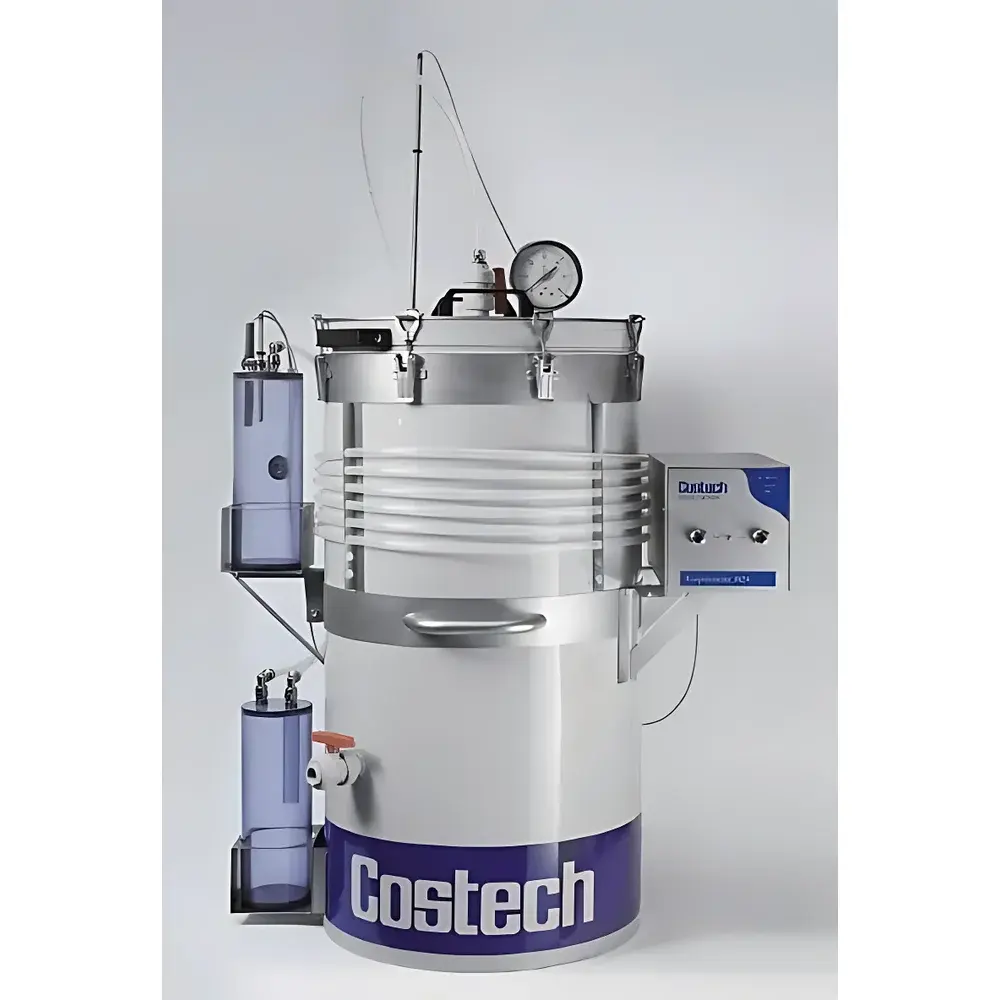
NC Technologies NCT RESPIROMETER 3024B Dynamic Insulated Respirometer
| Brand | NC Technologies |
|---|---|
| Origin | Italy |
| Model | Respirometer 3024B |
| Measurement Principle | Polarographic Oxygen Consumption |
| Oxygen Range | 0–25 % |
| Temperature Range | 0–100 °C |
| Airflow Rate | 10–500 L/h |
| Oxygen Resolution | 0.1 % |
| Temperature Resolution | 0.1 °C |
| Flow Resolution | 0.1 L/h |
| Oxygen Accuracy | ±0.3 % of reading |
| Temperature Accuracy | ±0.5 °C |
| Flow Accuracy | ±1 % of full scale |
| Dimensions | 900 × 750 × 1000 mm |
| Weight | 27 kg |
| Power Supply | 230 V~50 Hz, Max. 2 A |
| Connectivity | Ethernet (RJ45, Cat.5) |
| Gas Supply | High-purity compressed air (3 bar) |
| Software | Respi On Line (embedded), Respi Off Line (data analysis & export to TXT/XLS) |
Overview
The NC Technologies NCT RESPIROMETER 3024B is a dynamic insulated respirometer engineered for standardized, high-reproducibility assessment of biological stability in organic substrates—primarily compost feedstocks, digestates, and municipal biowastes. It operates on the principle of polarographic oxygen consumption measurement under controlled aerobic conditions, quantifying the Dynamic Respiration Index (DRI) as defined by UNI/TS 11184 (prEN 15590). DRI expresses oxygen uptake rate (mg O₂·kg⁻¹ VS·h⁻¹) during active microbial oxidation of readily biodegradable organic compounds. Unlike static or closed-circuit systems, the 3024B maintains continuous airflow (10–500 L/h) to sustain a stable oxygen partial pressure (~14 % v/v) and remove CO₂ in real time—ensuring optimal physiological conditions for aerobic heterotrophs and minimizing diffusion limitations. This dynamic equilibrium enables direct correlation between measured respiration kinetics and substrate biodegradability potential, making it suitable for both routine quality control and process optimization in composting and anaerobic digestion facilities.
Key Features
- Dynamic insulated chamber with precision temperature control (0–100 °C, ±0.5 °C accuracy) to simulate field-relevant thermophilic/mesophilic conditions
- Polarographic oxygen sensor with 0.1 % resolution and ±0.3 % reading accuracy, calibrated traceably to NIST-traceable standards
- Integrated mass flow controller for regulated airflow (10–500 L/h, ±1 % full-scale accuracy), ensuring consistent gas exchange and CO₂ sweep-out
- Embedded real-time firmware: Respi On Line — fully autonomous operation without external PC; supports automated DRI calculation, alarm thresholds, and local data logging
- Robust mechanical architecture: stainless-steel frame, insulated double-wall chamber, and sealed gas pathways compliant with ISO 14040 LCA boundary requirements
- RJ45 Ethernet interface (Cat.5) enabling remote monitoring, firmware updates, and integration into centralized laboratory information management systems (LIMS)
Sample Compatibility & Compliance
The 3024B accommodates heterogeneous solid organic matrices up to 1 kg (VS-based loading), including green waste, food waste, sewage sludge, agricultural residues, and stabilized compost. Sample containers are standardized 2-L glass reactors with septum-sealed lids and integrated gas inlet/outlet ports. The system complies with the methodological framework of UNI/TS 11184 and aligns with the technical basis of prEN 15590 for biological stability evaluation. It supports GLP-aligned workflows through audit-trail-enabled data capture, user-access controls, and timestamped raw signal logging. While not FDA 21 CFR Part 11-certified out-of-the-box, its Respi Off Line software supports configurable electronic signatures and export formats (TXT, XLS) compatible with validated GMP/QA documentation systems.
Software & Data Management
Respi On Line runs natively on the instrument’s embedded ARM-based controller, delivering real-time DRI computation, trend visualization, and programmable incubation protocols (e.g., 4-, 24-, or 96-hour assays). All sensor outputs—including O₂ concentration, chamber temperature, and volumetric flow—are logged at 1-second intervals and stored internally (≥30 days at default sampling rate). Respi Off Line (Windows-compatible desktop application) provides post-acquisition analysis: baseline correction, kinetic curve fitting (first-order exponential decay models), statistical comparison across sample batches, and customizable reporting templates. Data exports preserve metadata (operator ID, calibration dates, ambient conditions) and conform to ISO/IEC 17025 clause 7.5.2 for result traceability.
Applications
- Biological stability screening of compost prior to land application (EU End-of-Waste criteria compliance)
- Process monitoring of windrow and in-vessel composting systems to identify stabilization endpoints
- Feedstock characterization for anaerobic digestion plants—predicting methane yield potential and inhibition risks
- Research on microbial community activity under varying C/N ratios, moisture content, or inoculant treatments
- Validation of pretreatment efficacy (e.g., thermal hydrolysis, enzymatic lysis) on biodegradability enhancement
- Teaching laboratories: hands-on demonstration of aerobic respiration kinetics, microbial growth phases, and substrate utilization theory
FAQ
What does DRI measure, and how is it different from SOUR or AT4?
DRI quantifies oxygen uptake rate under dynamic airflow, reflecting real-time metabolic activity of indigenous microbiota. Unlike SOUR (Specific Oxygen Uptake Rate), which requires biomass separation, or AT4 (aeration test over 4 days), DRI captures short-term (2–4 h) peak respiration and correlates more directly with labile carbon content.
Is external calibration required before each run?
Zero and span calibration using nitrogen and certified air (20.9 % O₂) is recommended before each analytical session or after extended idle periods (>72 h); automated drift compensation is applied during long-term assays.
Can the system operate unattended for multi-day tests?
Yes—Respi On Line supports scheduled start/stop, auto-save intervals, and low-power sleep mode. Internal memory retains full-resolution data even during brief power interruptions.
What gas purity specifications are mandatory for reliable results?
Compressed air must be oil-free, particle-filtered (<0.01 µm), and dried to ≤−40 °C dew point; CO₂ content must remain <10 ppm to prevent sensor interference and ensure accurate O₂ differential calculation.
How is temperature uniformity maintained across the sample bed?
The insulated chamber employs Peltier-assisted heating/cooling and forced-air circulation via a low-turbulence blower, achieving ±0.8 °C spatial homogeneity (measured at 9 points per 2-L reactor) per ISO 17025 internal validation reports.







