
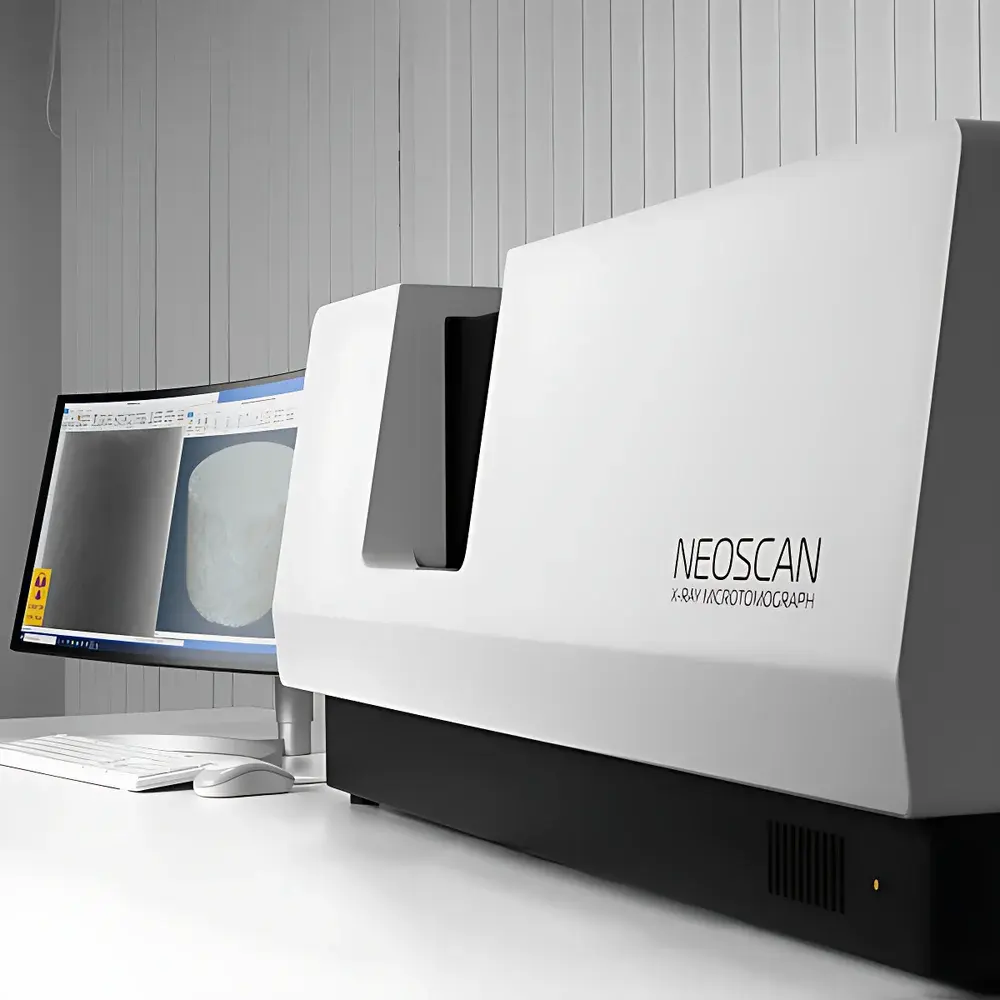
Neoscan NeoScan-PlantBreed High-Resolution Industrial Micro-CT System
| Brand | Neoscan |
|---|---|
| Origin | Belgium |
| Detector Type | Flat-Panel Detector |
| Scan Mode | Sample Rotation Only (RO) |
| Spatial Resolution | 2 µm |
| X-ray Energy | 110 kV |
| Field of View | 100 × 163 mm |
| Maximum Sample Weight | 20 kg |
| System Dimensions | 1200 × 640 × 520 mm |
Overview
The Neoscan NeoScan-PlantBreed is a high-resolution industrial micro-computed tomography (micro-CT) system engineered specifically for non-destructive, three-dimensional phenotyping in plant breeding and agricultural research. Operating on the principle of cone-beam X-ray computed tomography, it employs a fixed-source, fixed-detector geometry with precise sample rotation to acquire hundreds of projection images per scan. These projections are reconstructed using filtered back-projection or iterative algorithms into isotropic voxel datasets—enabling quantitative morphometric analysis of internal anatomical structures without physical sectioning. Unlike conventional histology or destructive sampling, this system preserves sample integrity across longitudinal studies, supporting repeat scanning of living or hydrated specimens under controlled environmental conditions. Its 110 kV microfocus X-ray source delivers sufficient photon flux for high-contrast imaging of low-Z biological materials—including roots, stems, seeds, and rhizosphere soil matrices—while maintaining sub-2 µm spatial resolution at optimal magnification. The system is designed for integration into GLP-compliant laboratories and supports traceable calibration protocols aligned with ISO/IEC 17025 requirements for measurement uncertainty reporting.
Key Features
- Sub-2 µm true spatial resolution (measured per ASTM E2982–22), validated using NIST-traceable line-pair test objects
- Flat-panel detector with scintillator-coupled amorphous silicon sensor, optimized for soft-tissue contrast in botanical samples
- Dedicated sample rotation-only (RO) scanning geometry—minimizing mechanical drift and maximizing geometric stability during long-duration acquisitions
- Integrated environmental chamber interface (optional) for in-situ monitoring of root growth dynamics under controlled humidity, temperature, and CO2 levels
- Rigid granite-based mechanical architecture with active vibration damping, ensuring repeatability <±0.3 µm over multi-hour scans
- Modular shielding design compliant with IEC 61000-6-3 for electromagnetic compatibility and IEC 62463 for radiation safety in laboratory environments
Sample Compatibility & Compliance
The NeoScan-PlantBreed accommodates specimens up to 100 mm in diameter and 163 mm in height, with maximum load capacity of 20 kg—sufficient for intact potted plants, root-soil cores, mature fruit clusters, or multi-plant trays. Sample holders include precision-machined aluminum stages with adjustable clamping, hydrogel-compatible mounts for live root imaging, and low-absorption carbon-fiber cradles for high-fidelity seed analysis. All hardware and firmware comply with EU Machinery Directive 2006/42/EC and Electromagnetic Compatibility Directive 2014/30/EU. Data acquisition workflows meet ALCOA+ principles (Attributable, Legible, Contemporaneous, Original, Accurate, Complete, Consistent, Enduring, Available) and support audit-ready metadata embedding per FDA 21 CFR Part 11 when paired with optional electronic signature modules.
Software & Data Management
Bundled NeoRecon v5.2 reconstruction suite provides GPU-accelerated FDK and SART algorithms, real-time ring artifact correction, and beam-hardening compensation tuned for organic matrices. Quantitative analysis is performed via NeoAnalyze Pro—featuring ISO 16234-compliant porosity segmentation, skeletonization-based root topology mapping (branch order, link length, bifurcation angle), and volumetric parameter extraction (tissue volume fraction, surface-area-to-volume ratio, connectivity density). Export formats include DICOM-CT, NIfTI, STL, and CSV with embedded calibration metadata. The software architecture supports automated batch processing, version-controlled pipeline scripting (Python API), and secure DICOM PACS integration. Audit trails record all user actions, parameter modifications, and reconstruction iterations—fully compliant with GLP documentation standards for regulatory submissions.
Applications
- Root architecture phenotyping: Quantification of lateral root density, taproot taper, cortical aerenchyma formation, and mycorrhizal colonization patterns in situ within soil-filled rhizotrons
- Seed developmental biology: Non-invasive tracking of embryo expansion, endosperm degradation kinetics, and testa cracking dynamics during imbibition and germination
- Stem vascular bundle mapping: 3D reconstruction of xylem vessel networks, pit aperture distribution, and embolism propagation under drought stress treatments
- Fruit texture & quality assessment: Correlation of internal void fraction, locule geometry, and placental tissue density with post-harvest shelf-life and mechanical firmness metrics
- Pathogen–host interaction studies: Visualization of fungal hyphal invasion pathways, insect larval tunneling trajectories, and necrotic lesion progression in intact tissues
FAQ
What is the minimum achievable voxel size for plant root imaging?
The system achieves isotropic voxels down to 1.8 µm under optimal magnification and exposure settings; actual resolution depends on sample size, X-ray energy selection, and detector binning configuration.
Can the system image live, hydrated plant material over time?
Yes—when equipped with the optional environmental control module, it supports time-lapse micro-CT of growing roots or germinating seeds inside sealed chambers with continuous gas exchange and moisture regulation.
Is the software compatible with third-party analysis platforms such as Avizo or Dragonfly?
All reconstructed volumes export in standard 32-bit TIFF stacks, NIfTI, and DICOM formats—ensuring full interoperability with commercial and open-source segmentation tools.
Does the system support automated scanning protocols for high-throughput breeding trials?
NeoRecon includes a programmable macro engine enabling unattended batch scanning of up to 48 samples per run, with auto-alignment, dose optimization, and QC flagging based on signal-to-noise ratio thresholds.
How is radiation dose managed for sensitive biological samples?
Dose is minimized via pulsed X-ray exposure, adaptive exposure time per projection, and hardware-based beam filtration; typical effective dose for a full root scan is <0.5 Gy—well below thresholds for measurable physiological impact in angiosperms.



