
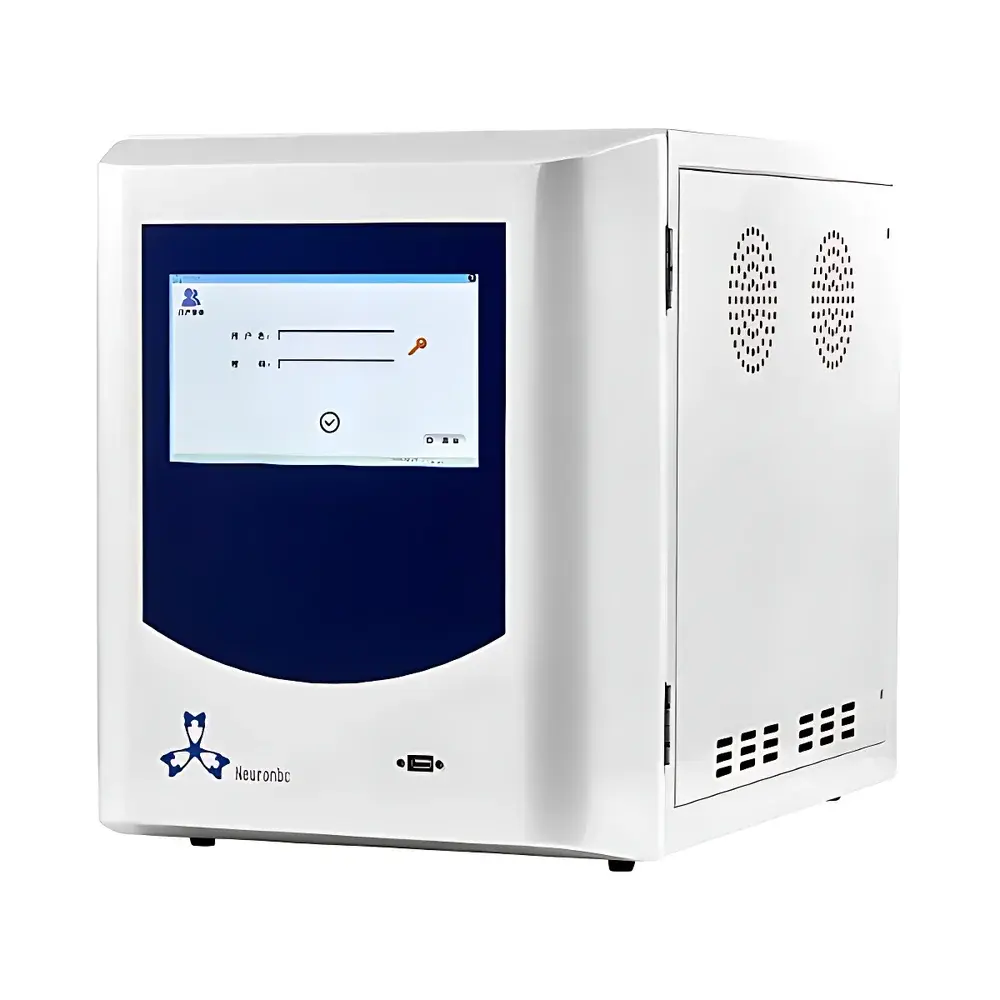
NeuronBC TA-200 High-Range Total Organic Carbon Analyzer
| Brand | NeuronBC |
|---|---|
| Origin | Beijing, China |
| Model | TOC-TA-200 |
| Instrument Type | Laboratory TOC Analyzer |
| Detection Principle | Non-Dispersive Infrared (NDIR) Absorption |
| Oxidation Method | High-Temperature Catalytic Combustion |
| Measurement Range | 0–30,000 mg/L |
| Accuracy | ±3% |
| Detection Limit | 1 ppb |
| Resolution | 1 ppb |
| Repeatability | ±3% |
Overview
The NeuronBC TA-200 High-Range Total Organic Carbon Analyzer is a laboratory-grade instrument engineered for precise, reliable quantification of total organic carbon in aqueous matrices using non-dispersive infrared (NDIR) detection following high-temperature catalytic combustion oxidation. Designed to meet the rigorous demands of regulatory-compliant water quality assessment, the TA-200 delivers robust performance across ultra-trace to high-concentration TOC measurements—from 1 ppb to 30,000 mg/L—without dilution or method switching. Its core architecture integrates thermally stabilized combustion at 680 °C with a proprietary platinum-catalyzed reactor, ensuring complete oxidation of refractory and particulate-bound organics, including humic substances, surfactants, and pharmaceutical residues. The NDIR detector employs a 24-bit digital signal acquisition system, minimizing baseline drift and enabling high-fidelity CO₂ quantification under variable sample load conditions. This measurement principle aligns with ASTM D7573, ISO 8245, and USP , supporting data integrity requirements in GLP and GMP environments.
Key Features
- Modular mechanical architecture enables rapid component replacement—combustion tube, NDIR cell, and TIC reaction module—reducing mean time to repair (MTTR) without recalibration.
- Integrated TIC (Total Inorganic Carbon) reaction chamber combines heating, active cooling, condensate management, and liquid-level monitoring in a single flow path—minimizing dead volume and cross-contamination risk.
- Intelligent flow control system dynamically adjusts carrier gas velocity and refrigeration power based on injection volume and sample salinity, maintaining optimal moisture removal efficiency and detector stability.
- Low-voltage internal circuitry (<24 VDC) complies with IEC 61010-1 safety standards, eliminating electrical hazards during routine maintenance or service access.
- Real-time diagnostic software continuously compares operational parameters (e.g., combustion temperature, IR absorbance baseline, gas flow rate) against user-defined thresholds; automatic alerts include actionable remediation guidance—not just fault codes.
- Self-diagnostic leak detection monitors differential pressure across the sample introduction manifold and combustion gas supply lines, halting analysis and flagging anomalies before erroneous data generation.
- Dual-stage signal processing: 32-bit embedded controller handles real-time thermal compensation and flow normalization, while the 24-bit NDIR digitizer preserves dynamic range across five orders of magnitude.
Sample Compatibility & Compliance
The TA-200 accommodates a broad spectrum of aqueous samples—including potable water, ultrapure water (UPW), municipal wastewater, industrial effluents, seawater (with optional salt matrix compensation), and biopharmaceutical process streams. It supports direct injection of samples with suspended solids up to 50 mg/L and chloride concentrations ≤25,000 mg/L when configured with corrosion-resistant fluidic pathways. Regulatory alignment includes full traceability per FDA 21 CFR Part 11 (audit trail, electronic signatures, data immutability), compliance-ready reporting templates for ISO/IEC 17025 accreditation, and built-in validation protocols satisfying USP System Suitability criteria. All calibration and system suitability test records are timestamped, user-annotated, and exportable in CSV/PDF formats with cryptographic hash verification.
Software & Data Management
The TA-200 operates via NeuronBC TOC Suite v4.2—a Windows-based application featuring role-based access control (RBAC), configurable workflow templates, and automated report generation compliant with LIMS integration standards (ASTM E1482, ANSI/NIST SP 500-291). Raw spectral data, chromatographic traces, and system logs are stored in encrypted SQLite databases with automatic daily backup to network drives or cloud repositories. Audit trails capture every parameter change, calibration event, and user login—retained for ≥10 years per ALCOA+ principles. Remote monitoring is supported via secure TLS 1.2 web interface, enabling real-time status dashboards and push notifications for maintenance intervals or calibration due dates.
Applications
- Environmental monitoring: compliance testing of surface water, groundwater, and wastewater discharge per EPA Method 415.3 and EU Directive 2000/60/EC.
- Pharmaceutical manufacturing: UPW system validation, cleaning verification, and bioburden risk assessment in accordance with Annex 1 and PIC/S PI 007-6.
- Power generation: boiler feedwater and condensate TOC surveillance to prevent turbine deposit formation and corrosion under deposit (CUD).
- Electronics industry: monitoring rinse water purity in semiconductor fabrication where TOC < 1 ppb is required for advanced node lithography processes.
- Academic and contract research laboratories: method development for complex matrices (e.g., landfill leachate, algal blooms) leveraging programmable oxidation temperature ramping and multi-point calibration curves.
FAQ
What sample volume is required for a standard analysis?
Typical injection volume is 50–500 µL, adjustable via software; low-volume mode supports 20 µL injections for precious or highly concentrated samples.
Does the TA-200 require external gas supplies?
Yes—high-purity oxygen (≥99.995%) is required for combustion; zero air or nitrogen may be used as carrier gas depending on configuration.
Can the instrument measure TOC in saline or brackish water?
Yes, with optional high-salinity kit including Hastelloy fluidic components and adaptive chloride compensation algorithms.
How often must the NDIR detector be calibrated?
Factory calibration is stable for ≥12 months; daily system suitability checks using certified sucrose and sodium bicarbonate standards are recommended.
Is remote software update capability available?
Firmware and software updates are delivered via secure HTTPS portal with SHA-256 signature verification and rollback support.







