
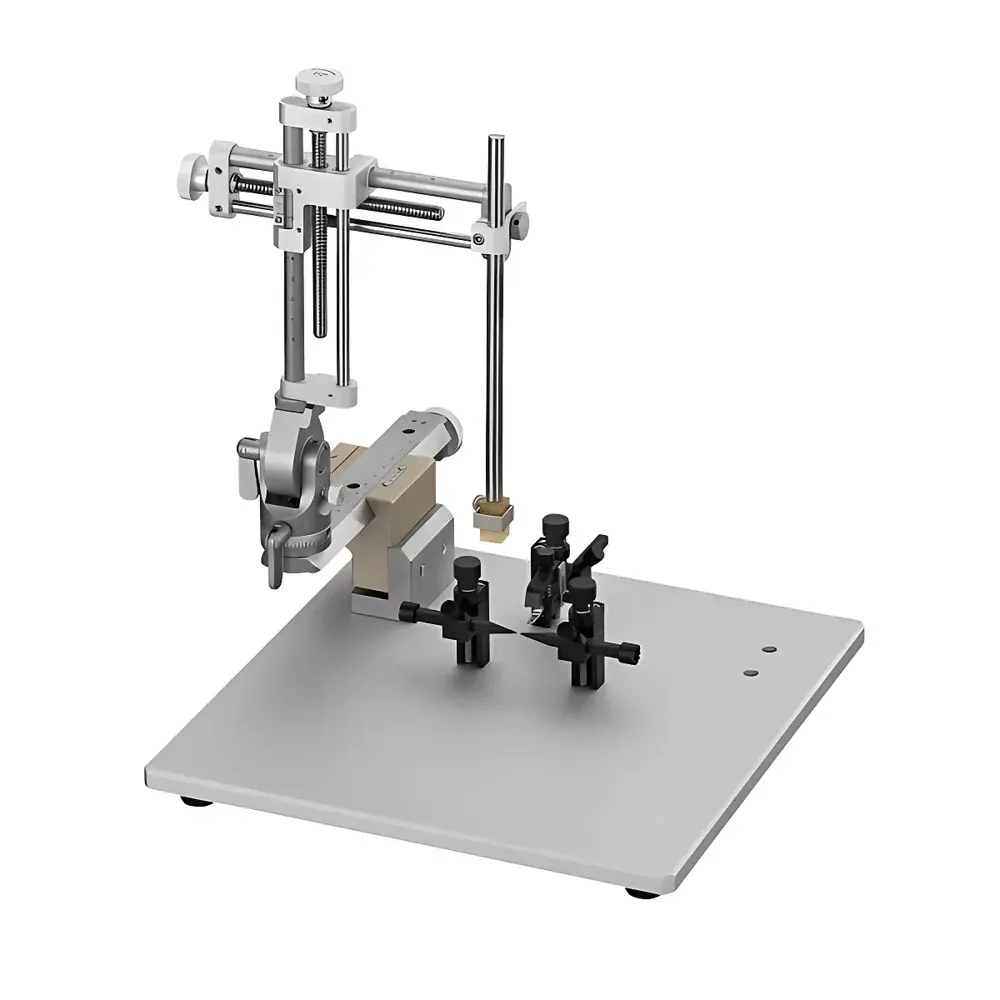
NeuroStar Lite Small Animal Stereotaxic Instrument for Mice
| Origin | Guangdong, China |
|---|---|
| Manufacturer Type | Authorized Distributor |
| Origin Category | Domestic (PRC) |
| Model | NeuroStar Lite Mouse Stereotaxic Instrument |
| Pricing | Available Upon Request |
| Base Plate Dimensions | 255 mm × 255 mm |
| Ear Bar Material | Polyoxymethylene (POM) |
| Incisor Bar Vertical Adjustment Range | 0–20 mm |
| Ear Bar Vertical Adjustment Range | 0–20 mm |
| Ear Bar Graduation Scale | 1 mm resolution |
| Included Ear Bars | Two pairs — 18° and 45° blunt-tipped |
Overview
The NeuroStar Lite Small Animal Stereotaxic Instrument for Mice is an engineered platform designed to support high-precision intracranial procedures in rodent neuroscience research. Based on the principles of stereotactic coordinate geometry—where anatomical targets are localized relative to standardized bregma-lambda reference points—the instrument provides mechanical stability and reproducible positioning essential for stereotactic injections, electrode implantation, cannula placement, and microlesioning in murine models. Its compact footprint (255 mm × 255 mm base plate) optimizes benchtop space without compromising rigidity or alignment fidelity. Constructed with a modular aluminum alloy frame and precision-machined POM (polyoxymethylene) ear bars, the system delivers dimensional stability under repeated thermal and mechanical stress, ensuring long-term calibration integrity across multi-day experimental series.
Key Features
- Lightweight yet rigid construction utilizing aerospace-grade aluminum alloy for frame integrity and minimal thermal drift
- Polyoxymethylene (POM) ear bars offering superior wear resistance, low friction coefficient, and chemical inertness—critical for repeated sterilization and compatibility with ethanol, isopropanol, and hydrogen peroxide decontamination protocols
- Graduated vertical adjustment mechanisms (0–20 mm range) for both incisor bar and ear bars, each marked with 1 mm刻度 (scale resolution), enabling rapid visual verification of bilateral symmetry during animal fixation
- Interchangeable ear bar configurations: two pairs included—18° and 45° blunt-tipped—optimized for differential skull morphology across C57BL/6, BALB/c, CD-1, and transgenic mouse strains
- Modular arm design supporting single-arm (Model 900-0068-50768507), dual-arm (900-0068-51068510), digital readout (900-0068-51368513), and dual-arm digital (900-0068-51668516) variants—facilitating seamless integration with microinjection pumps, electrophysiology manipulators, or fiber photometry setups
Sample Compatibility & Compliance
The NeuroStar Lite accommodates standard adult mice (20–35 g) and juvenile subjects down to 12 g when used with optional miniature ear bar inserts. Skull fixation conforms to established murine stereotactic atlases (e.g., Paxinos & Franklin, 4th ed.) and supports reproducible targeting of subcortical nuclei including the hippocampus (CA1, DG), ventral tegmental area (VTA), nucleus accumbens (NAc), and medial prefrontal cortex (mPFC). All components meet ISO 13485–aligned manufacturing controls for laboratory equipment; surface finishes comply with ISO 10993–5 cytotoxicity requirements. The instrument is compatible with standard autoclaving (121°C, 20 min) and plasma sterilization workflows, supporting GLP-compliant longitudinal studies.
Software & Data Management
While the base NeuroStar Lite is a manual mechanical system, digital variants (Models 900-0068-51368513 and 900-0068-51668516) integrate high-resolution linear encoders (±2 µm repeatability) and RS-485/USB-C interfaces. Firmware supports timestamped coordinate logging, user-defined coordinate presets, and export to CSV or MATLAB-compatible .mat formats. Audit trail functionality—including operator ID, timestamp, and parameter change history—is enabled to satisfy FDA 21 CFR Part 11 requirements for electronic records in regulated preclinical studies.
Applications
- Stereotactic delivery of viral vectors (AAV, lentivirus) into defined brain regions for optogenetic or chemogenetic circuit mapping
- Chronic implantation of chronic EEG/ECoG electrodes or microdialysis probes with submillimeter targeting accuracy
- Validation of neuroanatomical targeting in Cre-loxP transgenic lines prior to behavioral phenotyping
- Standardized lesion modeling in neurodegeneration (e.g., 6-OHDA striatal injection for Parkinson’s models) or psychiatric disease paradigms (e.g., NMDA receptor antagonist infusion)
- Training platform for graduate-level neuroscience laboratories requiring ISO-aligned procedural documentation and inter-operator reproducibility metrics
FAQ
What mouse strains are validated for use with this instrument?
C57BL/6J, BALB/c, Swiss Webster, CD-1, and FVB/N mice have been verified for consistent skull fixation and coordinate reproducibility using the supplied 18° and 45° ear bars.
Is the instrument compatible with MRI-guided surgical planning workflows?
Yes—coordinate offsets between bregma-based stereotactic coordinates and MRI-derived atlas spaces (e.g., Allen Mouse Brain Common Coordinate Framework v3) can be applied via the digital variant’s preset library function.
Can the base plate be mounted directly onto a stereomicroscope stage?
The base plate features four M4 threaded mounting holes (20 mm pitch) aligned to standard Leica, Zeiss, and Olympus microscope stage adapters; custom brackets are available upon request.
Does the system include calibration certification documentation?
Each unit ships with a factory-verified mechanical calibration report traceable to NIST-traceable length standards, including angular deviation (< ±0.1°) and linear travel error (< ±5 µm over full 20 mm range).



