
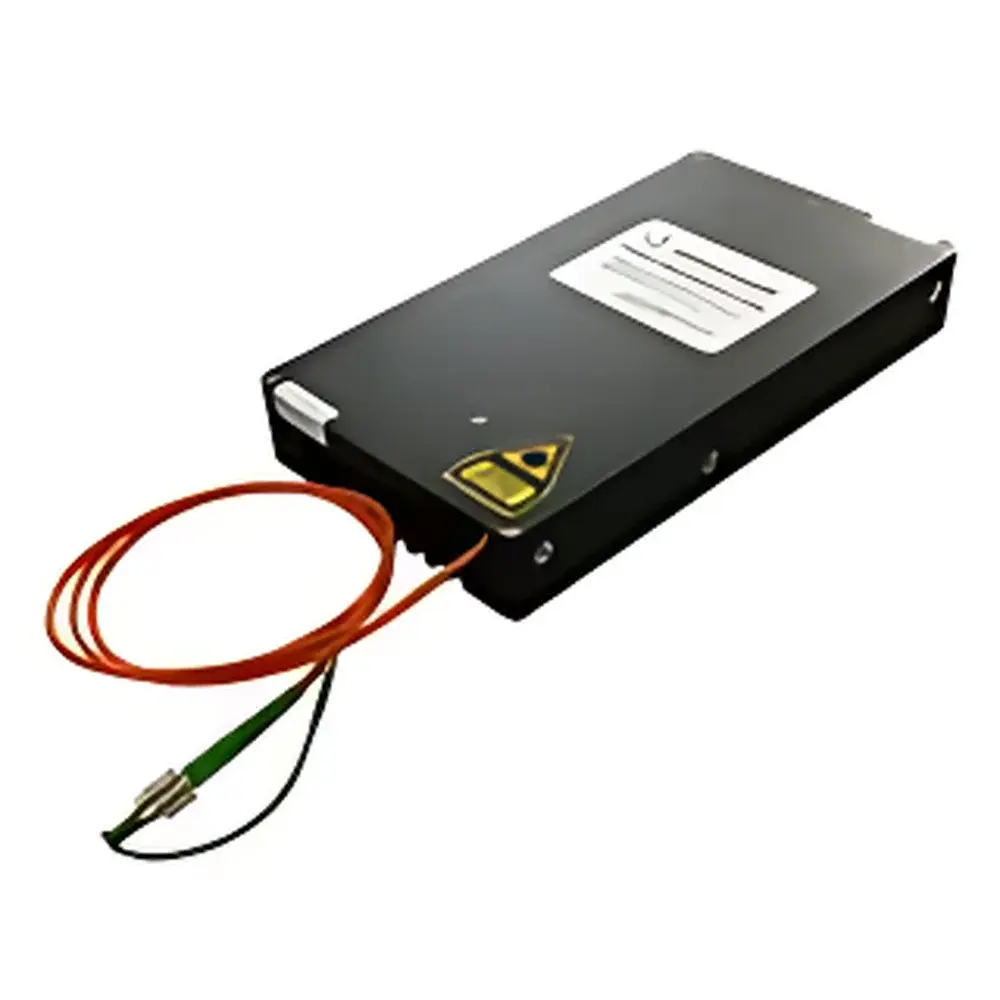
NewOpto newopto Narrow-Linewidth Tunable Laser Source
| Brand | NewOpto |
|---|---|
| Origin | Zhejiang, China |
| Manufacturer Type | Authorized Distributor |
| Country of Origin | China |
| Model | newopto |
| Central Wavelengths | 1.0 μm, 1.3 μm, 1.5 μm, 1.6 μm |
| Output | Polarization-Maintaining (PM) Fiber |
| Output Power | 10–1000 mW |
| Linewidth | 1–1000 kHz |
| Tuning Range | 0–3 nm |
| Wavelength Stability | ±1 pm |
| Power Stability | ≤1% (RMS, 8 hrs) |
| Frequency Modulation Bandwidth | <0.1 GHz (amplitude), 10 Hz–100 kHz (repetition rate) |
| Frequency Noise | <300–500 Hz/√Hz @ 1 Hz |
| Intensity Noise | <−130 dB/Hz @ 1 Hz |
| Operating Temperature | 0–50 °C |
| Power Supply | 110–240 VAC, 50–60 Hz |
| Power Consumption | <2 W (per channel) |
| Dimensions | 326 × 161 × 78 mm³ |
| Weight | 1.5 kg |
Overview
The NewOpto newopto Narrow-Linewidth Tunable Laser Source is a precision-engineered optical instrument designed for applications demanding high spectral purity, fine wavelength control, and long-term operational stability. Based on distributed feedback (DFB) or external cavity diode laser (ECDL) architecture—depending on configuration—it delivers single-frequency, polarization-maintaining (PM) fiber-coupled output with sub-kilohertz to low-megahertz linewidths. Its tunability across up to 3 nm within C-, L-, O-, or S-band windows enables flexible integration into interferometric sensing, coherent detection, and frequency metrology systems. The laser’s low phase noise (<300–500 Hz/√Hz @ 1 Hz) and ultra-low relative intensity noise (<−130 dB/Hz @ 1 Hz) ensure minimal signal degradation in heterodyne and homodyne architectures. Engineered for laboratory and field-deployable environments, it features robust mechanical design, active thermal stabilization, and immunity to ambient vibration—critical for distributed fiber optic sensing and underwater acoustic monitoring where environmental perturbations are unavoidable.
Key Features
- Single longitudinal mode (SLM) operation with linewidth configurable from 1 kHz to 1 MHz, optimized for coherence-length-sensitive applications
- Continuous, mode-hop-free wavelength tuning over 0–3 nm via integrated piezoelectric transducer (PZT) and temperature-controlled grating actuation
- Polarization-maintaining (PM) fiber output with extinction ratio >20 dB, enabling stable interference in polarization-diverse systems
- High wavelength stability (±1 pm over 8 hours) and power stability (≤1% RMS), validated under GLP-aligned drift testing protocols
- Low power consumption (<2 W per channel) and compact footprint (326 × 161 × 78 mm³), supporting multi-channel rack-mount integration without forced-air cooling
- Comprehensive analog/digital modulation interface: DC-coupled current bias input, TTL-compatible frequency dithering (10 Hz–100 kHz), and analog amplitude modulation (<0.1 GHz bandwidth)
Sample Compatibility & Compliance
This laser source is compatible with standard SMF-28, PM1550, and HI1060 fibers, and supports FC/APC, FC/PC, and custom connectorization. It meets IEC 61340-5-1 for electrostatic discharge (ESD) protection and complies with CE marking requirements for electromagnetic compatibility (EMC) per EN 61326-1 and safety per EN 60825-1 (Class 1M). While not certified for medical or aerospace use out-of-the-box, its design adheres to traceable calibration practices aligned with ISO/IEC 17025 principles. For regulated environments—including pharmaceutical process analytical technology (PAT) or oilfield downhole sensing—the system supports optional audit trail logging and user-access control when integrated with third-party SCADA or LabVIEW-based supervisory software.
Software & Data Management
The laser operates via RS232, USB-C, or optional Ethernet (TCP/IP) interface, enabling remote parameter control using vendor-provided SDKs (C/C++, Python, MATLAB). All critical operational parameters—including setpoint wavelength, output power, modulation frequency, and real-time temperature feedback—are logged with timestamped metadata at user-defined intervals (10 ms–10 s resolution). When deployed in multi-laser arrays, synchronization is achieved through shared 10 MHz reference clock input and programmable trigger delay (0–100 ns resolution). Data export supports CSV and HDF5 formats, facilitating post-acquisition analysis in tools compliant with FDA 21 CFR Part 11 requirements when paired with validated electronic lab notebook (ELN) systems.
Applications
- Coherent Optical Communications: Local oscillator (LO) source for DP-QPSK and higher-order modulation formats in C+L-band transmission systems
- Distributed Acoustic Sensing (DAS): Seed laser for φ-OTDR systems requiring >10 km sensing range and sub-µε strain resolution
- Atomic Physics & Metrology: Pump/probe source for Rb, Cs, or Yb vapor cell experiments; optical frequency comb seeding
- Gas Spectroscopy: High-resolution absorption spectroscopy targeting narrow ro-vibrational lines (e.g., CH₄, CO₂, H₂O) in environmental monitoring
- Fiber Optic Gyroscopes (FOGs): Low-noise source minimizing Kerr-induced bias drift in interferometric rotation sensing
- Photonic Microwave Generation: Optical heterodyning platform for generating mm-wave carriers (10–100 GHz) with phase noise <−100 dBc/Hz @ 10 kHz offset
FAQ
Is this laser suitable for use in a Class 1000 cleanroom environment?
Yes—its fully sealed chassis, absence of moving parts beyond the PZT actuator, and lack of outgassing materials meet ISO 14644-1 Class 6 (equivalent to Fed Std 209E Class 1000) particulate limits when operated within specified temperature/humidity ranges.
Can multiple units be synchronized for parallel heterodyne detection?
Yes—each unit includes a 10 MHz reference input and trigger-in port; phase alignment accuracy of <10 ps between channels is achievable using calibrated delay lines and common-clock distribution.
Does the system support OEM integration into custom instrumentation?
Yes—NewOpto provides mechanical drawings (STEP), electrical interface schematics, and full command-line protocol documentation for seamless integration into third-party platforms.
What is the typical warm-up time to achieve specified wavelength stability?
Under ambient conditions (23 ± 2 °C), full spectral stability (±1 pm) is attained within 15 minutes after power-on, as verified by internal wavemeter feedback loop convergence.
Are calibration certificates traceable to NIST or other national standards bodies available?
Yes—upon request, factory calibration reports with uncertainty budgets traceable to NIM (China National Institute of Metrology) are provided; NIST-traceable calibration may be arranged via accredited third-party labs.



