
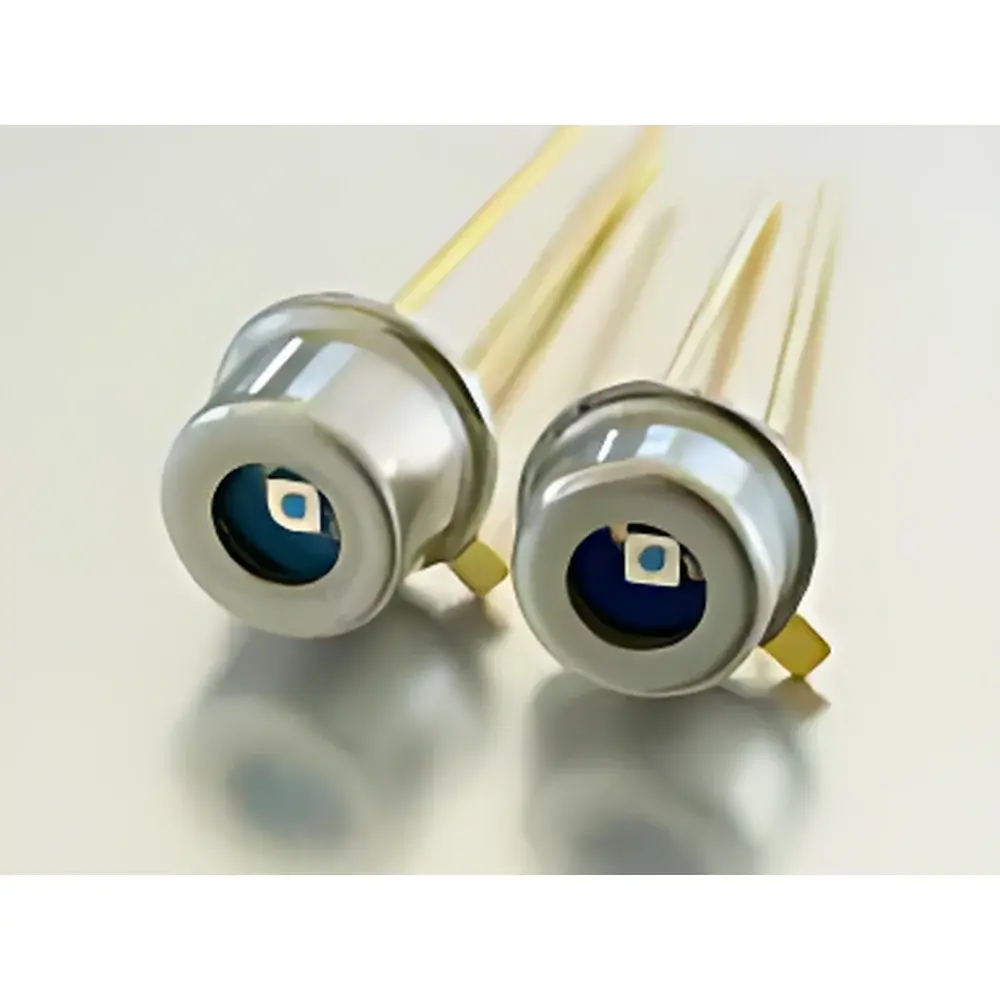
NewOpto First Sensor Avalanche Photodiode (APD) Module
| Brand | NewOpto |
|---|---|
| Origin | Germany |
| Manufacturer Type | Authorized Distributor |
| Product Category | Imported Optical Component |
| Model | First Sensor Series 8/9/10/11/12 |
| Component Type | Semiconductor Photodetector |
| Spectral Range | 360–1100 nm |
| Packaging | TO-5, TO-52, TO-5i, TO-8, LCC6.1, SOJ22GL, BGA, DIL18 |
| Active Area | Ø0.1–Ø5.0 mm (0.008–19.63 mm²) |
| Gain (M) | Up to 100 |
| Dark Current | 0.05–60 nA (dependent on series and bias) |
| Rise Time | <0.18–3 ns |
| Bandwidth | Up to 3 GHz (Series 12) |
| Compliance | RoHS, REACH, ISO 9001-certified supply chain |
Overview
The NewOpto First Sensor Avalanche Photodiode (APD) Module is a high-sensitivity, internally gain-enabled semiconductor photodetector engineered for low-light optical signal detection across scientific, industrial, and defense applications. Unlike standard PIN photodiodes, APDs operate under reverse bias near or above their breakdown voltage, enabling impact ionization and electron-hole multiplication—yielding internal current gain (M = 10–100) without external amplification. This mechanism delivers superior signal-to-noise ratio (SNR) in photon-starved conditions, particularly critical in time-resolved measurements such as time-of-flight (ToF) laser ranging, LiDAR, fluorescence lifetime imaging, and single-photon counting (in Geiger mode configurations). The module integrates rigorously selected First Sensor silicon APD chips—manufactured in Germany—with standardized hermetic packaging (TO-5, TO-52, LCC6.1, etc.) and optional transimpedance amplifier (TIA) hybrid variants for direct analog output. Each series is spectrally optimized to match common laser emission lines and scintillation spectra, ensuring maximal quantum efficiency (QE > 80% in specified bands) and minimal excess noise factor.
Key Features
- Spectrally segmented series architecture: Series 11 (360–560 nm, blue-enhanced), Series 12 (500–750 nm, flat 3 GHz response), Series 8 (750–820 nm, ultra-fast rise time < 0.18 ns), Series 9 (750–930 nm, LiDAR-optimized), and Series 10 (860–1100 nm, including 1064 nm YAG compatibility)
- Hermetically sealed packages (TO-5, TO-52S1/S3, TO-5i, TO-8Si, LCC6.1f) ensuring long-term stability, moisture resistance, and thermal robustness under continuous bias operation
- Low dark current performance: 0.05 nA (Series 8, Ø0.1 mm) to 60 nA (Series 10, Ø5 mm), calibrated at M = 100 and specified reverse bias
- High-speed variants with integrated TIAs: AD230-8-2.3G and AD500-9-400M provide impedance-matched 50 Ω outputs, eliminating need for external RF amplification stages
- Multi-element array options: 8-, 16-, 25- (5×5), and 64- (8×8) element APD arrays with integrated NTC/PTC temperature compensation, supporting beam position sensing, quadrant detection (e.g., QA4000-10), and parallelized ToF acquisition
- Compliance-ready design: Manufactured under ISO 9001 quality management; RoHS and REACH compliant; documentation supports traceability for GLP/GMP environments where detector calibration history is auditable
Sample Compatibility & Compliance
The First Sensor APD modules are compatible with standard optical bench mounting (e.g., SM1-threaded lens tubes), fiber-pigtailed coupling (via FC/PC or SMA adapters), and OEM integration into vacuum-compatible or temperature-controlled enclosures. All silicon-based devices are rated for operation from −40 °C to +85 °C ambient, with thermally stabilized bias networks recommended for gain-critical applications. For regulatory alignment, the modules meet IEC 61000-4 electromagnetic immunity standards when used with appropriate shielding and grounding practices. While not standalone medical devices, Series 11 APDs are routinely deployed in FDA-cleared analytical instruments (e.g., flow cytometers, microplate readers) where spectral matching to scintillator decay profiles (e.g., NaI:Tl, LYSO) is essential. No CE marking is applied directly to bare APD components; final system-level conformity (CE, UKCA, FCC) remains the responsibility of the integrating equipment manufacturer.
Software & Data Management
As passive photodetector components, First Sensor APDs do not embed firmware or require proprietary drivers. They interface seamlessly with industry-standard data acquisition systems—including National Instruments PXI platforms, Keysight DAQ modules, and custom FPGA-based digitizers—via analog voltage output (when paired with TIA hybrids) or current-mode output (for direct transimpedance conversion). NewOpto provides comprehensive datasheets with SPICE-compatible behavioral models for circuit simulation (e.g., LTspice, Cadence), including temperature-dependent gain curves and capacitance vs. bias plots. Calibration reports—traceable to PTB (Physikalisch-Technische Bundesanstalt) reference standards—are available upon request for metrology-grade deployments. For array configurations, pinout schematics and thermal derating guidelines support PCB layout compliance with IPC-2221 Class B requirements.
Applications
- Laser rangefinding and pulsed time-of-flight (pToF) LiDAR systems (Series 9, 10)
- High-speed optical communications receivers (1–3 Gbps, Series 12)
- Biomedical instrumentation: Flow cytometry, confocal microscopy, time-resolved fluorescence spectroscopy (Series 11)
- Industrial automation: Precision motion control feedback, encoder readout, laser triangulation sensors (Series 8)
- Defense & aerospace: Target designation, missile warning systems, secure free-space optical links (Series 10 @ 1064 nm)
- Nuclear and particle physics: Scintillation light readout for gamma/X-ray detection (Series 11, 12)
- Quantum optics experiments requiring sub-nanosecond timing resolution and low afterpulsing probability
FAQ
What is the maximum stable gain (M) achievable with these APDs, and how is it controlled?
Gain is determined by applied reverse bias voltage relative to breakdown (VBR). First Sensor specifies M = 100 at nominal operating voltage; users must implement temperature-compensated bias supplies to maintain gain stability, as VBR exhibits ~0.1 %/°C drift.
Are these APDs suitable for single-photon detection?
These are linear-mode APDs—not Geiger-mode SPADs—and are not designed for photon-counting below ~10⁴ photons/pulse. For true single-photon sensitivity, consider dedicated SPAD arrays or SiPMs.
Do you offer custom spectral filtering or AR coatings?
Yes—NewOpto provides optional broadband or laser-line anti-reflection coatings (e.g., 1064 nm V-coating) and integrated bandpass filters upon request, subject to MOQ and lead time.
How is dark current measured, and does it include leakage from packaging?
Dark current values in datasheets are measured at specified bias and temperature using guarded 4-wire Kelvin connections; they reflect total device current, including bulk and surface contributions—but exclude external circuit leakage.
Can these APDs be operated in gated mode for background suppression?
Yes—fast rise times (< 0.18 ns for Series 8) and low junction capacitance enable synchronization with picosecond laser pulses via active quenching circuits or fast-switching bias controllers.





