
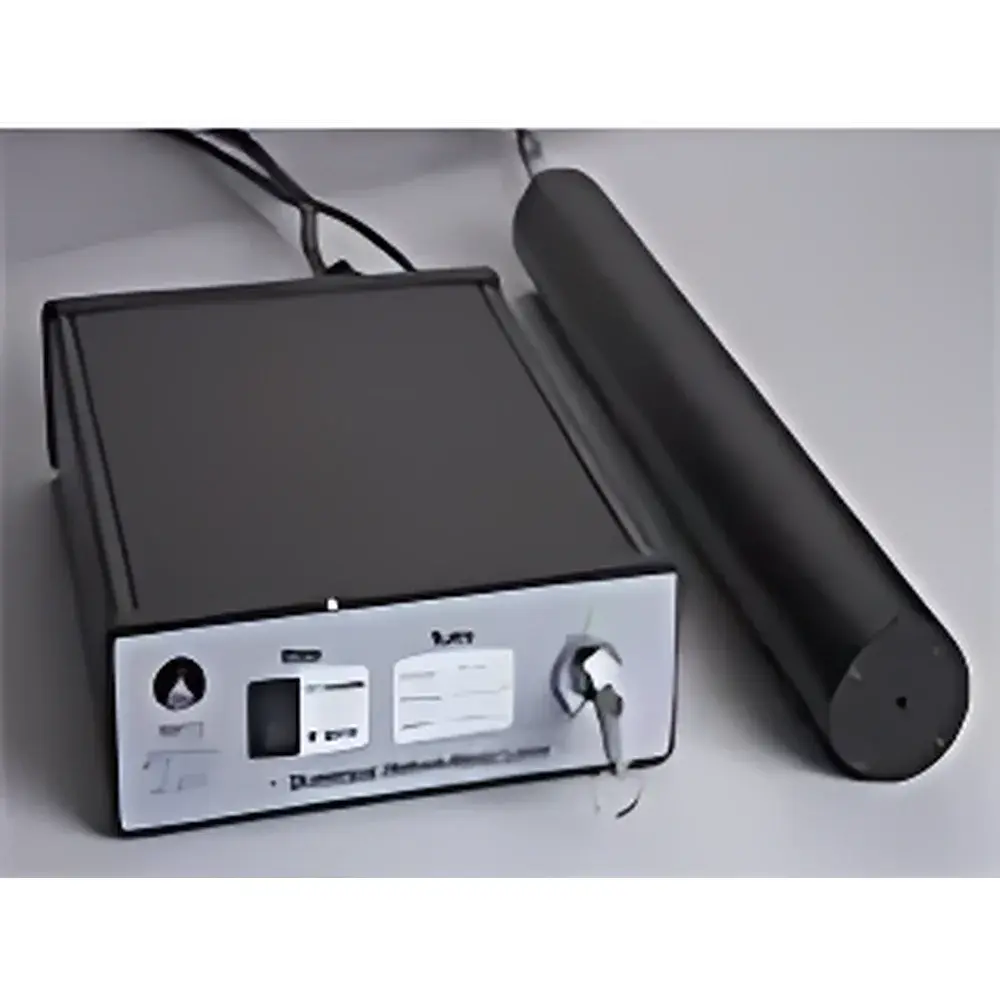
NewOpto SL Series Frequency-Stabilized Helium-Neon Laser
| Brand | NewOpto |
|---|---|
| Model | SL-01 / SL-02 |
| Wavelength | 633 nm |
| Output Power | >1.2 mW (SL-01), >2.4 mW (SL-02) |
| Polarization Ratio | >800:1 |
| Spatial Mode | TEM₀₀ |
| Beam Diameter | 0.63 mm |
| Beam Divergence | 1.3 mrad |
| Warm-up Time | <10 min |
| Frequency Stability (1 min) | ±2×10⁻⁹ (freq. stabilized mode) |
| Frequency Stability (1 hr) | ±5×10⁻⁹ |
| Frequency Stability (8 hr) | ±1×10⁻⁸ |
| Intensity Stability (1 min) | ±0.1% (intensity stabilized mode) |
| Intensity Stability (1 hr) | ±0.2% |
| Thermal Frequency Drift | <2 MHz/°C |
| Linewidth | <1 MHz (typical, single longitudinal mode) |
Overview
The NewOpto SL Series Frequency-Stabilized Helium-Neon (He-Ne) Laser is a precision gas laser system engineered for metrological-grade stability and long-term coherence in demanding optical applications. Operating at the fundamental helium-neon transition wavelength of 633 nm, the SL laser employs active frequency stabilization via saturated absorption spectroscopy in an internal iodine cell or equivalent reference scheme—ensuring traceable alignment to the SI-defined wavelength standard. Unlike free-running He-Ne lasers, the SL series maintains sub-10⁻⁹ fractional frequency stability over multi-hour intervals, enabling its use as a primary length reference in interferometric setups compliant with ISO 230-6 and VDI/VDE 2634 standards. Its TEM₀₀ Gaussian output, narrow intrinsic linewidth (800:1) support diffraction-limited beam propagation and minimal mode-matching uncertainty in heterodyne and homodyne detection architectures.
Key Features
- Two operational modes: Frequency-stabilized mode (for ultra-stable wavelength reference) and intensity-stabilized mode (for low-noise power delivery)
- Active thermal and current feedback control architecture minimizing drift from ambient temperature fluctuations (<2 MHz/°C)
- Integrated warm-up monitoring with full stabilization achieved in under 10 minutes
- Hermetically sealed plasma tube with optimized bore geometry and cathode design, delivering >20,000 hours of rated service life
- Low-noise, regulated DC power supply with EMI-filtered output and interlock-compatible safety circuitry
- Front-panel status indicators and analog monitoring outputs (0–5 V) for real-time tracking of frequency error signal and photodiode current
Sample Compatibility & Compliance
The SL laser is designed for integration into Class 1 or Class 3R laser safety-compliant systems per IEC 60825-1:2014 and FDA 21 CFR Part 1040.10. Its fixed-wavelength, single-longitudinal-mode output eliminates spectral ambiguity in calibration workflows requiring NIST-traceable sources—making it suitable for accredited metrology labs operating under ISO/IEC 17025. The device meets RoHS Directive 2011/65/EU requirements and carries CE marking for EMC (EN 61326-1) and LVD (EN 61010-1) conformity. No sample preparation or consumables are required; operation is limited to stable AC line input (100–240 VAC, 50/60 Hz) and ambient temperatures between 15 °C and 30 °C.
Software & Data Management
While the SL laser operates autonomously without host software, optional USB-to-TTL interface modules enable remote monitoring and logging of stabilization status, intensity error signals, and temperature telemetry via LabVIEW™, Python (PySerial), or MATLAB® environments. All analog monitor outputs comply with IEEE 1199-1995 signal conditioning conventions, supporting seamless integration into automated calibration stations governed by GLP/GMP data integrity protocols. Audit trails—including timestamps, operator IDs, and environmental logs—can be generated externally when paired with validated SCADA or LIMS platforms meeting FDA 21 CFR Part 11 electronic record requirements.
Applications
- Primary wavelength reference in displacement interferometry (e.g., laser Doppler vibrometry, gravitational wave detector alignment)
- Stabilized source for holographic interferometry and digital holography reconstruction
- Cavity ring-down spectroscopy (CRDS) cavity locking and mode matching verification
- Calibration of wavemeters, spectrometers, and optical spectrum analyzers against the 633 nm iodine-stabilized standard
- Education and research labs requiring reproducible, low-drift visible laser sources for quantum optics experiments (e.g., spontaneous parametric down-conversion pump alignment)
- OEM integration into automated optical inspection systems where long-term intensity and frequency repeatability are critical to measurement uncertainty budgets
FAQ
What is the difference between frequency-stabilized and intensity-stabilized operation modes?
Frequency stabilization actively locks the laser’s longitudinal mode to an atomic reference (e.g., iodine hyperfine transition), achieving sub-Hz-level frequency uncertainty. Intensity stabilization regulates output power via fast photodiode feedback but permits inherent frequency drift—suitable for applications prioritizing amplitude consistency over spectral fidelity.
Is the SL laser compatible with vacuum environments?
No. The laser head contains air-cooled thermal mass and non-hermetic electrical connectors; operation is specified only for atmospheric pressure and controlled laboratory conditions.
Can the SL laser be used for interferometric calibration per ISO 10791-6?
Yes—when operated in frequency-stabilized mode and mounted on vibration-isolated optical tables with thermal shielding, the SL series meets the ≤1×10⁻⁸ frequency instability threshold required for grade-0 interferometer calibration over 8-hour cycles.
Does the laser include a built-in beam expander or collimation adjustment?
No. The SL emits a collimated 0.63 mm diameter beam with 1.3 mrad divergence. External beam shaping optics must be selected and aligned per application-specific M² and Rayleigh range requirements.




