
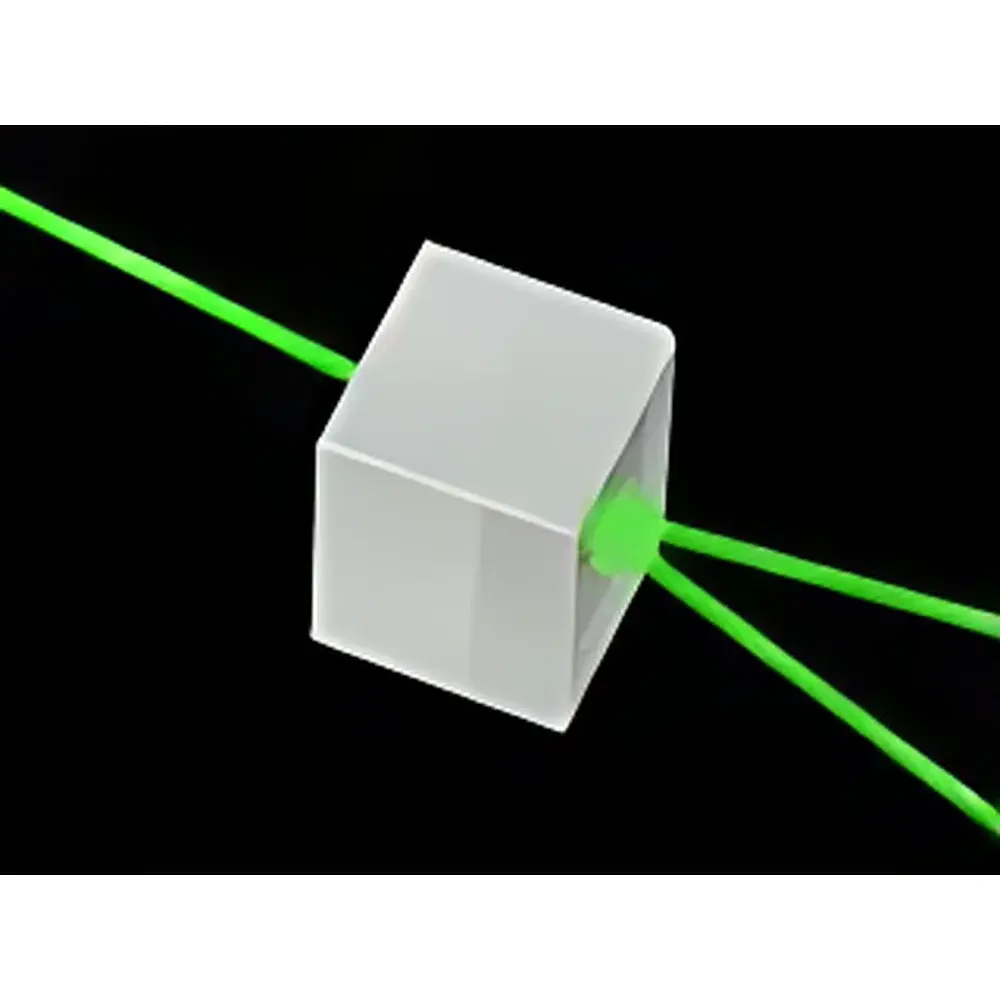
NewOpto Wollaston Polarizing Prism
| Brand | NewOpto |
|---|---|
| Origin | USA |
| Manufacturer Type | Authorized Distributor |
| Product Category | Imported Optical Component |
| Model | WPP5 / WPP10 |
| Material | Tellurium Dioxide (TeO₂) |
| Extinction Ratio | <1:10⁵ |
| Laser Damage Threshold | 200 MW/cm² (1064 nm, 12 ns, 1 Hz) |
| Surface Quality | 20/10 Scratch-Dig |
| Flatness | λ/4 @ 633 nm |
| Beam Separation Angle | 5° (WPP5) or 10° (WPP10) @ 633 nm |
| Length-to-Aperture Ratio (L/A) | 0.5–1.0 (WPP5), 0.8–1.2 (WPP10) |
Overview
The NewOpto Wollaston Polarizing Prism is a high-precision birefringent beam-splitting optical component engineered for critical polarization-state separation in advanced photonic systems. Based on the fundamental principle of double refraction in anisotropic crystalline materials, the prism splits an incident unpolarized or partially polarized beam into two orthogonally polarized output beams—ordinary (o-ray) and extraordinary (e-ray)—propagating at a precisely defined angular separation. Constructed from high-purity tellurium dioxide (TeO₂), this prism delivers exceptional birefringence, low absorption across visible to near-infrared wavelengths, and superior thermal and mechanical stability—making it ideal for demanding applications including terahertz time-domain spectroscopy (THz-TDS), phase-contrast microscopy, laser interferometry, and quantum optics setups where polarization fidelity and spatial beam discrimination are non-negotiable.
Key Features
- High extinction ratio <1:10⁵ ensures robust suppression of cross-polarized leakage, enabling accurate polarization analysis in metrology-grade instruments.
- Laser damage threshold of 200 MW/cm² (measured at 1064 nm, 12 ns pulse width, 1 Hz repetition rate) supports integration into high-peak-power pulsed laser systems without risk of surface ablation or bulk degradation.
- Surface quality rated at 20/10 scratch-dig and wavefront flatness of λ/4 @ 633 nm guarantee minimal wavefront distortion and diffraction-limited performance in collimated beam paths.
- Two standardized configurations: WPP5 provides 5° beam separation at 633 nm with L/A ratio optimized between 0.5–1.0; WPP10 delivers 10° separation with L/A 0.8–1.2—enabling flexible design trade-offs between angular dispersion, aperture size, and optical path length.
- Monolithic TeO₂ construction eliminates adhesive interfaces, eliminating delamination risks and ensuring long-term environmental stability under vacuum, humidity, or thermal cycling conditions typical in research-grade optical benches.
Sample Compatibility & Compliance
The NewOpto Wollaston Prism is compatible with collimated beams ranging from 350 nm to 2000 nm, with optimal performance calibrated at 633 nm (HeNe) and 1064 nm (Nd:YAG). Its TeO₂ substrate exhibits negligible hygroscopicity and no phase transition below 400 °C, supporting operation in cleanroom, ultra-high vacuum (UHV), and cryogenic environments. While not certified to a specific regulatory standard as a standalone component, the prism conforms to ISO 10110-7 (surface imperfections) and ISO 10110-3 (wavefront tolerance) specifications for precision optical elements. When integrated into final instrumentation, it supports compliance with GLP/GMP-aligned optical subsystem validation protocols and meets material traceability requirements per ASTM E2919 for optical component qualification in regulated R&D laboratories.
Software & Data Management
As a passive optical component, the Wollaston Prism requires no embedded firmware, drivers, or software interface. However, its precise angular separation and polarization purity directly impact data integrity in polarization-sensitive measurement workflows—including Mueller matrix acquisition, ellipsometric calibration, and THz electric-field waveform reconstruction. Users are advised to document prism serial number, orientation markings (e.g., input face arrow), and measured extinction ratio during system commissioning to support audit-ready traceability under FDA 21 CFR Part 11-compliant data management frameworks. Integration into LabVIEW, MATLAB, or Python-based control suites is achieved via mechanical alignment records and calibrated polarization state mapping—not digital communication.
Applications
- Terahertz Time-Domain Spectroscopy (THz-TDS): Serves as a polarization analyzer in electro-optic sampling detection arms, resolving THz field vector components with sub-picosecond temporal resolution.
- Phase-Contrast Microscopy: Enables quantitative phase gradient imaging by generating laterally sheared orthogonal polarization references for differential interference contrast (DIC) and Nomarski configurations.
- Laser Interferometry: Used in heterodyne and polarization-maintaining interferometers for displacement metrology, gravitational wave detector prototypes, and adaptive optics wavefront sensing.
- Quantum Optics Experiments: Supports Bell-state analysis, polarization entanglement verification, and single-photon polarization routing in free-space and fiber-coupled quantum information testbeds.
- Polarimetric Calibration Sources: Functions as a reference polarizing splitter in NIST-traceable calibration chains for Stokes parameter analyzers and imaging polarimeters.
FAQ
What is the operational wavelength range of the WPP5 and WPP10 prisms?
The prisms are characterized for optimal performance from 350 nm to 2000 nm, with nominal beam separation angles specified at 633 nm. Angular dispersion varies predictably with wavelength due to TeO₂’s birefringence curve—full spectral data sheets are available upon request.
Can these prisms be used with femtosecond laser pulses?
Yes—while the laser damage threshold is specified for nanosecond pulses, TeO₂’s intrinsic bandgap and low nonlinear absorption coefficient make it suitable for 800 nm, 100-fs Ti:sapphire pulses at average powers ≤1 W, provided beam fluence remains below 0.1 J/cm².
Is anti-reflection coating included?
Standard units ship uncoated. Custom broadband AR coatings (e.g., R<0.25% from 400–1100 nm) are available as an optional upgrade with lead-time extension.
How is beam separation angle affected by temperature?
TeO₂ exhibits a thermo-optic coefficient (dn/dT) of ~1.5 × 10⁻⁶ K⁻¹. Over a ±10 °C ambient shift, angular deviation remains within ±0.02°—negligible for most alignment-stable optical tables.
Do you provide mounting solutions or kinematic mounts?
NewOpto offers precision-machined aluminum kinematic mounts (KMW series) with ±1 arcsec tip/tilt adjustability and SM1-thread compatibility, sold separately to maintain optical axis alignment integrity during system integration.



