
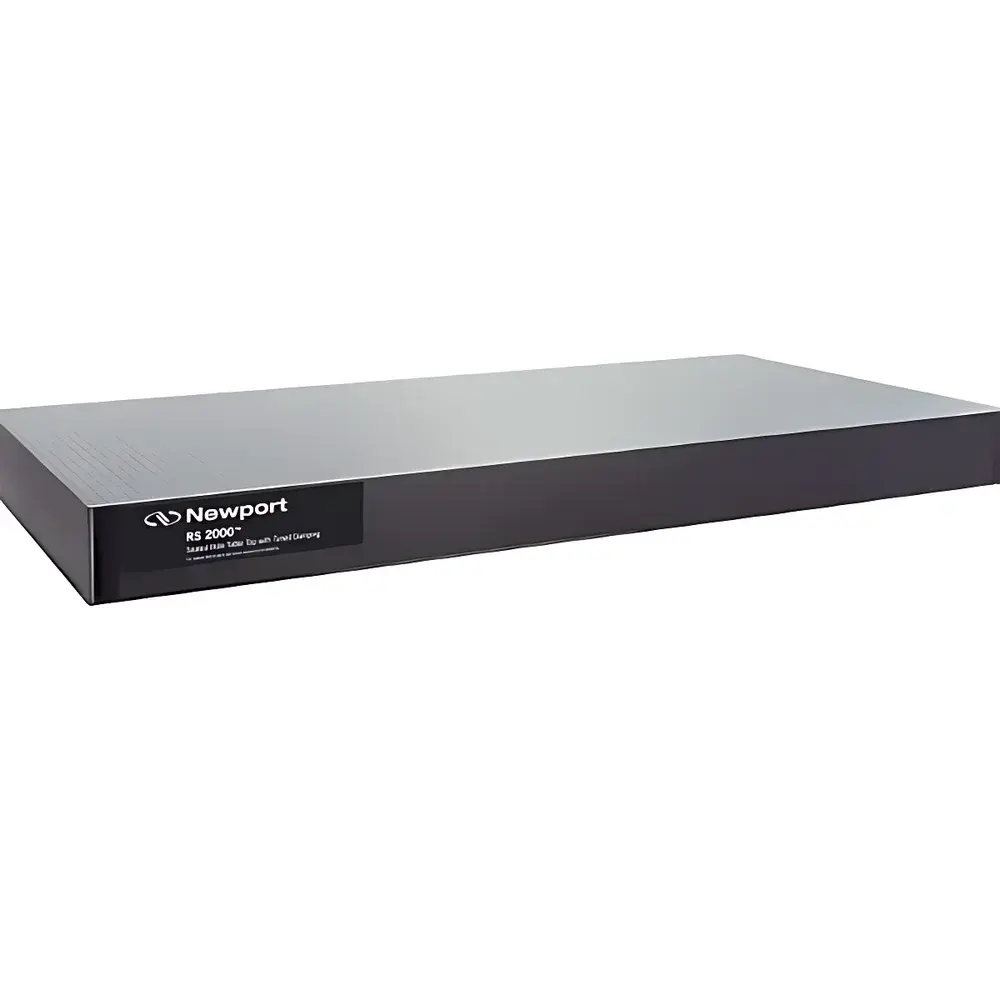
Newport RPR Series Reliance™ Broadband-Damped Optical Table
| Brand | Newport |
|---|---|
| Origin | USA |
| Manufacturer Type | Authorized Distributor |
| Origin Category | Imported |
| Model | RPR Series |
| Price | USD $1,200–$3,500 (varies by size and configuration) |
| Surface Thickness | 4.8 mm |
| Core Structure | Vertically bonded trussed honeycomb with constrained-layer damping |
| Working Surface | Ferromagnetic 430 stainless steel |
| Mounting Holes | 1/4"-20 or M6 on 1.0" (25 mm) grid |
| Hole Sealing | Conical polymer cups, 19 mm deep |
| Edge Finish | Damped composite edge |
| Compliance | ASTM E1776, ISO 10816-5 (vibration sensitivity reference), compatible with GLP/GMP lab infrastructure |
Overview
The Newport RPR Series Reliance™ Optical Table is a broadband-damped, industrial- and education-grade optical platform engineered for stability, long-term dimensional integrity, and consistent vibration attenuation across a wide frequency spectrum (typically 1 Hz to >1 kHz). Unlike tuned-mass or resonant-damping platforms—such as Newport’s RS2000/RS4000 series—the RPR employs a passive, multi-layer constrained-layer damping architecture integrated into a vertically bonded trussed honeycomb core. This design delivers high static stiffness (>1.5 × 10⁶ N/m in vertical direction for standard 1200 × 2400 mm tables), low thermal drift (<0.5 µm/°C over operational range), and broadband mechanical loss factor (η ≈ 0.03–0.05) without requiring active tuning or external calibration. The 4.8 mm thick ferromagnetic 430 stainless steel top plate provides uniform magnetic compatibility for kinematic mounts, translation stages, and optical component holders, while maintaining surface flatness within ±15 µm over 1 m² after 72-hour environmental stabilization.
Key Features
- Broadband constrained-layer damping: Integrated viscoelastic interlayer between top plate and honeycomb core suppresses structural resonances across low-, mid-, and high-frequency bands—eliminating localized surface modes and sidewall ringing.
- Vertically bonded trussed honeycomb core: Each 0.010-inch-thick 304 stainless steel cell wall is fully bonded through its entire height using proprietary elastomeric adhesive; this architecture achieves 30–40% higher dynamic stiffness versus conventional spot-bonded cores.
- Individually sealed mounting holes: 19 mm deep conical polymer cups (non-corrosive, high-impact polyacetal) isolate each 1/4″-20 or M6 threaded insert from particulate ingress and liquid exposure—preserving long-term damping performance and enabling solvent-based cleaning without degradation.
- Damped composite edge finish: Reinforced perimeter treatment prevents edge-mode excitation and reduces airborne coupling into the table structure—critical for interferometric and ultrafast laser applications.
- Standardized alphanumeric grid: Laser-etched coordinate indexing supports rapid, repeatable component layout and facilitates documentation traceability in regulated environments (e.g., ISO/IEC 17025-compliant labs).
Sample Compatibility & Compliance
The RPR Series is compatible with all standard optomechanical hardware—including kinematic mounts (KM100, KM200), translation stages (TS-12, UT1), and optical posts (TR-series)—and integrates seamlessly with Newport’s S-2000A active leveling isolators, SL-series pneumatic isolators, and RL-series rigid support legs. Its surface material meets ASTM F2627 (ferromagnetic compatibility for vacuum-compatible optics) and exhibits no outgassing per ASTM E595 when conditioned at 23 °C / 50% RH. While not certified to ISO 14644-1 Class 5, the sealed-hole design supports cleanroom-adjacent use (Class 7–8) when paired with appropriate enclosures. Platform flatness and damping performance are validated per ISO 10816-5 Annex B for laboratory-grade vibration-sensitive equipment.
Software & Data Management
The RPR itself is a passive mechanical system and requires no firmware, drivers, or embedded software. However, its metrological stability enables direct integration into automated optical alignment workflows using third-party motion controllers (e.g., Thorlabs APT, PI GCS2) and vision-guided positioning systems. For quality assurance documentation, Newport provides full material certification (mill test reports for 430 SS), core bond integrity validation data, and individual unit flexure curve plots (measured via laser Doppler vibrometry per ISO 7626-5). These datasets are supplied in CSV and PDF formats for inclusion in lab audit trails compliant with FDA 21 CFR Part 11 and ISO/IEC 17025 record retention requirements.
Applications
- Undergraduate and graduate teaching laboratories: Stable platform for Michelson interferometers, Fourier-transform spectroscopy setups, and basic laser cavity alignment—where cost-effective repeatability outweighs sub-Hz isolation needs.
- Industrial QC stations: Mounting base for vision inspection systems, laser micromachining jigs, and automated lens centering stations operating in non-seismically isolated factory floors.
- Mid-tier R&D environments: Support structure for femtosecond oscillator chains, optical coherence tomography (OCT) prototypes, and fiber-optic sensor characterization benches requiring <5 nm RMS displacement under ambient HVAC-induced vibration.
- Calibration reference surfaces: Used as inertial reference plane for coordinate measuring machine (CMM) probe qualification and laser tracker volumetric error mapping where thermal hysteresis must remain below 0.2 µm/°C.
FAQ
Is the RPR Series suitable for vacuum applications?
Yes—when specified with vacuum-compatible fasteners and optional bake-out certification (up to 80 °C), the RPR table meets ASTM E595 total mass loss (TML) < 1.0% and collected volatile condensable materials (CVCM) < 0.10%.
Can I retrofit my existing RPR table with active isolation?
Yes—the RPR is mechanically and dimensionally compatible with Newport’s S-2000A isolator system, including its integrated height-adjustment mechanism and auto-releveling sensors.
What is the expected service life under continuous lab use?
With proper maintenance (biannual surface cleaning, avoidance of abrasive solvents), the RPR platform maintains specification-grade performance for ≥25 years—validated by accelerated aging tests per MIL-STD-810G Method 502.6.
Does Newport provide custom hole patterns or cutouts?
Yes—custom grid layouts, aperture cutouts, and embedded grounding strips are available under Newport’s OEM engineering services (lead time: 8–12 weeks; minimum order: one unit).
How does RPR compare to RS-series tables in terms of first-mode resonance?
RPR exhibits a broadened, damped first bending mode centered near 120–150 Hz (size-dependent), whereas RS-series tables feature sharp, narrow-band tuned rejection peaking at 8–12 Hz—making RPR more effective above 50 Hz but less optimal for sub-10 Hz floor noise suppression.




