
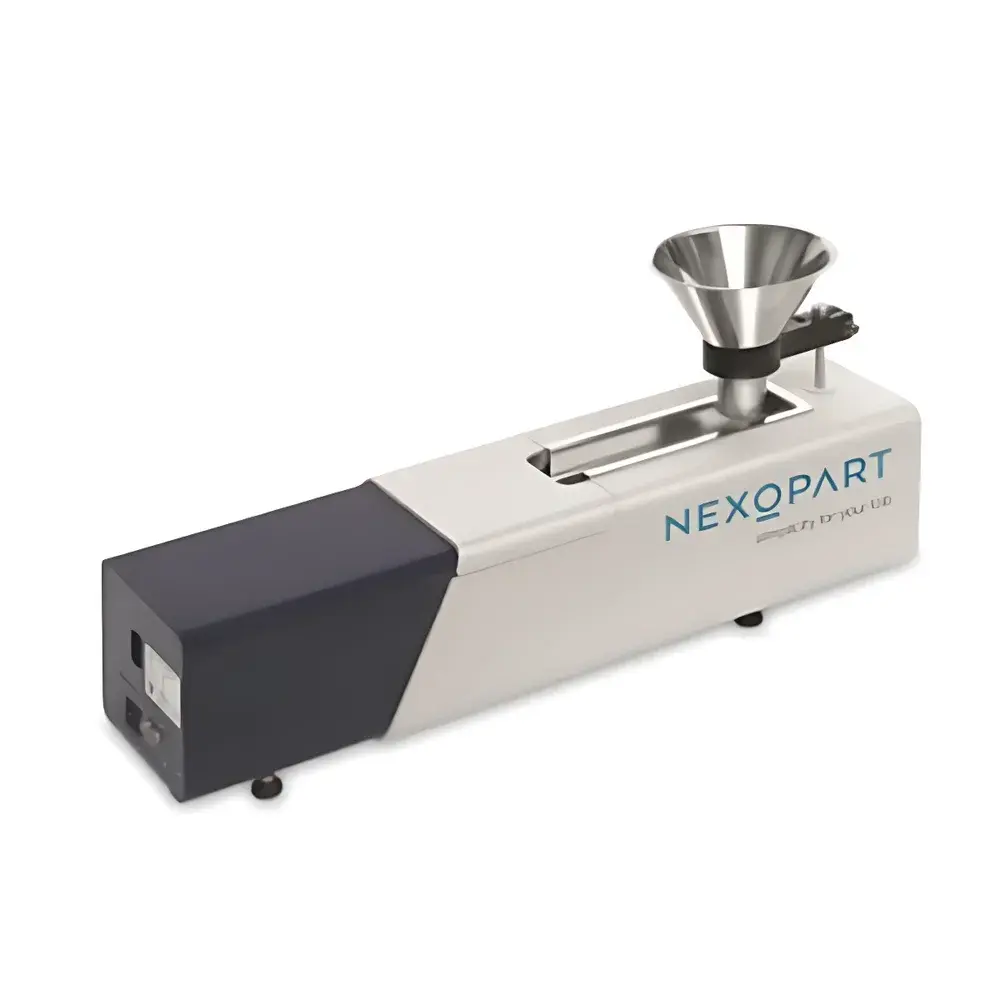
NEXOPART CPA2-1 Dynamic Particle Image Analyzer (formerly Haver & Boecker)
| Brand | NEXOPART |
|---|---|
| Origin | Germany |
| Model | HAVER CPA 2-1HR |
| Measurement Range | 20 µm – 30 mm |
| Power Supply | 230 V / 115 V, 50/60 Hz |
| Feeder Width | 55 mm |
| Camera | CMOS, 2927 px horizontal resolution, 100 MHz pixel clock |
| Light Source | LED |
| Interface | GigE Vision, USB, BUS-Extension |
| Dimensions | 810 × 200 × 400 mm (L×W×H) |
| Weight | 21 kg |
Overview
The NEXOPART CPA2-1 Dynamic Particle Image Analyzer is a laboratory-grade, high-resolution particle characterization system engineered for simultaneous size and shape analysis of dry, free-flowing particulates ranging from 20 µm to 30 mm. Unlike static image analyzers or laser diffraction systems, the CPA2-1 employs real-time dynamic imaging: particles pass through a precisely controlled gravity-fed chute under constant LED illumination, captured in motion by a high-speed CMOS camera operating at 100 MHz pixel clock frequency. This enables full-field, single-particle resolution with no assumptions about particle sphericity or optical equivalence—delivering true morphological descriptors (e.g., circularity, aspect ratio, convexity, solidity) alongside equivalent spherical diameter (ESD), Feret diameters, and projected area-based metrics. Designed as the successor to the legacy Haver & Boecker CPA platform—and now developed and supported by NEXOPART, the spin-off entity consolidating Haver & Boecker’s sieving expertise and Hosokawa Alpine’s particle analysis heritage—the CPA2-1 bridges industrial robustness with academic-grade metrological traceability.
Key Features
- Real-time dynamic imaging with 100% particle capture per batch—no statistical sampling bias or undersampling of coarse or irregular fractions
- Automated funnel height adjustment ensures optimal particle trajectory and focus consistency across material densities and flow rates
- GigE Vision interface enables deterministic, low-latency image streaming over standard Ethernet cables up to 100 m—ideal for integration into centralized lab networks or cleanroom-adjacent setups
- Modular architecture supports seamless coupling with optional accessories: NEXOPART AS24 automated sample feeder (24-position carousel), ultrasonic dispersion module for cohesive fine powders, and CPA 2-1 ONLINE for continuous process monitoring
- Integrated LED illumination provides stable, flicker-free, spectrally neutral lighting—eliminating thermal drift and enabling long-term measurement repeatability without recalibration
- Compact footprint (810 × 200 × 400 mm) and 21 kg mass allow benchtop deployment, mobile lab use, or relocation between QC and R&D workstations without structural reinforcement
Sample Compatibility & Compliance
The CPA2-1 accepts dry, non-sticky, free-flowing granular materials—including fertilizers, ceramic powders, ground glass, plastic pellets, animal feed, abrasives, food grains, and construction aggregates—without solvent or vacuum requirements. Its 55 mm wide feeder accommodates heterogeneous batches while maintaining laminar particle descent. The system complies with ISO 13322-1:2020 (Particle size analysis — Image analysis methods — Part 1: Static image analysis) and supports audit-ready operation under GLP and GMP environments via CpaServ’s built-in metadata logging (operator ID, timestamp, SOP version, instrument configuration). While not FDA 21 CFR Part 11–certified out-of-the-box, CpaServ’s user-access control, electronic signature support, and immutable result archiving enable validation pathways for regulated pharmaceutical or food safety applications.
Software & Data Management
CpaServ software—developed exclusively for the CPA platform and compatible with Windows 10/11—provides intuitive workflow navigation without third-party drivers or camera SDK dependencies. It features SOP-driven measurement protocols: users define material-specific parameters (exposure time, threshold, minimum/maximum particle area, morphology filters) and store them as reusable templates. Post-acquisition, CpaServ delivers ISO-compliant reports including D10/D50/D90, span, shape distribution histograms, and scatter plots (e.g., circularity vs. ESD). Raw images and binary masks are exported in TIFF/PNG; quantitative data exports to CSV, Excel, or SQL databases. All operations generate timestamped audit trails compliant with ALCOA+ principles (Attributable, Legible, Contemporaneous, Original, Accurate, Complete, Consistent, Enduring, Available).
Applications
- Quality control of mineral fillers and coated pigments where aspect ratio impacts rheology and dispersion stability
- Feed pellet integrity assessment in animal nutrition—detecting fines generation during transport or storage
- Grading of abrasive grits for surface finishing applications, where angularity directly correlates with cutting efficiency
- Batch release testing of ceramic green bodies prior to sintering—identifying agglomerates or oversized particles that induce cracking
- Verification of milling endpoint in pharmaceutical excipient processing, especially for lactose or microcrystalline cellulose blends
- Research into granular flow physics using high-fidelity shape descriptors for discrete element method (DEM) model calibration
FAQ
Does the CPA2-1 require calibration standards or certified reference materials?
No routine physical calibration is required. System geometry and pixel-to-micron mapping are factory-validated using NIST-traceable stage micrometers. Users may perform periodic verification using supplied glass scale targets.
Can the CPA2-1 analyze wet or sticky samples?
It is designed exclusively for dry, free-flowing powders and granules. For cohesive or hygroscopic materials, pairing with the optional ultrasonic dispersion module or pre-drying protocols is recommended.
Is remote operation supported?
Yes—via GigE Vision and CpaServ’s network-enabled mode, operators can initiate measurements, monitor live streams, and retrieve results from any Windows client on the same LAN, including laptops and tablets.
How does the CPA2-1 differ from laser diffraction analyzers?
Laser diffraction infers size from ensemble scattering patterns and assumes spherical, non-absorbing particles. CPA2-1 measures each particle individually in 2D projection, delivering direct morphological insight and eliminating Mie theory dependency—critical for anisotropic, porous, or translucent materials.
What maintenance is required?
Annual optical inspection and LED intensity verification are recommended. The self-cleaning funnel mechanism minimizes residue buildup, and all consumables (e.g., feeder liners) are field-replaceable without tools.





