
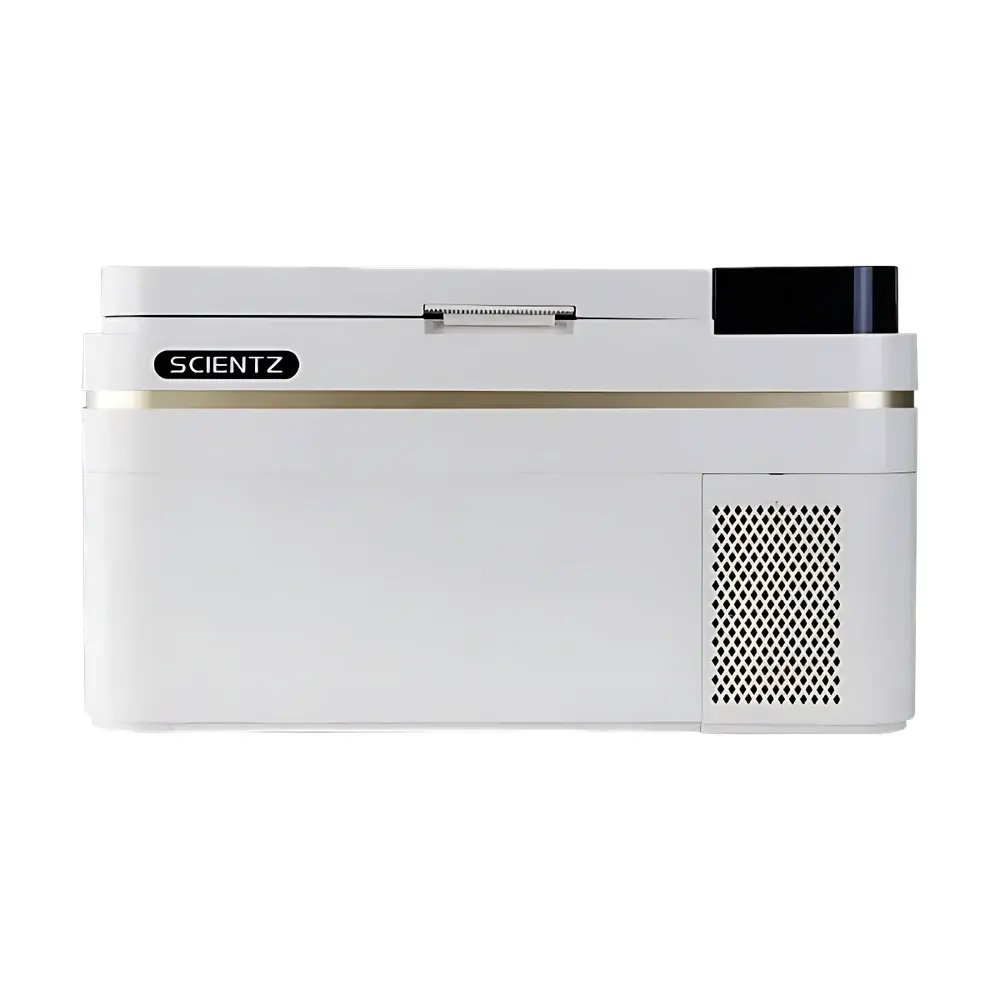
Ningbo Scientz SCIENTZ-08-IIID Non-Contact Ultrasonic DNA Shearer
| Brand | Ningbo Scientz |
|---|---|
| Origin | Zhejiang, China |
| Manufacturer Type | Original Equipment Manufacturer (OEM) |
| Country of Origin | China |
| Model | SCIENTZ-08-IIID |
| Pricing | Upon Request |
Overview
The Ningbo Scientz SCIENTZ-08-IIID Non-Contact Ultrasonic DNA Shearer is an engineered solution for precise, reproducible, and contamination-free nucleic acid fragmentation in next-generation sequencing (NGS) library preparation and chromatin immunoprecipitation (ChIP) workflows. Unlike probe-based sonicators that rely on direct mechanical coupling and localized cavitation, the SCIENTZ-08-IIID employs a bath-mounted transducer architecture operating at a fundamental ultrasonic frequency (typically 40–50 kHz), generating uniform acoustic energy distribution across the entire water bath. This design enables isothermal, non-contact shearing—where samples remain sealed within individual microcentrifuge tubes immersed in a temperature-controlled water bath. The system leverages controlled acoustic cavitation in the surrounding liquid medium to transmit shear forces through tube walls, resulting in consistent double-stranded DNA cleavage without thermal denaturation or aerosol generation. Its operational principle aligns with established physical mechanisms described in ISO 17025-accredited protocols for nucleic acid fragmentation and complies with biosafety Level 2 (BSL-2) containment requirements for handling clinical or infectious samples.
Key Features
- Non-contact, sealed-tube operation eliminates cross-contamination and aerosol exposure—critical for high-value, low-input, or pathogenic samples.
- 4.3-inch medical-grade resistive touchscreen interface with intuitive navigation and real-time parameter feedback.
- Programmable storage for up to 50 user-defined protocols, supporting repeatable method transfer across shifts or operators.
- Adjustable ultrasonic duty cycle: continuous or pulsed mode with configurable on/off intervals to optimize fragment size distribution and minimize heat accumulation.
- Fine-tunable power output and total sonication time (in seconds), enabling empirical optimization for diverse sample matrices (e.g., crosslinked chromatin, native nuclei, or purified genomic DNA).
- Integrated safety monitoring: real-time detection and automatic shutdown for overcurrent, overvoltage, and bath temperature excursions beyond set thresholds.
- Acoustically damped enclosure reduces operational noise to <55 dB(A) at 1 m distance—suitable for shared laboratory environments.
- Motor-driven tube rotation ensures homogeneous energy exposure across all sample positions, mitigating edge effects and improving inter-tube reproducibility.
Sample Compatibility & Compliance
The SCIENTZ-08-IIID accommodates standard 1.5 mL and 2.0 mL microcentrifuge tubes (including low-retention and skirted variants) and supports aqueous sample volumes from 100 µL to 500 µL. It is validated for use with common ChIP and NGS lysis buffers (e.g., RIPA, SDS-based, or TE variants) and compatible with downstream enzymatic steps including end-repair, A-tailing, and adapter ligation. While not certified to IEC 61000-6-3 or UL 61010-1 as a standalone medical device, its electrical and thermal safety design conforms to general laboratory equipment standards under GB 4793.1–2007 (equivalent to IEC 61010-1). For regulated environments, audit-ready documentation—including calibration logs, maintenance records, and protocol validation reports—can be maintained per GLP/GMP expectations. The system does not require FDA 21 CFR Part 11-compliant software out-of-the-box but supports manual recordkeeping aligned with ALCOA+ data integrity principles.
Software & Data Management
The SCIENTZ-08-IIID operates via embedded firmware with no external PC dependency. All parameters—including power level (%), total duration (s), pulse width (ms), interval (ms), and rotational speed (rpm)—are entered directly via the touchscreen. Each saved protocol includes timestamp, operator ID field (manually entered), and version-controlled naming. Data export is not supported natively; however, users may document settings and outcomes in electronic lab notebooks (ELNs) such as LabArchives or Benchling. For laboratories requiring traceability, integration with LIMS systems can be achieved via manual entry or barcode-scanned protocol recall using third-party middleware.
Applications
- Fragmentation of genomic DNA for Illumina, Ion Torrent, and Oxford Nanopore library construction.
- Shearing of crosslinked chromatin in ChIP-seq, CUT&RUN, and CUT&Tag workflows.
- Cell lysis and nuclear extraction from mammalian, plant, and microbial sources under native or denaturing conditions.
- Disruption of protein aggregates and inclusion bodies during recombinant protein purification.
- Microemulsification of lipid nanoparticles (LNPs) and nanostructured carriers in formulation development.
- Controlled mechanical disruption of extracellular vesicles and exosomes for RNA isolation.
FAQ
What is the typical DNA fragment size range achievable with the SCIENTZ-08-IIID?
With optimized settings (e.g., 10–30% amplitude, 30–120 s total time, 30/30 ms pulse/intervals), fragment sizes between 100 bp and 500 bp are routinely obtained; sub-200 bp distributions are achievable for high-sensitivity applications.
Can the instrument process multiple samples simultaneously?
Yes—it accommodates up to 12 × 1.5 mL tubes in a single run, with independent positioning and synchronized rotation ensuring parallel processing without inter-sample interference.
Is temperature control integrated into the system?
The unit includes a built-in cooling jacket connection port for external recirculating chillers; users must supply a compatible chiller (e.g., Huber or Julabo) to maintain bath temperatures between 4 °C and 25 °C during extended runs.
Does the system support regulatory compliance for clinical or pharmaceutical use?
It meets general laboratory safety standards and supports method validation practices required under ISO/IEC 17025, but formal qualification (IQ/OQ/PQ) must be performed by the end user in accordance with internal SOPs and applicable regional regulations (e.g., EU Annex 11, USP ).




