
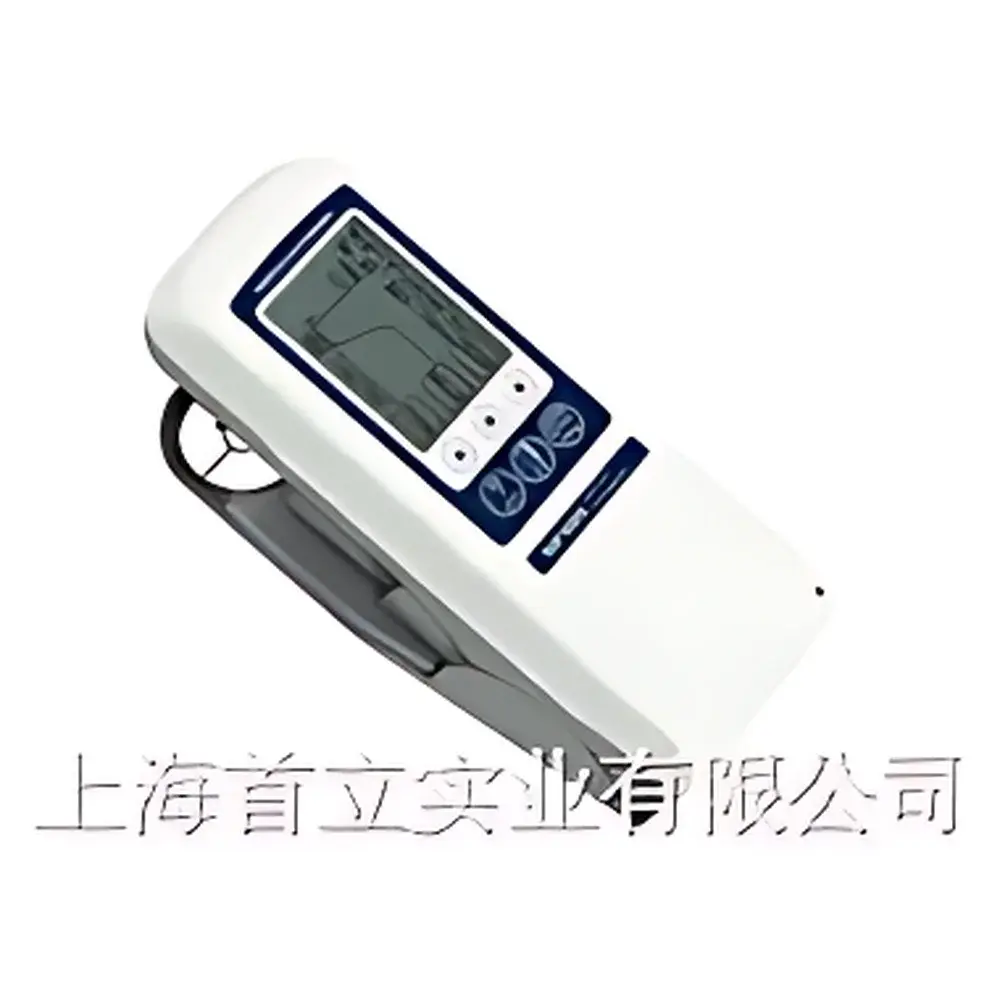
NIPPON DENSHOKU NF999 Portable Spectrophotometric Color Difference Meter
| Brand | NIPPON DENSHOKU |
|---|---|
| Origin | Japan |
| Model | NF999 |
| Instrument Type | Portable |
| Light Source | Tungsten Halogen Lamp |
| Spectral Range | 400–700 nm |
| Optical Geometry | 0°/45° Dual-Beam Fiber Optic System |
| Measurement Aperture | Ø10 mm (standard), Ø3 mm, Ø2 mm |
| Illuminants | A, C, D50, D65, F2, F6, F7, F8, F10, F11, F12 |
| Observer Angles | 2°, 10° |
| Compliance | JIS Z 8722, ISO 7724-1/2/3, DIN 5033, DIN 5036, DIN 6174, ASTM D2244, ASTM E308, ASTM E1164, JIS K 7654, ISO 5/4, ANSI PH2.17, DIN 16536 |
| Wavelength Interval | 10 nm |
| Repeatability (ΔE*ab, white tile, n=20) | ≤0.05 |
| Stability (24 h, 10-min intervals) | ≤0.05 ΔE*ab |
| Measurement Time | ~2 s |
| Data Storage | 400 spectral measurements |
| Reference Data Capacity | 40 sets (spectral reflectance or XYZ) |
| Display | 128 × 64 dot matrix LCD (62 × 44 mm active area) |
| Power | Rechargeable NiCd battery (4.8 V, 800 mAh) |
| Battery Life | ~1,000 measurements per full charge (20–25°C, 10 s interval) |
| Communication | IrDA infrared (compliant with IrDA 1.0), RS-232C (≤19.2 kbps) |
| Operating Temperature | 5–40°C |
| Dimensions | 212 × 77 × 84 mm |
| Weight | 870 g (including battery) |
Overview
The NIPPON DENSHOKU NF999 is a high-precision portable spectrophotometric color difference meter engineered for rigorous industrial and laboratory color measurement tasks. Utilizing a dual-beam fiber-optic optical system with 0°/45° geometry, the NF999 captures spectral reflectance data across the visible spectrum (400–700 nm) at 10 nm intervals—enabling traceable, physics-based color quantification aligned with human visual response under standardized illuminants and observer conditions. Unlike tristimulus meters, its spectrophotometric architecture supports full spectral data acquisition, permitting post-acquisition calculation of multiple color spaces, difference formulas, and density metrics without hardware modification. Designed for field-deployable operation, it operates independently of AC power, delivering laboratory-grade repeatability (ΔE*ab ≤ 0.05 over 20 repeated measurements on a white calibration tile) and long-term stability (≤0.05 ΔE*ab over 24 hours under controlled thermal conditions). Its compact form factor (212 × 77 × 84 mm, 870 g) and ergonomic handheld configuration make it suitable for in-line quality control, R&D sampling, and mobile technical service applications where spatial constraints or process continuity preclude benchtop instrumentation.
Key Features
- Simultaneous spectral reflectance and reflection density (CMYK) measurement—enabling integrated color and print quality assessment in a single device.
- Multi-illuminant support (A, C, D50, D65, F2–F12) and dual observer angles (2° and 10°) compliant with ISO/CIE standard viewing conditions.
- Data compensation function: reference spectral reflectance values can be imported to align NF999 output with enterprise-wide instrument fleets—reducing inter-device variability and supporting cross-platform color data harmonization.
- Comprehensive color space coverage: L*a*b*, L*C*h*, L*u*v*, XYZ, Yxy, Hunter Lab, Munsell (HV/C under D65/2°), WI (ASTM E313, ISO 2470), YI (ASTM D1925, JIS K7103), and MI—calculated in real time from raw spectral data.
- Configurable color difference algorithms: ΔE*ab, ΔE*94 (with adjustable kL/kC/kH), ΔECMC (l:c = 2:1), ΔEFMC-2, ΔEuv, and ΔEH, supporting industry-specific tolerance specifications.
- On-device graphical display of spectral reflectance curves, color deviation plots, and L*a*b* chromaticity diagrams—no external software required for preliminary analysis.
- 20-sample averaging function with selectable aperture sizes (Ø2 mm, Ø3 mm, Ø10 mm) for heterogeneous or textured surfaces such as textiles, coatings, and agricultural products.
- Bilingual UI (English/Japanese), 180° display rotation, target spot indicator, and step-by-step on-screen help—optimized for operator flexibility and training efficiency.
Sample Compatibility & Compliance
The NF999 accommodates solid, semi-opaque, and matte-surface samples including printed media, polymer films, painted panels, foodstuffs, pharmaceutical tablets, and textile swatches. Its Ø10 mm standard aperture ensures representative sampling for most industrial substrates; optional Ø3 mm and Ø2 mm apertures enable precise micro-area analysis of fine patterns, halftone dots, or localized discoloration. Reflectance measurement range spans 0–200%, supporting both highly reflective and low-reflectance materials (e.g., black plastics, carbon-filled composites). The instrument conforms to 17 international standards—including ISO 7724 (colorimetry), ASTM D2244 (color difference evaluation), JIS Z 8722 (color measurement methods), and DIN 6174 (color difference formulae)—ensuring data interoperability in regulated environments. While not inherently 21 CFR Part 11-compliant as a standalone device, its RS-232C and IrDA interfaces support integration into validated color management workflows when paired with compliant software (e.g., Color Mate) and documented electronic record procedures.
Software & Data Management
Raw spectral data (31-point reflectance array), calculated colorimetric values, and pass/fail judgments are stored internally—400 measurement records retained even during battery replacement. Up to 40 user-defined reference spectra (entered manually or imported via PC) serve as comparison baselines for real-time ΔE computation. Data export is supported via two physical layers: IrDA infrared (IrDA 1.0 compliant) for cable-free transfer to laptops or tablets, and RS-232C serial interface (up to 19.2 kbps) for legacy system integration. Optional Color Mate software enables advanced reporting, statistical process control (SPC) charting, batch trend analysis, and direct Excel-compatible CSV export. All communication protocols are ASCII-based and do not require proprietary drivers, facilitating compatibility with custom LIMS or MES platforms. Audit trail functionality (e.g., timestamped calibration logs, operator ID tagging) must be implemented at the host software level per GLP/GMP requirements.
Applications
- Print & Packaging: CMYK density profiling, dot gain analysis, trapping verification, and substrate-to-proof color matching under press-relevant illuminants (D50, D65, F series).
- Automotive & Industrial Coatings: Quantitative fade monitoring, batch-to-batch consistency checks, and weathering study correlation using ΔE*94 or ΔECMC with industry-accepted tolerances.
- Food & Agriculture: Objective freshness grading (e.g., chlorophyll degradation in leafy greens), meat color stability tracking, and fruit ripeness classification via L*a*b* trajectory analysis.
- Pharmaceuticals & Medical Devices: Tablet coating uniformity assessment, medical-grade plastic hue verification, and regulatory submission-ready color documentation per ICH Q5C guidelines.
- Academic Research & Materials Science: Spectral library development, pigment dispersion homogeneity studies, and multi-angle appearance characterization (via sequential 2°/10° measurements).
FAQ
Does the NF999 require warm-up time before measurement?
No. The tungsten halogen light source and solid-state photodiode detector enable immediate operation upon power-on—eliminating stabilization delays common in xenon-pulsed or LED-based systems.
Can spectral data be exported for third-party analysis?
Yes. Full 31-point spectral reflectance values (400–700 nm @ 10 nm) are exportable via RS-232C or IrDA as ASCII text, compatible with MATLAB, Python (NumPy/Pandas), or commercial spectroscopy software.
How is calibration traceability maintained?
The instrument ships with a NIST-traceable ceramic white calibration tile (certified reflectance ≥99% in visible range). Annual recalibration against primary standards is recommended; NIPPON DENSHOKU provides certified recalibration services with uncertainty reporting per ISO/IEC 17025.
Is the NF999 suitable for measuring transparent or translucent materials?
No. It is designed exclusively for opaque or diffusely reflecting surfaces. Transmission or haze measurements require dedicated transmission-mode spectrophotometers (e.g., NF100 series).
What environmental conditions affect measurement accuracy?
Ambient temperature deviations >±5°C from calibration temperature trigger automatic warning indicators. Relative humidity outside 30–80% non-condensing may impact long-term sensor drift; operation within 5–40°C is strictly specified.





