
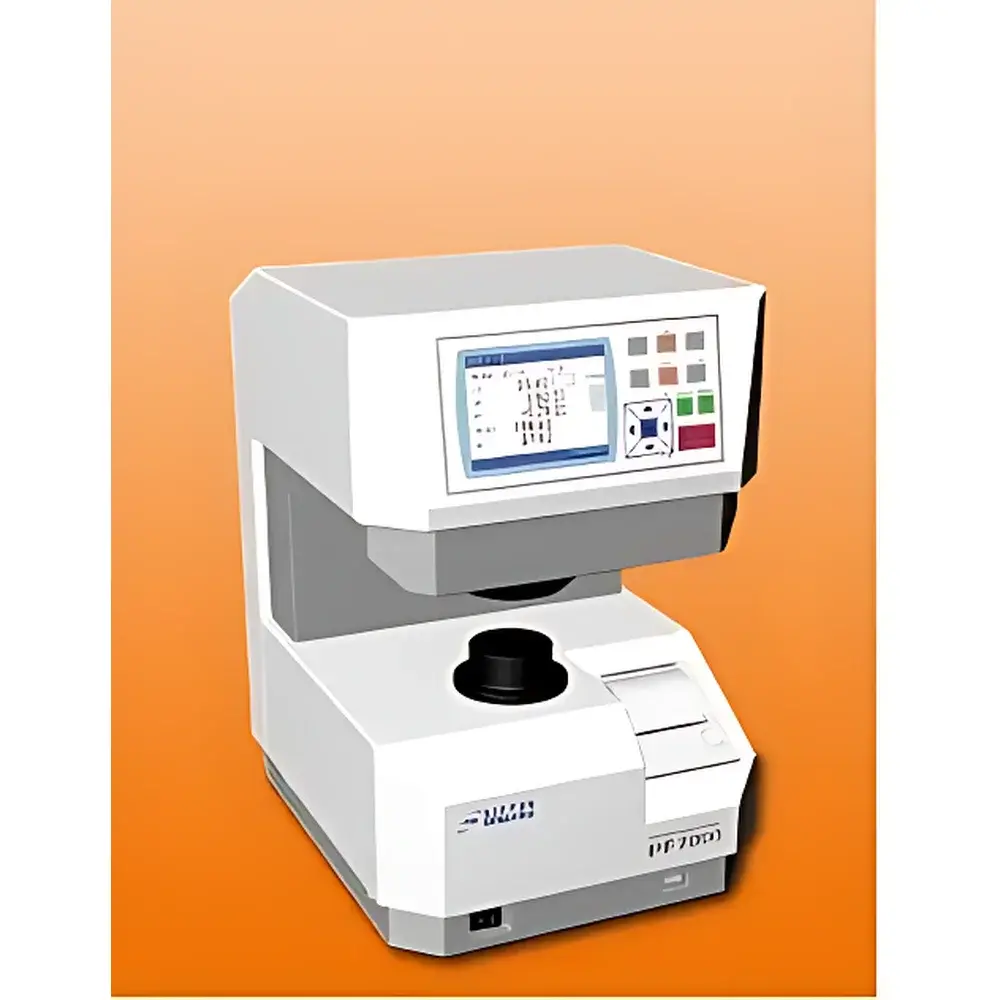
NIPPON DENSHOKU PF7000 Spectrophotometric Whiteness and Color Difference Meter
| Brand | NIPPON DENSHOKU |
|---|---|
| Origin | Japan |
| Model | PF7000 |
| Product Type | Benchtop Color Difference Meter |
| Optical Geometry | d/8° integrating sphere |
| Light Source | Pulsed Xenon Lamp |
| Spectral Range | 400–700 nm |
| Wavelength Interval | 10 nm |
| Repeatability | ΔE*ab ≤ 0.03 |
| Measurement Aperture | Ø28 mm (illumination Ø34 mm) |
| Standard Illuminants | A, C, D65, F6, F8, F10 |
| Observer Angles | 2° and 10° |
| Photometric System | Dual-beam compensation |
| Output Interface | RS-232C |
| Power Supply | AC 100–240 V, 50/60 Hz, 120 VA |
| Dimensions | 230 × 425 × 530 mm (W×D×H) |
| Weight | 23.0 kg |
Overview
The NIPPON DENSHOKU PF7000 is a high-precision benchtop spectrophotometric whiteness and color difference meter engineered for rigorous quality control in pulp, paper, and board manufacturing. It operates on the principle of diffuse illumination at 0° with integrated sphere detection (d/8° geometry), enabling accurate measurement of diffuse blue light reflectance—critical for compliance with ISO 2470 (paper and board whiteness), ISO 2469 (pulp whiteness), JIS P 8148, JIS P 8152, and JIS P 8150 (colorimetric evaluation of paper). The instrument employs a pulsed xenon lamp as its broadband light source, delivering stable spectral output across the visible range (400–700 nm) without thermal drift or aging-related intensity decay. Its dual-beam compensation photometric system minimizes error from source fluctuation and detector drift, ensuring long-term stability and inter-instrument agreement required in multi-site production environments.
Key Features
- Compliance with dual-standard white measurement protocols: ISO 2470/2469 and JIS P 8148/P 8152 for pulp, paper, and board
- Full-spectrum acquisition at 10 nm intervals (400–700 nm), supporting CIE XYZ, L*a*b*, L*C*h*, and ΔE*ab calculations
- Simultaneous evaluation of whiteness indices (CIE, Ganz, Hunter), yellowness index (ASTM E313), and fluorescence intensity (via UV-excitation mode)
- Programmable standard illuminants (A, C, D65, F6, F8, F10) and observer angles (2° and 10°) to match diverse regulatory and customer specifications
- Built-in clock function enabling time-stamped measurement logging and synchronized print output of test date, time, and result data
- Robust mechanical architecture with temperature-compensated optical path and sealed integrating sphere (BaSO₄-coated) for consistent scatter performance
Sample Compatibility & Compliance
The PF7000 accommodates flat, rigid, or moderately flexible sheet materials up to 5 mm thickness and 300 mm × 300 mm dimensions. Its Ø28 mm measurement area and Ø34 mm illumination zone are optimized for uniform sampling of heterogeneous surfaces such as coated papers, recycled boards, and unbleached pulps. The instrument meets ISO/IEC 17025 traceability requirements when used with NIST-traceable ceramic calibration tiles (provided with unit). It supports GLP-compliant operation through user-accessible calibration logs, instrument identification tagging, and audit-ready printouts. While not FDA 21 CFR Part 11 certified out-of-the-box, its RS-232C interface enables integration into validated LIMS environments where electronic record integrity is enforced via external software controls.
Software & Data Management
Data acquisition and reporting are managed via embedded firmware with no external PC dependency. All spectral and colorimetric results—including raw reflectance curves, whiteness values, and ΔE*ab deviations against stored standards—are stored internally (up to 1,000 records) and exportable via RS-232C to spreadsheet-compatible ASCII files. The device supports batch mode testing with auto-averaging across up to 10 consecutive readings per sample, reducing operator-induced variability. Calibration verification routines (using supplied white and black reference tiles) generate pass/fail status flags with timestamped metadata, satisfying internal QA documentation requirements under ISO 9001 and ISO 14001 frameworks.
Applications
- Whiteness qualification of bleached chemical pulps per ISO 2469 and JIS P 8152
- Color consistency monitoring of coated and uncoated printing papers during roll-to-roll production
- Fluorescent whitening agent (FWA) quantification in recycled fiber blends using UV-enhanced reflectance modes
- Supplier qualification testing against customer-defined color tolerances (e.g., ΔE*ab ≤ 0.5 for premium packaging grades)
- Research-grade spectral analysis of optical brighteners’ degradation kinetics under accelerated aging conditions
- Regulatory submission support for TAPPI T 452, ISO 11475, and DIN 6174 compliance reports
FAQ
Does the PF7000 comply with ISO 2470:2022 and ISO 2469:2022?
Yes—the optical design, spectral bandwidth, and calculation algorithms fully conform to both current editions, including the updated CIE 1931 2° observer weighting functions and D65/10° default settings.
Can the instrument measure fluorescent samples without UV filter artifacts?
Yes—the pulsed xenon source includes inherent UV emission (down to ~360 nm), and the sphere coating maintains high UV reflectance; optional UV cutoff filters are available for non-fluorescent baseline correction.
Is remote calibration possible via RS-232C?
No—calibration must be performed manually using the supplied reference tiles; however, calibration history and verification timestamps are retained and exportable.
What maintenance is required for long-term repeatability?
Annual verification with NIST-traceable standards is recommended; the xenon lamp has a rated lifetime of ≥1×10⁶ flashes, and the sphere coating is rated for >10 years under typical lab use.
Does the PF7000 support custom whiteness formulas?
No—it implements only standardized indices (CIE, Ganz, Hunter, ASTM E313); custom mathematical models require post-processing of exported spectral data.





