
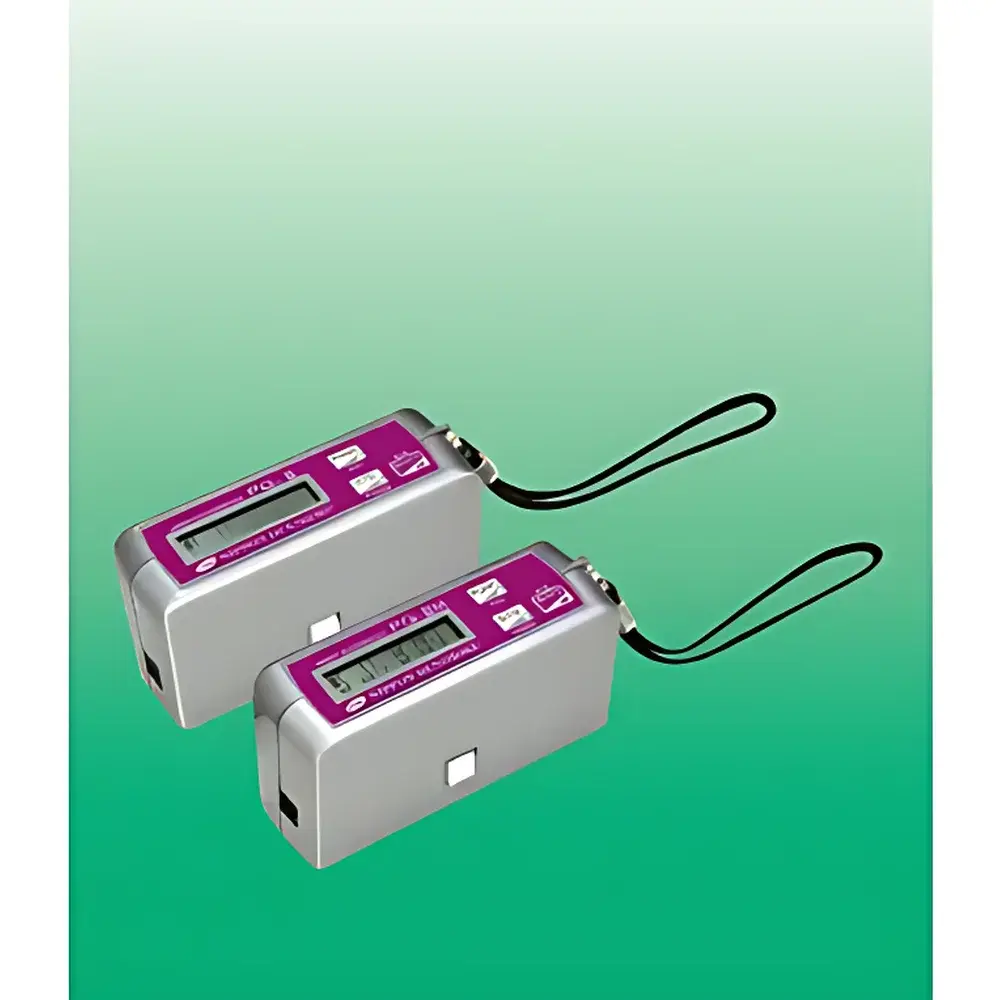
NIPPON DENSHOKU PG-2M Portable Gloss Meter
| Brand | NIPPON DENSHOKU |
|---|---|
| Origin | Japan |
| Model | PG-2M |
| Measurement Angles | 20°, 60°, 85° |
| Measurement Range | 0.0–2000 GU |
| Accuracy | ±1 GU (0.0–199.9 GU), ±10 GU (200–2000 GU) |
| Repeatability | ±1 GU |
| Spot Size | 20°: 10.0 × 10.6 mm |
| 60° | 10.0 × 20.0 mm |
| 85° | 10.0 × 40.1 mm |
| Power Supply | 9 V alkaline battery (1×) |
| Dimensions | 150 × 49 × 80 mm |
| Weight | 0.42 kg (without battery) |
| Light Source | 5 V / 125 mA halogen lamp |
| Interface | RS-232C |
| Compliance | JIS Z 8722, JIS K 5400, ISO 2813, ISO 7688, ASTM D 523, ASTM D 2457, DIN 67530, TAPPI T 480 |
Overview
The NIPPON DENSHOKU PG-2M Portable Gloss Meter is a precision-engineered optical instrument designed for rapid, field-deployable gloss assessment of flat or gently curved surfaces across industrial quality control, R&D, and manufacturing environments. Operating on the principle of specular reflectance measurement—where incident light at defined geometries reflects off a sample surface and is quantified by a calibrated photodetector—the PG-2M delivers traceable, standardized gloss values in Gloss Units (GU). Its tri-angle configuration (20°, 60°, and 85°) enables comprehensive characterization of surface finish: 20° for high-gloss materials (e.g., automotive clear coats, polished metals), 60° as the universal reference angle for medium-gloss substrates (e.g., plastics, painted panels), and 85° optimized for low-gloss and matte finishes (e.g., paper, textured coatings, architectural paints). Engineered for metrological integrity, the instrument adheres strictly to international standards including ISO 2813, ASTM D 523, JIS Z 8722, and DIN 67530—ensuring data compatibility across global supply chains and regulatory submissions.
Key Features
- Tri-angle measurement capability (20°, 60°, 85°) with automatic range selection across 0.0–2000 GU
- No warm-up required: stable halogen illumination (5 V / 125 mA) enables immediate measurement upon power-on
- Single-button operation with intuitive mode switching between angles, reference setting, averaging, and statistical functions
- Onboard data handling: stores up to 999 measurement records with timestamp, angle ID, and GU value; supports reference calibration, arithmetic mean calculation (n = 2–99), and deviation reporting
- Compact ergonomic form factor (150 × 49 × 80 mm), lightweight construction (0.42 kg without battery), and battery-powered operation (9 V alkaline) for unrestricted portability
- RS-232C interface enabling remote triggering, real-time data streaming, and integration into automated QA workflows or LIMS environments
Sample Compatibility & Compliance
The PG-2M accommodates a broad spectrum of non-metallic and metallic substrates—including coated metals, molded thermoplastics, laminated composites, printed papers, ceramic tiles, and powder-coated surfaces—provided the measurement area meets minimum flatness and size requirements per angle (e.g., ≥10.0 × 40.1 mm for 85°). Its optical geometry conforms to the “incident angle = viewing angle” condition mandated by ISO 2813 and ASTM D 523, ensuring comparability with laboratory-grade benchtop glossmeters. All factory calibrations are traceable to NIST-traceable standards via NIPPON DENSHOKU’s accredited calibration laboratory. The device satisfies essential requirements for GLP-compliant documentation when used with optional Windows-compatible data acquisition software, supporting audit-ready export of raw measurements, statistical summaries, and operator metadata.
Software & Data Management
When connected via RS-232C cable, the PG-2M functions as a plug-and-play sensor within validated Windows-based data acquisition platforms. Compatible software supports real-time monitoring, batch logging, CSV/Excel export, pass/fail thresholding against specification limits, and generation of measurement reports compliant with internal QA protocols. Audit trail functionality—including user login, timestamped actions, and immutable record history—is configurable to align with FDA 21 CFR Part 11 readiness where electronic records serve as primary data. Optional accessories include thermal printers for on-site certificate generation and calibration verification kits for periodic in-house verification.
Applications
- Automotive OEM and Tier-1 suppliers: verification of topcoat gloss uniformity across body panels and trim components
- Paper and packaging converters: monitoring gloss consistency of coated board, metallized films, and inkjet-receptive media per TAPPI T 480
- Architectural coatings manufacturers: batch release testing of interior/exterior paints under ISO 7688 and JIS K 5400
- Plastics processors: incoming inspection of injection-molded housings and extruded profiles per ASTM D 2457
- Quality assurance labs conducting multi-site interlaboratory comparisons requiring harmonized angular methodology
FAQ
Does the PG-2M require annual recalibration?
Yes. NIPPON DENSHOKU recommends annual recalibration using certified reference standards to maintain traceability to national metrology institutes. Calibration certificates include uncertainty budgets per ISO/IEC 17025.
Can the PG-2M measure curved surfaces?
It is designed for flat or low-curvature surfaces (radius > 200 mm). For highly curved geometries, results may deviate due to beam divergence and reflection angle distortion; use only when local surface flatness exceeds the specified spot dimensions.
Is the halogen lamp replaceable by the user?
No. The lamp is factory-aligned and sealed within the optical path. Lamp replacement requires return to an authorized NIPPON DENSHOKU service center to preserve angular accuracy and photometric calibration.
What data security features does the onboard memory support?
Internal memory retains readings without power but lacks encryption or password protection. For secure data governance, transfer records via RS-232C to validated software with role-based access controls and electronic signature capabilities.
How does the PG-2M handle ambient light interference?
The instrument employs synchronized pulsed illumination and narrow-band optical filtering to suppress ambient contributions. Measurements remain stable under typical indoor lighting (≤1000 lux); direct sunlight exposure should be avoided during operation.





