
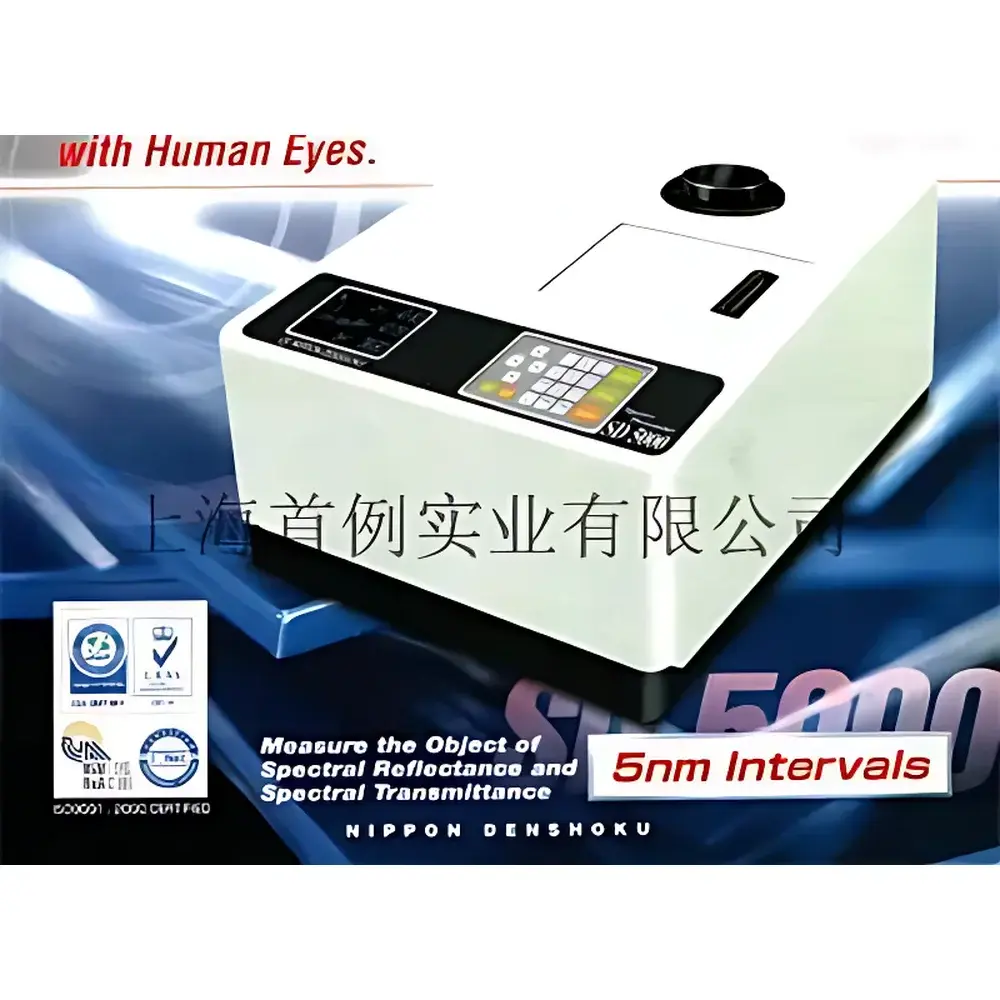
NIPPON DENSHOKU SD5000 Benchtop Spectrophotometric Colorimeter
| Brand | NIPPON DENSHOKU |
|---|---|
| Origin | Japan |
| Model | SD5000 |
| Instrument Type | Benchtop |
| Light Source | 12 V / 50 W Halogen Lamp |
| Spectral Range | 380 nm – 780 nm |
| Spectral Interval | 5 nm |
| Illumination/Viewing Geometry | d/8° (Diffuse/8°) and D/0° (Diffuse/0°) configurable |
| SCI/SCE Modes | Motorized, automatic switching |
| Measurement Apertures | Reflectance – 6 mm, 10 mm, 28 mm Ø |
| Integrating Sphere Diameter | 150 mm |
| Detector | 256-element CCD image sensor |
| Optical System | Post-dispersion via diffraction grating |
| Measurement Method | Dual-beam (sample/reference) |
| Compliance | JIS Z 8722, ISO 7724-1/2/3, ASTM E308, ASTM E313, ASTM D2244, DIN 5033 |
Overview
The NIPPON DENSHOKU SD5000 is a high-precision benchtop spectrophotometric colorimeter engineered for rigorous color measurement in R&D laboratories, quality control environments, and production facilities where traceable, repeatable, and standards-compliant color data are essential. It operates on the principle of post-dispersion spectrophotometry: light from a stabilized 12 V / 50 W halogen source is integrated within a 150 mm diameter sphere, directed onto the sample via diffuse illumination, and collected across the visible spectrum (380–780 nm) at 5 nm intervals using a 256-element CCD linear image sensor. This optical architecture enables true spectral reflectance and transmittance acquisition—forming the foundation for CIE color space calculations (XYZ, L*a*b*, L*C*h*, Yxy), chromaticity difference metrics (ΔEab, ΔE94, ΔECMC, ΔE00), and specialized indices (WI, YI, APHA, Gardner, HVC). The instrument supports both SCI (Specular Component Included) and SCE (Specular Component Excluded) modes via motorized internal optics—critical for accurate evaluation of metallic, pearlescent, or textured surfaces per ISO 7724-2 and ASTM D2244.
Key Features
- Dual-geometry capability: Configurable d/8° (diffuse illumination, 8° viewing) for reflectance and D/0° (diffuse illumination, 0° viewing) for transmittance—fully compliant with ISO 7724-1, JIS Z 8722, and ASTM E308.
- Motorized SCI/SCE switching: Eliminates manual recalibration and ensures consistent geometry selection during batch testing of glossy or structured materials.
- Multi-aperture reflectance measurement: Selectable 6 mm, 10 mm, and 28 mm measurement areas accommodate small components, standard plaques, and large-format samples without cropping—enhancing throughput and reducing preparation errors.
- Stabilized halogen illumination system: Thermally regulated 12 V / 50 W lamp maintains spectral output stability over extended operation, minimizing drift and ensuring long-term repeatability (RSD < 0.1% under controlled conditions).
- Integrated dual-beam optical path: Simultaneous sampling of test and reference signals compensates for source fluctuation and detector nonlinearity, improving photometric accuracy across the full spectral range.
- Onboard operational autonomy: Built-in fluorescent display (128 × 64 dots) and membrane keypad allow full instrument control—including calibration, measurement, data recall, and pass/fail judgment—without external PC connection.
Sample Compatibility & Compliance
The SD5000 accommodates solid, liquid, and translucent specimens through dedicated reflectance and transmittance ports. Its large 28 mm reflectance aperture and optional hinged dual-door sample chamber enable direct measurement of oversized panels, molded parts, textiles, and coated substrates—eliminating destructive sampling. For liquids and clear films, the D/0° transmittance mode delivers quantitative haze-corrected data aligned with ASTM D1003 and ISO 13468. All optical and computational routines conform to internationally recognized metrological frameworks: JIS Z 8722 (Japanese Industrial Standard for color measurement), ISO 7724 (colorimetry series), ASTM E308 (computing tristimulus values), ASTM E313 (yellowness index), and DIN 5033 (German colorimetric standard). Instrument validation documentation supports GLP and GMP audit requirements, including traceable calibration against NIST-traceable ceramic tiles and liquid standards.
Software & Data Management
The optional NIPPON DENSHOKU Color Management Software provides comprehensive post-acquisition analysis compatible with Windows Me through Windows XP (via RS-232 interface). It supports real-time spectral curve overlay, multi-sample trend tracking, statistical process control (SPC) charting (X̄/R, Cp/Cpk), and automated pass/fail assessment against user-defined tolerance limits (e.g., ΔL*a*b*, ΔECMC(2:1), ΔE94). Raw spectral data and calculated colorimetric values export natively to CSV format—enabling integration with LIMS, ERP, or custom QA dashboards. The software implements full audit trail functionality, logging operator ID, timestamp, instrument configuration, and calibration history—meeting foundational expectations of FDA 21 CFR Part 11 for electronic records in regulated industries. Local data storage retains up to 50 measurement sets onboard, with additional capacity via external printer or host PC.
Applications
The SD5000 serves critical roles across sectors requiring absolute color fidelity and regulatory alignment: automotive OEMs use it for paint and interior trim validation against AATCC TM173 and SAE J1545; packaging manufacturers rely on its APHA and Gardner scale compliance for resin and ink QC; pharmaceutical firms apply its WI/YI outputs for tablet coating consistency per USP ; and paint & coatings labs utilize its SCI/SCE flexibility to characterize effect pigments per ISO 18314-2. Its robust mechanical design, thermal management, and vibration-damped optical base make it suitable for factory-floor deployment alongside laboratory-grade precision.
FAQ
What standards does the SD5000 comply with?
It conforms to JIS Z 8722, ISO 7724-1/2/3, ASTM E308, ASTM E313, ASTM D2244, DIN 5033, and ASTM D1003 for reflectance and transmittance measurements.
Can the SD5000 measure both opaque and transparent samples?
Yes—reflectance mode (d/8°) for solids and powders; transmittance mode (D/0°) for liquids, films, and clear plastics.
Is SCI/SCE mode switching automated?
Yes—motor-driven internal baffles enable fully programmable, repeatable switching without manual intervention.
What is the smallest measurable sample area?
6 mm diameter aperture for high-resolution localized measurement of small features or printed elements.
Does the instrument support GLP/GMP documentation requirements?
The optional software provides full audit trail logging, electronic signature support, and calibration history retention—aligned with core GLP principles and foundational 21 CFR Part 11 expectations.
How is spectral stability maintained during prolonged operation?
Through active thermal regulation of the halogen lamp and dual-beam referencing, which compensates for spectral drift and detector aging in real time.




