
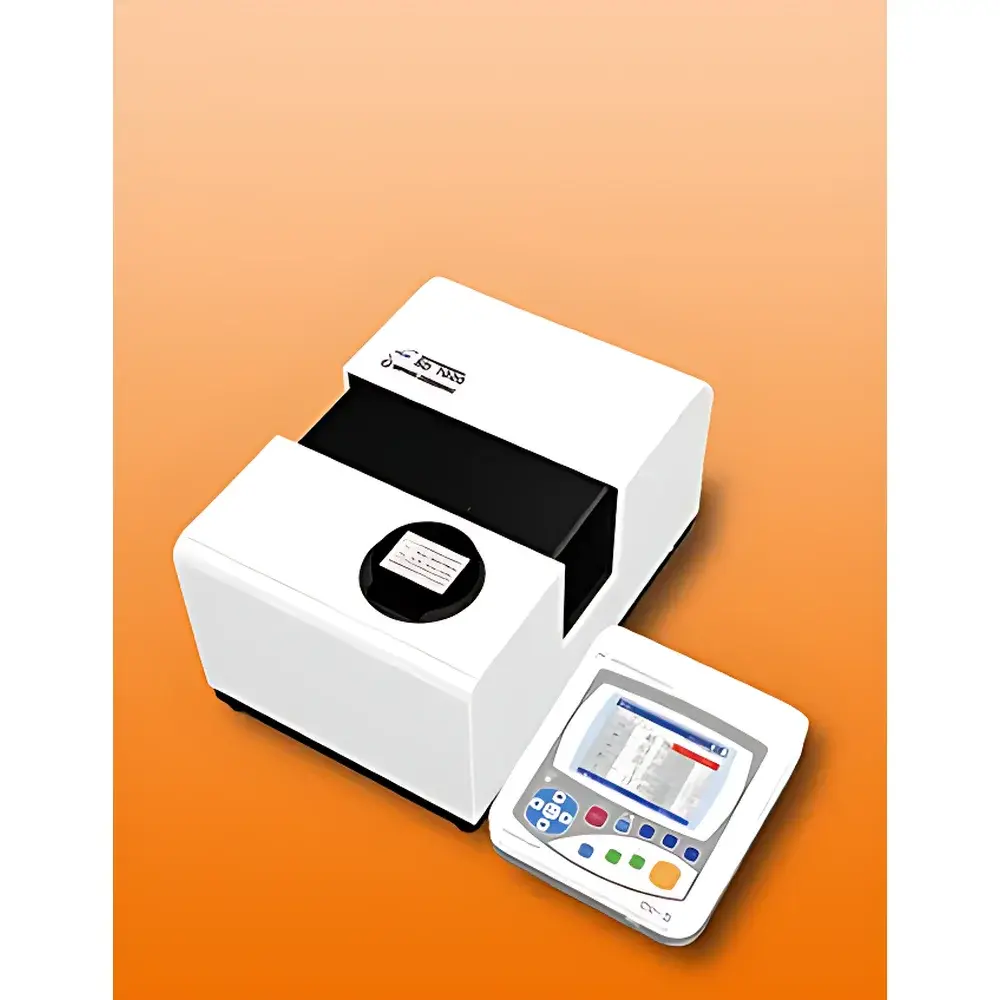
NIPPON DENSHOKU SD7000 High-Precision Spectrophotometric Colorimeter
| Brand | NIPPON DENSHOKU |
|---|---|
| Origin | Japan |
| Model | SD7000 |
| Illumination/Viewing Geometry | d/8° (SCI & SCE) and D/0° (transmittance) |
| Spectral Range | 380–780 nm |
| Interval | 5 nm |
| Measurement Time | ~3 s (SCI/SCE) |
| Aperture Options | LAV (Ø19 mm / Ø25.4 mm), MAV (Ø8 mm / Ø12.7 mm), SAV (Ø3 mm / Ø6.4 mm) |
| Detector | CMOS linear image sensor |
| Light Source | Pulsed xenon lamp |
| Reflectance Accuracy | σ < 0.1% (standard white tile, 30 measurements in 10 s) |
| Color Difference Repeatability | ΔE*ab σ < 0.01 |
| Compliance | JIS Z8715, Z8722, Z8729, Z8730 |
| Power Supply | 100–240 V AC, 50/60 Hz |
| Dimensions | 316 × 462 × 251 mm (W×D×H) |
| Weight | 14 kg (main unit only) |
| Optional | CUII controller |
Overview
The NIPPON DENSHOKU SD7000 is a high-precision spectrophotometric colorimeter engineered for metrologically rigorous color measurement across reflective, transmissive, and fluorescent sample types. Operating on dual-beam optical architecture with full-wavelength compensation, the instrument delivers traceable spectral data from 380 nm to 780 nm at 5 nm intervals—covering the full CIE standard observer visible spectrum. Its d/8° (diffuse illumination/8° viewing) geometry supports both Specular Component Included (SCI) and Specular Component Excluded (SCE) modes, enabling accurate assessment of metallic, pearlescent, and glossy surfaces without bias from specular reflectance. For transparent or translucent materials—including films, liquids, and optical filters—the SD7000 employs D/0° geometry (diffuse illumination/0° viewing), ensuring compliance with ISO 13655 and ASTM E308 for transmittance quantification. The pulsed xenon lamp provides stable, UV-stable illumination with negligible thermal drift, while the CMOS linear image sensor ensures high signal-to-noise ratio and long-term photometric stability.
Key Features
- Dual-geometry optical design: d/8° (SCI/SCE selectable) for reflectance; D/0° for transmittance—eliminating need for separate instruments.
- Motorized aperture switching system supporting three standardized field sizes: Large Area View (LAV: Ø19 mm / Ø25.4 mm), Medium Area View (MAV: Ø8 mm / Ø12.7 mm), and Small Area View (SAV: Ø3 mm / Ø6.4 mm), each with dedicated mechanical alignment fixtures.
- Integrated UV-filter module option enables controlled excitation for fluorescence measurement—critical for paper, textiles, and optical brightener–treated substrates per JIS Z8729 and ASTM E313.
- Large-sample access via motorized sliding door on the sample compartment, accommodating oversized specimens up to 400 mm × 300 mm for transmission mode without repositioning or segmentation.
- Real-time spectral validation: built-in reference channel continuously monitors lamp output and detector response, correcting for intensity fluctuations during acquisition.
- Thermally stabilized optical bench minimizes wavelength drift (<0.1 nm/h over 8 h at 23 °C ambient), ensuring inter-day repeatability required in GLP and GMP environments.
Sample Compatibility & Compliance
The SD7000 accommodates heterogeneous physical forms—including rigid solids, flexible films, granular powders, spherical objects (e.g., pills, beads), viscous liquids, and layered composites—without requiring custom holders or optical coupling media. Its modular sample stage supports optional accessories such as liquid cuvette holders (10 mm path length), powder cells with pressure-compensated windows, and spherical sample rotators for isotropic averaging. Regulatory alignment includes full support for JIS Z8715 (color difference evaluation), Z8722 (instrumental colorimetry), Z8729 (fluorescent material testing), and Z8730 (multi-angle gloss/color correlation); ASTM standards D1925 (yellowness index), E308 (CIE tristimulus computation), and E313 (whiteness/yellowness). Data integrity meets FDA 21 CFR Part 11 requirements when used with validated CUII controller firmware and audit-trail-enabled software.
Software & Data Management
Bundled proprietary software provides real-time visualization of spectral curves, CIELAB/CIELCH plots, ΔE*ab deviation heatmaps, and batch statistical summaries (mean, SD, CPK). All raw spectral data are stored in vendor-neutral XML format compliant with ASTM E2534, enabling third-party integration with LIMS (e.g., LabWare, Thermo SampleManager) and ERP systems. Software features include automated pass/fail thresholding against master standards, multi-instrument fleet calibration synchronization, and export-ready reports conforming to ISO/IEC 17025 documentation requirements. The optional CUII controller adds local touchscreen operation, SOP-driven measurement workflows, electronic signature capture, and encrypted database logging—supporting full 21 CFR Part 11 compliance for regulated manufacturing QA/QC labs.
Applications
- Automotive OEMs and Tier-1 suppliers for paint, plastic trim, and interior fabric color matching under controlled D65, A, and F2 illuminants.
- Pharmaceutical packaging validation—measuring color consistency of blister foils, printed labels, and gelatin capsules per USP and ICH Q5C.
- Paper and pulp quality control: quantifying brightness (ISO 2470), yellowness (ASTM E313), and optical brightener content via UV-excited reflectance.
- Food and beverage R&D: monitoring pigment degradation in sauces, dairy products, and fruit juices using time-series spectral tracking.
- Academic and national metrology institutes performing inter-laboratory color round-robin studies under ISO/IEC 17043 guidelines.
FAQ
Does the SD7000 support measurement of curved or irregularly shaped samples?
Yes—the instrument’s d/8° integrating sphere design inherently averages diffuse reflectance across non-planar geometries. Optional articulating sample stages and vacuum-adhesion fixtures are available for secure positioning of cylindrical, spherical, or textured surfaces.
Can spectral data be exported to MATLAB or Python for custom analysis?
Yes—raw .XML files contain full wavelength-intensity arrays (380–780 nm @ 5 nm), CIE XYZ values, and metadata (illuminant, observer, geometry). These are directly parsable using standard libraries (e.g., lxml, pandas) without proprietary SDKs.
Is NIST-traceable calibration verification possible?
Yes—NIPPON DENSHOKU provides factory-certified calibration tiles (certified reflectance standards SRM 2035, 2036) with NIST-traceable uncertainty statements. Annual recalibration services include full spectral responsivity mapping and geometric validation per ISO 13655 Annex B.
What is the maximum sample thickness measurable in transmittance mode?
The D/0° transmittance port accepts samples up to 50 mm thick when using the extended-path accessory kit. Standard configuration supports up to 25 mm with minimal beam vignetting.
How does the SD7000 handle ambient light interference during measurement?
The pulsed xenon source operates at microsecond-scale exposure synchronized with CMOS readout, effectively rejecting continuous ambient light. Ambient light rejection ratio exceeds 10⁴:1, validated per CIE Publication 15:2018 Section 7.3.2.





