
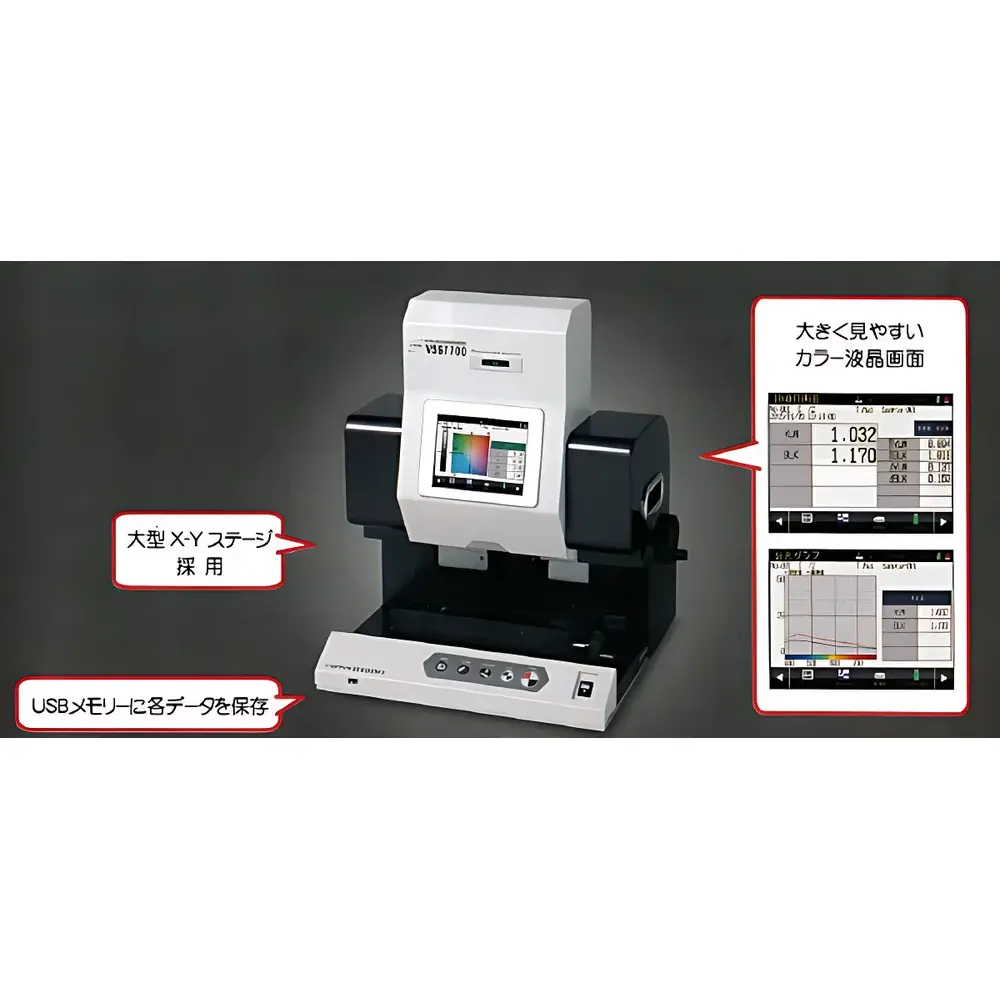
NIPPON DENSHOKU VSS7700 Micro-Area Spectrophotometer
| Brand | NIPPON DENSHOKU |
|---|---|
| Origin | Japan |
| Model | VSS7700 |
| Product Type | Spectrophotometric Colorimeter |
| Instrument Type | Benchtop |
| Optical Geometry | 0°/45° Integrating Sphere |
| Light Source | Tungsten Halogen Lamp |
| Spectral Range | 380–780 nm |
| Repeatability | ΔE*ab ≤ 0.001 |
| Measurement Apertures | Ø0.03 mm, Ø0.05 mm, Ø0.2 mm, Ø0.5 mm |
| Display | 5.7″ Color TFT LCD |
| Detector | CMOS Image Sensor with Spectral Dispersion Optics |
| Objective Lens | 10× Microscope Objective |
| Power Supply | AC 100–220 V, 20/60 Hz, 40 VA |
| Dimensions (W×D×H) | 371 × 422 × 471 mm |
| Weight | 17.9 kg |
Overview
The NIPPON DENSHOKU VSS7700 Micro-Area Spectrophotometer is a precision benchtop instrument engineered for non-contact, high-spatial-resolution spectral color measurement of extremely small surface areas—down to Ø0.03 mm—without physical contact or sample damage. Leveraging microscope-based optical design and dual-beam full-spectrum compensation architecture, the VSS7700 combines 45° illumination geometry with 0° viewing (0°/45°) within an integrating sphere to deliver stable, geometry-controlled reflectance data compliant with CIE 15:2018 and ISO 13655:2017. Its core function is to isolate and quantify spectral reflectance from micro-regions on heterogeneous, textured, or patterned surfaces—including printed dots, LCD pixel elements, thin-film coatings, semiconductor traces, and cosmetic pigment clusters—where conventional 8-mm or 4-mm aperture instruments fail to resolve localized chromatic variation.
Key Features
- Micro-area targeting via integrated 10× microscope objective lens and high-resolution CMOS imaging sensor, enabling real-time visual confirmation and precise positioning of measurement spots;
- Four interchangeable apertures (Ø0.03 mm, Ø0.05 mm, Ø0.2 mm, Ø0.5 mm) mounted on a motorized turret—each calibrated traceably to NIST-traceable standards;
- Dual-beam optical path with real-time reference compensation, minimizing drift from lamp aging or thermal fluctuation during extended measurement sessions;
- 5.7-inch color TFT LCD display with multi-tab interface supporting simultaneous visualization of numerical values (CIE XYZ, L*a*b*, hCIELCh), spectral curves (380–780 nm), ΔE*ab deviation maps, and multiple color difference metrics (including JIS K 7373 and ASTM D1925 yellowness indices);
- Comprehensive illuminant library (A, C, D65, F6, F8, F10) and observer angle options (2° and 10° standard observers), configurable per measurement sequence;
- Robust mechanical platform: XYZ-adjustable stage (250 × 120 mm travel range) with fine-focus micrometer controls, accommodating both oversized substrates and fragile micro-components;
- Touchscreen + membrane switch hybrid operation interface supporting multilingual UI (English and Japanese) and audit-ready parameter logging.
Sample Compatibility & Compliance
The VSS7700 accommodates flat, curved, and slightly irregular surfaces—provided optical access and focus stability are maintained. It supports measurement of opaque, translucent, and semi-gloss materials including inkjet prints, OLED panels, automotive trim films, pharmaceutical tablet coatings, and textile dye patches. All optical components comply with ISO 13655:2017 (spectral measurement of graphic arts), JIS Z 8722 (colorimetric methods), and ASTM E308 (computation of CIE tristimulus values). The system’s repeatability (ΔE*ab ≤ 0.001 under controlled lab conditions) meets internal QC requirements for Tier-1 display and packaging suppliers operating under IATF 16949 and ISO 9001 frameworks. Optional specular component included (SCI/SCE modes) via detachable mirror head for gloss-inclusive or gloss-excluded evaluation per ISO 2813.
Software & Data Management
The optional Color Management Software (CMS-VSS) provides full instrument control, batch measurement sequencing, statistical process monitoring (SPC), and export to CSV, XML, or industry-standard CGATS.2 formats. It supports GLP-compliant audit trails—including user ID, timestamp, calibration history, and parameter lockout—with optional 21 CFR Part 11 compliance modules (electronic signatures, role-based access, and immutable log archiving). Data analysis includes spectral similarity indexing (CIEDE2000 across user-defined wavelength bands), multi-sample comparative charts, and automated pass/fail reporting against master reference tolerances. Integration with LIMS and MES platforms is supported via TCP/IP and OPC UA protocols.
Applications
- Quality assurance of micro-printed security features (e.g., banknote guilloches, QR code color fidelity);
- Color consistency validation across individual sub-pixels in AMOLED and microLED displays;
- Characterization of pigment dispersion uniformity in cosmetic foundations and automotive clearcoats;
- Quantitative assessment of photodegradation gradients on UV-aged polymer films;
- R&D support for spectral tuning of interference pigments and structural-color coatings;
- Validation of color registration accuracy in high-resolution gravure and flexographic printing.
FAQ
What is the smallest measurable area supported by the VSS7700?
The instrument supports four calibrated micro-apertures, with the smallest being Ø0.03 mm—equivalent to ~700 µm²—achievable under optimal focus and sample flatness conditions.
Does the VSS7700 support SCI and SCE measurement modes?
Yes; the optional U-shaped specular reflection probe enables SCI (specular component included) mode for total reflectance, while standard 0°/45° geometry defaults to SCE (specular component excluded) unless the mirror head is engaged.
Is calibration traceable to national standards?
All factory calibrations are performed using NIST-traceable ceramic tiles and spectral standards; users receive a certificate of calibration with uncertainty budget per ISO/IEC 17025 guidelines.
Can the VSS7700 measure transparent or backlit samples?
No—it is designed exclusively for reflectance measurement of opaque or semi-opaque surfaces. Transmittance or fluorescence applications require dedicated instrumentation (e.g., VSS-7500T or FS-7 series).
What environmental conditions are required for optimal performance?
Ambient temperature must be stabilized between 15–35 °C, with relative humidity below 80% non-condensing; vibration isolation and ambient light shielding are recommended for sub-ΔE*ab = 0.005 repeatability.




