
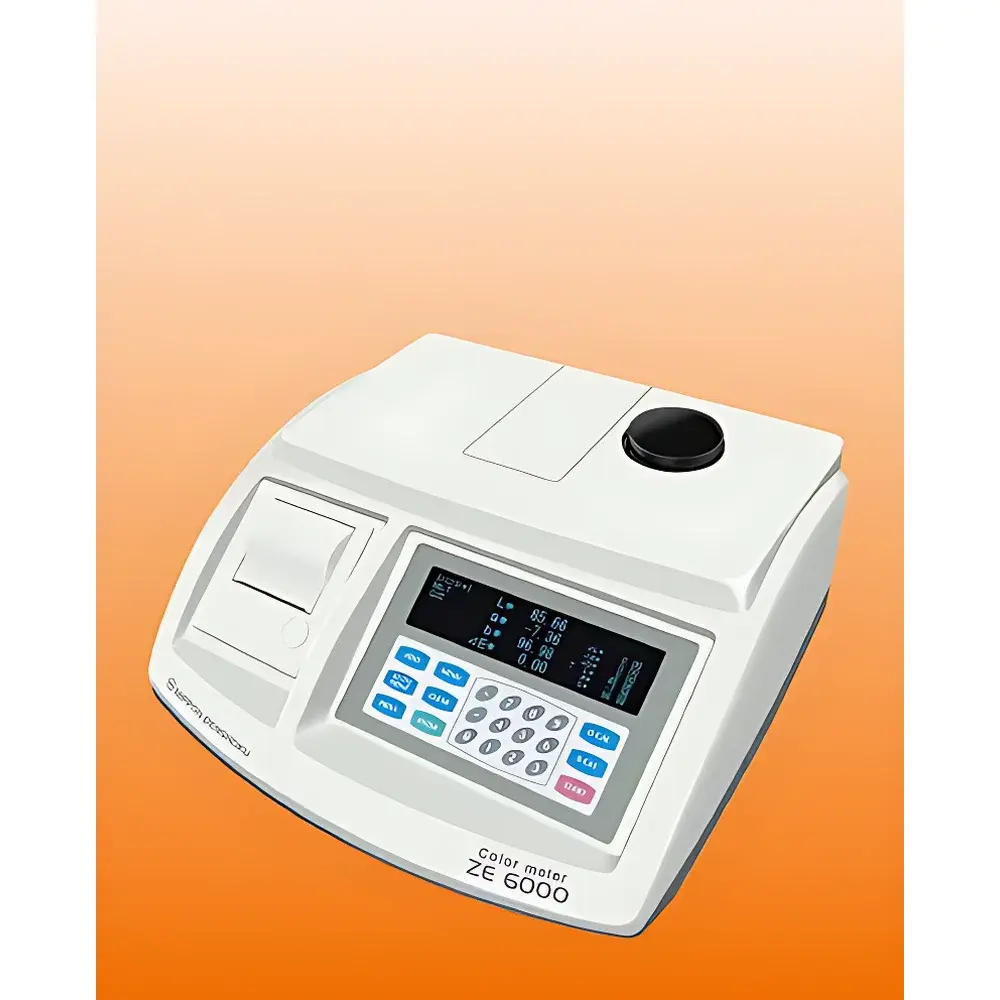
NIPPON DENSHOKU ZE6000 Benchtop Color Difference Meter
| Brand | NIPPON DENSHOKU |
|---|---|
| Origin | Japan |
| Model | ZE6000 |
| Instrument Type | Benchtop |
| Optical Geometry | 8°/diffuse (d) |
| Light Source | 12 V / 50 W Halogen Lamp |
| Spectral Range | 380–780 nm (10 nm interval) |
| Repeatability | ΔE* ≤ 0.02 (after 30 min warm-up, 30 consecutive measurements at 10 s intervals) |
| Compliance | JIS Z 8722, ASTM E 308, ASTM E 313, ASTM D 1925 |
| Measurement Areas | Reflectance – Ø6 mm, Ø10 mm, Ø30 mm (optional Ø3 mm) |
| Display | 256 × 64 dot matrix (166.25 × 41.45 mm active area) |
| Interface | RS-232C |
| Power | 100–240 V AC, 50/60 Hz, 100 W |
| Dimensions & Weight | 425 × 415 × 189 mm, 13 kg |
Overview
The NIPPON DENSHOKU ZE6000 is a precision benchtop color difference meter engineered for high-reproducibility spectral color measurement in industrial quality control, R&D laboratories, and regulatory-compliant manufacturing environments. It operates on the principle of spectrophotometric reflectance and transmittance analysis using a calibrated halogen light source and silicon photodiode array detection. The instrument adheres to the 8°/diffuse (d) optical geometry per JIS Z 8722, enabling accurate measurement of both matte and glossy surfaces without directional bias. Its dual-mode capability—simultaneous reflectance and transmittance evaluation—supports diverse sample forms including solids, liquids, powders, films, tablets, and irregularly shaped specimens. With a full visible spectrum coverage from 380 nm to 780 nm at 10 nm resolution, the ZE6000 delivers CIE XYZ tristimulus values directly, forming the foundation for all derived color spaces (CIELAB, CIELCH, CIEYxy) and difference metrics (ΔE*, ΔE94, ΔECMC). Designed for stability under continuous operation, the system incorporates thermal stabilization protocols and flash-test functionality to minimize drift during extended measurement sessions.
Key Features
- Dual optical path architecture supporting both reflectance (Ø6 mm, Ø10 mm, Ø30 mm, and optional Ø3 mm apertures) and transmittance (Ø30 mm) measurements in a single platform.
- High-stability 12 V / 50 W halogen lamp with rapid-response silicon photodiodes ensuring consistent spectral output and low-noise signal acquisition.
- Large-format monochrome LCD display (256 × 64 dots) with dedicated visualization modes: spectral reflectance curves, CIELAB trajectory plots, Yxy chromaticity diagrams, polarized color deviation charts, and numeric data tables.
- Onboard statistical processing—including mean, standard deviation, and pass/fail tolerance evaluation—for up to 99 sample sets against 20 stored reference standards.
- Comprehensive color difference calculation engine supporting ΔL*a*b*, ΔL*u*v*, ΔE*, ΔE94, ΔECMC (1:1 and 2:1), YI (ASTM E 313 and D 1925), whiteness (CIE and CIELAB), yellowness index, haze-related OD, and Munsell HVC conversion (C/2° and D65/2° illuminants).
- Integrated thermal printer with customizable print templates covering full metrological traceability: sample ID, date/time stamp, illuminant/observer, raw XYZ, derived Lab/LCh/Yxy, and tolerance status flags.
- Foot-switch interface for hands-free operation—critical in GMP-compliant pharmaceutical tablet inspection or food packaging QA workflows where operator hygiene and ergonomics are prioritized.
Sample Compatibility & Compliance
The ZE6000 accommodates heterogeneous material classes without mechanical reconfiguration: rigid solids (e.g., painted panels, plastic housings), translucent films (PET, PVC), viscous liquids (coatings, syrups), granular powders (pigments, APIs), and small-diameter cylindrical objects (pharmaceutical tablets via Ø3 mm aperture). Its compliance framework aligns with international colorimetry standards including JIS Z 8722 (Japanese Industrial Standard for color measurement methods), ASTM E 308 (computing CIE tristimulus values), ASTM E 313 (yellowness index), and ASTM D 1925 (plastic yellowness). While not inherently 21 CFR Part 11 compliant, its RS-232C serial interface enables integration into validated Windows-based systems running NIPPON DENSHOKU’s optional color management software—supporting audit trails, electronic signatures, and secure data archiving when deployed within GLP/GMP-regulated environments.
Software & Data Management
Data export is native via RS-232C to Windows platforms (Windows 98 through Vista) meeting minimum specifications: Pentium 300 MHz CPU, 128 MB RAM, 10 MB free disk space, and SVGA (800 × 600, 64k-color) display. The optional Windows color management software provides structured database import/export in CSV and TXT formats, facilitating interoperability with LIMS, ERP, and statistical process control (SPC) tools. All exported files retain metadata such as calibration timestamp, instrument ID, measurement conditions, and operator-defined annotations. Internal memory retains 99 sample groups and 20 reference profiles; no volatile storage is used—ensuring data integrity during power interruption. File handling supports direct conversion to spreadsheet-ready formats without third-party utilities, reducing post-processing overhead in routine QC reporting.
Applications
- Automotive OEM paint and trim validation against OEM color standards (e.g., BMW, Toyota TSBs).
- Pharmaceutical solid dosage form color consistency testing per USP and ICH Q5C guidelines.
- Food and beverage product batch-to-batch hue verification (e.g., caramel color intensity in soft drinks, tea extract browning index).
- Paper and packaging industry whiteness/yellowness certification aligned with ISO 2470 and TAPPI T 452.
- Plastics compounding labs performing pigment dispersion uniformity assessment via spatial ΔE* mapping across molded plaques.
- Textile dye lot approval using ΔECMC (2:1) tolerances specified in AATCC Evaluation Procedure 1.
FAQ
What illumination/observer combinations does the ZE6000 support?
C/2°, D65/2°, and D65/10°—all implemented per CIE 15:2004 and JIS Z 8722 Annex B.
Can the ZE6000 measure opaque liquids?
Yes, when used with the optional transmission cell holder and matched quartz cuvettes (pathlength ≥10 mm); absorbance correction is applied automatically.
Is calibration traceable to NIST or JCSS standards?
Factory calibration uses NIPPON DENSHOKU’s JCSS-accredited reference tiles (certified per JIS Z 8722 Annex C); users may perform daily verification with supplied ceramic standards.
Does the instrument support custom tolerance ellipsoids (e.g., CMC l:c)?
Yes—CMC (1:1) and CMC (2:1) are embedded algorithms; user-defined ellipsoid parameters are not supported, but preconfigured settings meet >95% of industrial specification requirements.
How is thermal drift mitigated during long-duration measurements?
The halogen lamp power supply includes closed-loop current regulation, and the optical bench features passive aluminum heat-sinking; combined with the flash-test mode (single-pulse illumination), this limits thermal gradient-induced spectral shift to <0.01 nm/°C over 4 hours.



