
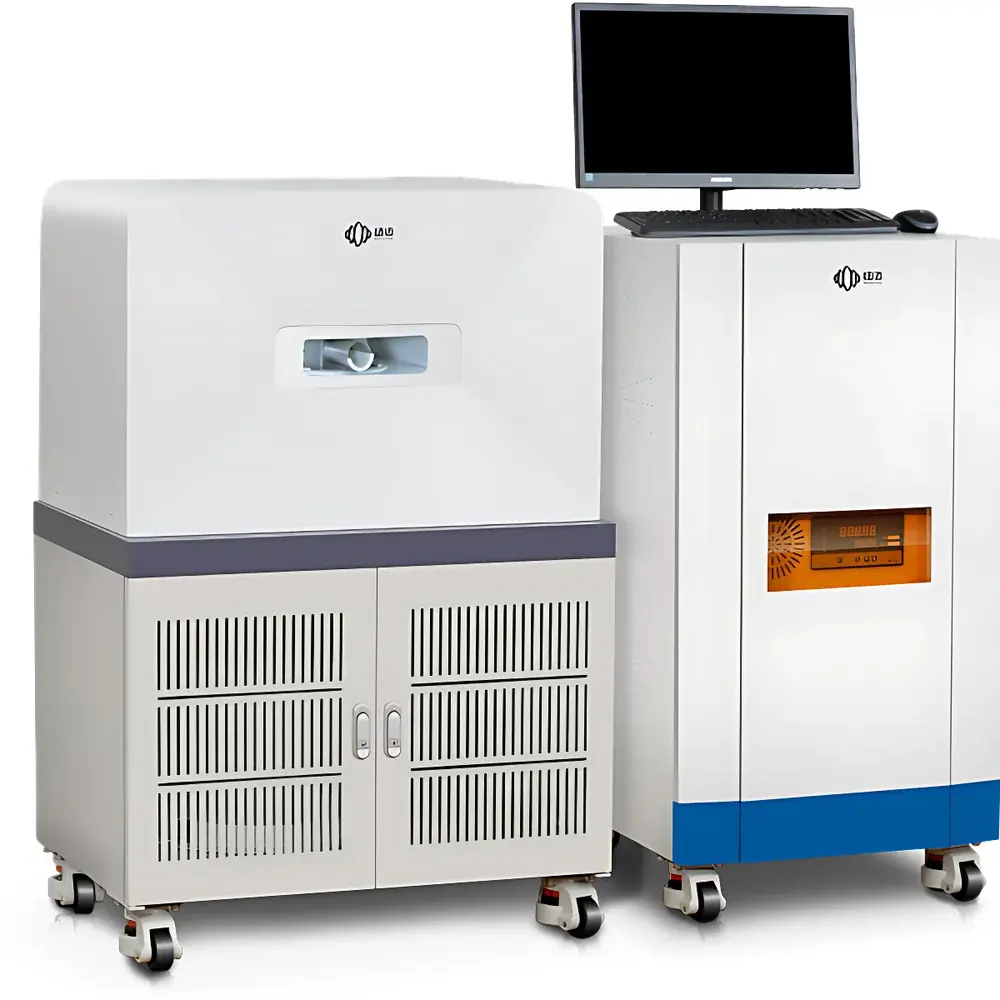
NIUMAG MacroMR Benchtop Nuclear Magnetic Resonance Rock Analyzer
| Brand | NIUMAG |
|---|---|
| Origin | Jiangsu, China |
| Magnet Type | Permanent Magnet |
| Static Magnetic Field Strength | 0.5 ± 0.08 T |
| Larmor Frequency | 21.3 MHz |
| Probe Coil Diameter | 60 mm |
| Application Domain | Geological Core Analysis, Petrophysical Characterization, Soil & Cement Hydration Monitoring |
| Compliance Framework | Designed for ASTM D7264 (flexural properties), ISO 10427 (NMR porosity/permeability correlation), and GLP-aligned data integrity workflows |
Overview
The NIUMAG MacroMR is a benchtop low-field nuclear magnetic resonance (NMR) analyzer engineered specifically for quantitative petrophysical characterization of geological and construction materials. Operating on the fundamental principles of pulsed NMR—specifically spin-echo decay (T₂ relaxation), inversion-recovery (T₁ measurement), and diffusion-weighted sequences—the MacroMR enables non-destructive, high-reproducibility assessment of fluid distribution, pore structure, and molecular mobility within heterogeneous solid matrices. Unlike conventional imaging-based MRI systems, the MacroMR prioritizes robust time-domain signal acquisition and multi-exponential T₂ spectral inversion, delivering statistically stable porosity, bound/free fluid ratio, and effective pore size distribution without reliance on calibration standards. Its permanent magnet architecture ensures field stability (<50 ppm/h drift) and eliminates cryogen dependency, making it suitable for long-term monitoring in core labs, geotechnical testing facilities, and cement research centers.
Key Features
- Stable 0.5 T permanent magnet system with active shimming, enabling consistent Larmor frequency (21.3 MHz) across ambient temperature variations (15–35 °C).
- 60 mm diameter RF probe optimized for heterogeneous rock cores (up to Ø50 mm × 100 mm), soil monoliths, and cement cylinders (Ø100 mm × 200 mm), with broadband tuning (1H, 19F optional).
- Integrated pulse programmer supporting CPMG, IR-CPMG, and stimulated echo sequences with variable inter-echo spacing (0.05–20 ms) and total echo train lengths up to 2 s.
- Dedicated NMR console with 16-bit ADC, real-time signal averaging, and hardware-based phase cycling to suppress acoustic ringing and eddy current artifacts.
- Rugged industrial chassis rated IP54, compliant with IEC 61000-6-2/6-4 for electromagnetic compatibility in shared lab environments.
Sample Compatibility & Compliance
The MacroMR accommodates standard cylindrical geological specimens (ASTM D4543, ISO 14688-1), including intact rock cores (sandstone, limestone, shale), frozen soil columns, hydrated cement paste, and mortar prisms. It supports custom sample holders for triaxial cells (up to 40 MPa confining pressure) and temperature-controlled chambers (−40 °C to +80 °C). Data acquisition and processing workflows are structured to meet audit requirements under GLP and GMP frameworks: all pulse sequences are timestamped and digitally signed; raw FID and T₂ spectra are stored in vendor-neutral HDF5 format with embedded metadata (sample ID, operator, environmental conditions, sequence parameters). Optional 21 CFR Part 11 compliance package includes electronic signature logging, role-based access control, and immutable audit trails.
Software & Data Management
NIUMAG’s RockAnalyzer v4.2 software provides end-to-end workflow automation—from sequence selection and parameter optimization to T₂ spectrum deconvolution using non-negative least squares (NNLS) and pore-size conversion via the Coates or Timur-Coates models. Batch processing supports parallel analysis of >50 samples with customizable reporting templates aligned with API RP 40 and ISO 10427 Annex B. Raw data export includes ASCII-compatible .dat files and MATLAB-readable .mat structures. Integration with LIMS platforms is enabled via RESTful API, supporting automated transfer of porosity, permeability index, and saturation profiles into enterprise QA/QC databases.
Applications
- Rock Physics & Reservoir Characterization: Quantification of clay-bound water (CBW), capillary-bound water (BVI), and free-fluid volume (FFI); differentiation of micro/meso/macroporosity in tight gas sandstones and organic-rich shales.
- Frozen Soil Mechanics: In-situ tracking of unfrozen water content during freeze-thaw cycles; correlation of T₂ cutoff shifts with ice lens formation and frost heave potential per ASTM D559/D560.
- Cementitious Materials Science: Real-time monitoring of hydration kinetics (induction, acceleration, deceleration phases); quantification of capillary porosity evolution and chloride ingress front progression.
- Multifield Coupling Experiments: Synchronized NMR acquisition during mechanical loading (uniaxial/triaxial), thermal cycling, or chemical exposure (acid/salt immersion), enabling damage mapping via T₂ shortening and signal amplitude loss.
FAQ
What sample sizes are supported?
Standard configuration accepts cylindrical samples up to Ø50 mm × 100 mm; optional large-bore probe (Ø80 mm) accommodates Ø75 mm × 150 mm cores.
Can the MacroMR perform diffusion-relaxation (D-T₂) correlation?
Yes—via integrated pulsed field gradient (PFG) module (max gradient strength 0.5 T/m), enabling pore geometry discrimination in anisotropic media.
Is calibration required for porosity quantification?
No absolute calibration is needed; signal amplitude is directly proportional to hydrogen density. Bulk volume and surface relaxivity corrections follow ISO 10427 guidelines.
How is temperature controlled during measurements?
External circulation chiller (±0.1 °C stability) interfaces with probe jacket; internal PT100 sensor feeds real-time compensation into T₂ fitting algorithms.
Does the system support remote operation and monitoring?
Yes—web-based GUI accessible via secure TLS 1.2 connection; live spectrum streaming and queue management available through NIUMAG CloudLink portal.





