
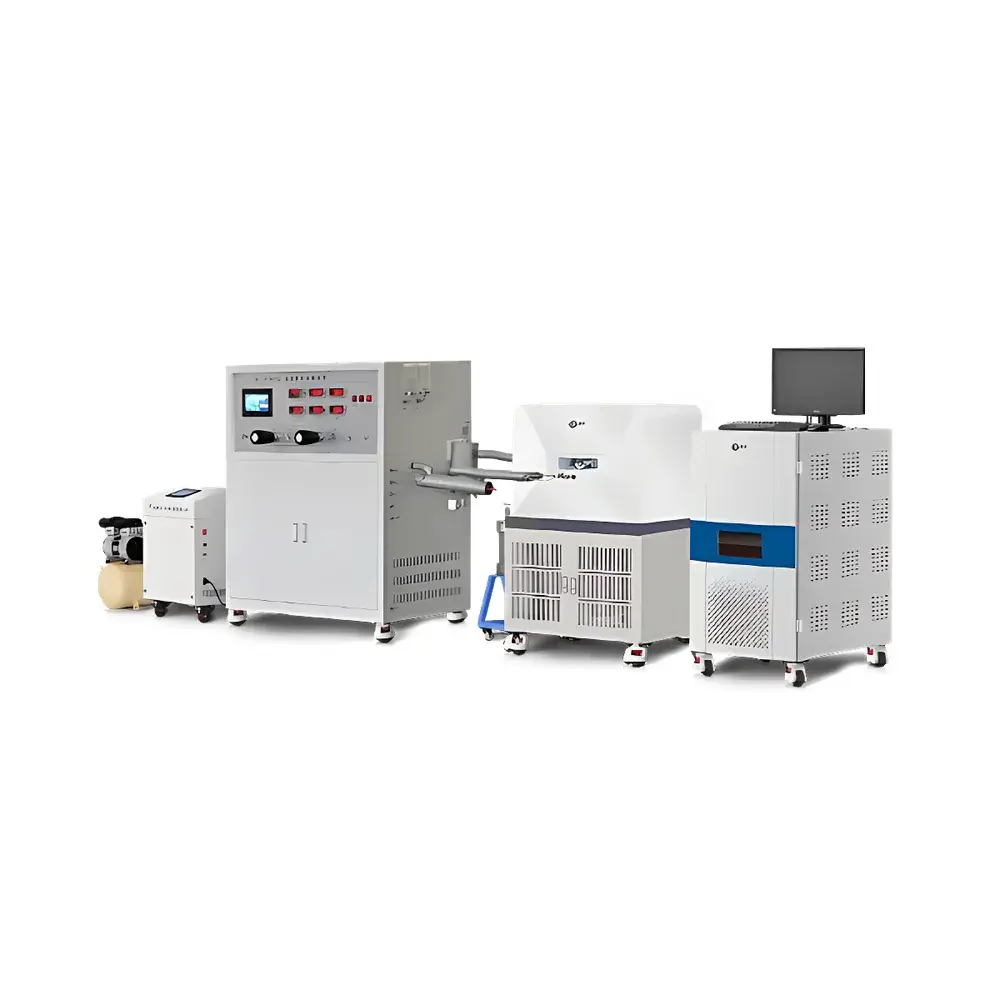
NIUMAG MacroMR12-150H-I-6 Low-Field Nuclear Magnetic Resonance Analyzer for Geotechnical Applications
| Brand | NIUMAG |
|---|---|
| Origin | Jiangsu, China |
| Instrument Type | Low-Field NMR Analyzer |
| Sample Type | Solid-Liquid Dual-Phase Porous Media |
| Magnetic Field Strength | 0.3 T ± 0.03 T |
| Maximum Sample Diameter | ≤150 mm |
| Maximum Sample Length | ≤100 mm (Ambient Temperature & Pressure) |
| Magnet Configuration | C-Shaped Open Bore |
| Sample Loading | Horizontal/Vertical Push-Pull Design |
| Core Capabilities | T₁/T₂ Relaxometry, Proton Density Mapping, T₁/T₂-Weighted Imaging |
| Environmental Simulation Support | Optional Temperature, Pressure, and Fluid Flow Modules (via Accessories) |
Overview
The NIUMAG MacroMR12-150H-I-6 is a purpose-engineered low-field nuclear magnetic resonance (NMR) analyzer designed specifically for geotechnical characterization of porous media—including soils, rocks, concrete, and frozen ground. Unlike destructive or indirect measurement techniques (e.g., gravimetric drying, mercury intrusion porosimetry, or resistivity profiling), this system leverages the physical principle of proton spin relaxation in hydrogen-bearing fluids (e.g., water, hydrocarbons) to non-invasively quantify pore-scale structural and dynamic properties. Operating at a stable 0.3 T field, the instrument delivers high reproducibility in T₁ and T₂ relaxation time distributions—directly correlated with pore size distribution, fluid saturation, bound/free water ratio, and transport heterogeneity. Its C-shaped open magnet architecture enables full-diameter core analysis without sectioning, preserving sample integrity and enabling longitudinal spatial resolution across heterogeneous formations.
Key Features
- C-shaped open-bore magnet with 110–150 mm usable aperture, accommodating intact rock cores (25–150 mm diameter) and large-volume soil specimens without cutting or compaction.
- High-stability temperature-controlled RF probe with integrated gradient coils, ensuring signal fidelity and spatial encoding accuracy for quantitative relaxometry and 2D/3D imaging.
- Dual-mode operation: simultaneous acquisition of T₁/T₂ relaxation spectra and T₁-, T₂-, or proton density-weighted images—enabling correlative microstructural and functional analysis.
- Modular accessory interface supporting standardized geomechanical fixtures: high-pressure core holders (up to 70 MPa), programmable thermal chambers (−40 °C to +80 °C), and flow-through cells for in-situ fluid displacement or reactive transport experiments.
- Robust mechanical design with push-pull horizontal/vertical sample loading, minimizing operator-induced vibration and enabling repeatable positioning for time-series monitoring.
Sample Compatibility & Compliance
The MacroMR12-150H-I-6 accepts solid-liquid composite samples typical of geotechnical practice: saturated/unsaturated soils, fractured or intact rock cores, cementitious materials, and frozen ground specimens. It complies with ISO 10427-2 (petrophysical NMR methods), ASTM D7260 (standard guide for NMR logging and core analysis), and supports GLP-aligned data traceability through timestamped metadata embedding (acquisition parameters, environmental conditions, operator ID). While not FDA-regulated, its software architecture adheres to principles of 21 CFR Part 11 for electronic records—audit trails, user authentication, and immutable raw data storage are implemented via optional configuration.
Software & Data Management
Control and analysis are performed using NIUMAG’s proprietary GeoMR™ software suite, built on a modular MATLAB-based framework. The platform provides real-time spectral preview, automated T₂ inversion using non-negative least squares (NNLS) with regularization, spatially resolved relaxation mapping, and customizable ROI-based quantification. All raw FID data, processed spectra, and image stacks are stored in vendor-neutral HDF5 format with embedded metadata (field strength, pulse sequence, temperature, pressure if active). Batch processing workflows support longitudinal studies (e.g., freeze-thaw cycling, hydration kinetics), and export modules generate CSV, PNG, and DICOM-compliant outputs for integration into third-party GIS or finite-element modeling environments.
Applications
- Soil Science: Quantification of unfrozen water content in permafrost, spatial mapping of moisture migration during infiltration/drainage, and differentiation of clay-bound vs. capillary water via T₂ cutoff analysis.
- Cementitious Materials: Monitoring early-age hydration kinetics through longitudinal T₁ changes, assessing pore structure evolution (0.1–100 µm range) via T₂ distribution, and evaluating chloride ingress or carbonation depth using contrast-enhanced imaging.
- Rock Physics: Pore network characterization in reservoir sandstones and shales; multi-phase fluid saturation tracking under confining stress; visualization of fracture propagation and stress-induced pore collapse during triaxial testing.
- Geoenvironmental Engineering: In-situ simulation of acid rain or saline groundwater interaction with limestone/marl, correlating T₂ shortening with mineral dissolution rates and secondary precipitation.
FAQ
What sample preparation is required prior to NMR analysis?
Minimal preparation is needed: samples must be sealed in non-magnetic, RF-transparent containers (e.g., glass or PTFE tubes) and equilibrated to the target temperature. No drying, coating, or vacuum saturation is necessary unless simulating specific boundary conditions.
Can the system operate under elevated pressure or temperature?
Yes—when equipped with optional accessories: high-pressure core holders (up to 70 MPa) and thermostatic chambers (−40 °C to +80 °C) integrate seamlessly with the main console and retain full NMR signal coherence.
How does T₂ relaxation relate to pore size in geological materials?
In fully saturated, surface-relaxation-dominated systems, T₂ is inversely proportional to pore radius (T₂ ∝ r / ρ₂, where ρ₂ is surface relaxivity). Calibration against independent porosimetry data allows conversion of T₂ distributions into quantitative pore size spectra.
Is imaging capability limited to 2D slices, or does it support volumetric reconstruction?
The system supports both 2D slice-selective imaging and 3D spin-echo acquisitions. Volumetric datasets (e.g., 128 × 128 × 32 matrix) are reconstructed using standard filtered backprojection or iterative SENSE algorithms embedded in GeoMR™.
What level of technical support is available outside China?
NIUMAG maintains international distributor partnerships with local application engineers trained in geotechnical NMR methodology. Remote diagnostics, pulse sequence optimization, and data interpretation support are provided in English, with documentation compliant with ISO/IEC 17025 reporting conventions.





