
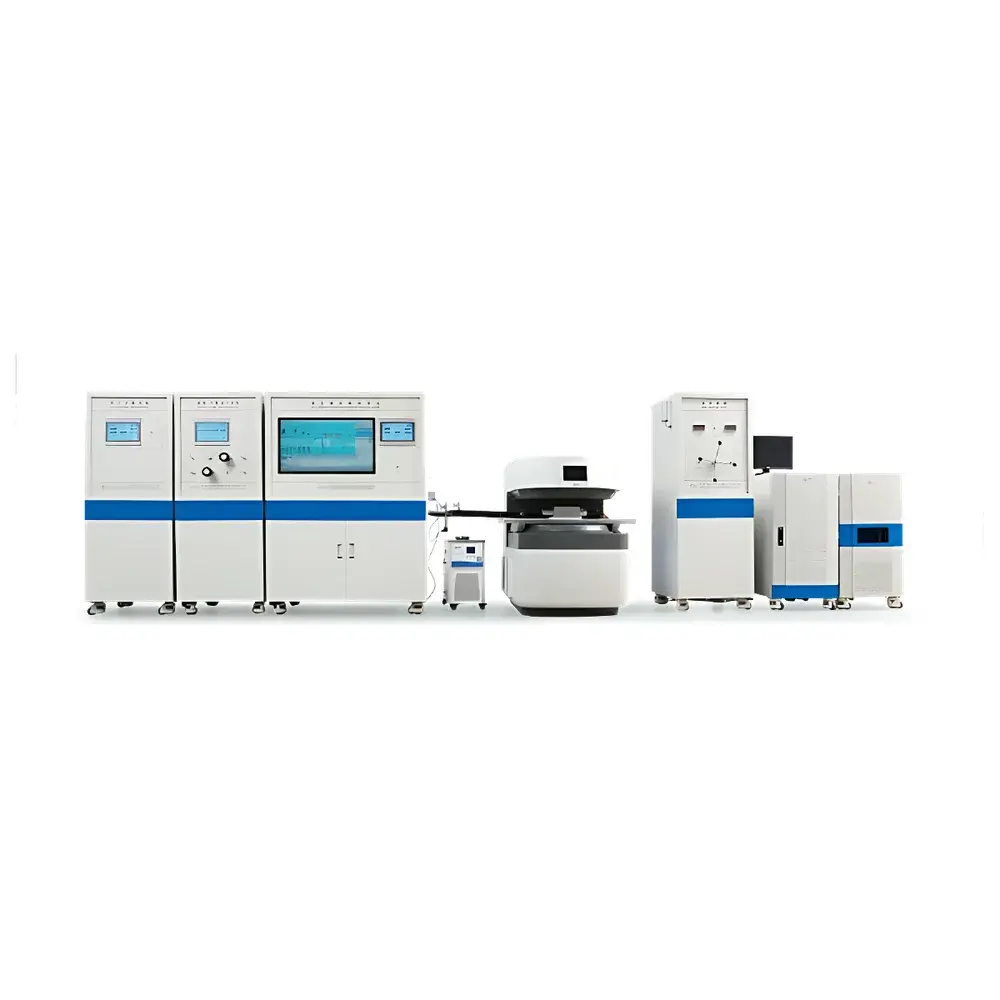
NIUMAG MacroMR12-150H-I High-Temperature High-Pressure In Situ NMR Experimental Module
| Brand | NIUMAG |
|---|---|
| Origin | Jiangsu, China |
| Instrument Type | Low-Field NMR Analyzer |
| Magnetic Field Strength | 0.3 T ± 0.03 T |
| Magnet Configuration | C-shaped open bore, transverse orientation |
| Temperature Range | Ambient to 80 °C |
| Pressure Range | 0–20 / 40 / 70 MPa (model-dependent probe options) |
| Maximum Sample Dimensions (ambient) | Ø ≤ 150 mm × L ≤ 100 mm |
| High-Pressure Core Sample Capacity | Ø 25.4 mm (1 inch) × L ≤ 80 mm |
| Sample Compatibility | Solid–liquid co-analyzed systems |
Overview
The NIUMAG MacroMR12-150H-I High-Temperature High-Pressure (HTHP) In Situ NMR Experimental Module is an engineered extension of the MacroMR12-150H-I low-field nuclear magnetic resonance analyzer, designed specifically for quantitative, time-resolved characterization of materials under geologically and industrially relevant extreme conditions. Operating on the physical principles of pulsed NMR—primarily spin-echo relaxation (T₂), diffusion-weighted imaging (PGSE), and saturation recovery (T₁)—the system enables non-invasive, label-free probing of molecular mobility, pore-scale fluid distribution, phase composition, and dynamic interfacial processes inside opaque samples. Unlike conventional ex situ analytical methods, this module maintains thermodynamic integrity throughout acquisition: samples remain continuously subjected to controlled temperature and confining pressure while undergoing real-time NMR signal acquisition. This eliminates post-extraction structural artifacts—such as volatile loss, phase recombination, or stress relaxation—that compromise data fidelity in offline analysis. The C-shaped open-bore magnet architecture provides unobstructed radial access for integration with external fluid injection systems, load frames, and thermal shrouds, supporting true in situ experimental workflows aligned with reservoir simulation standards.
Key Features
- Integrated HTHP probe design compatible with standard MacroMR12-150H-I platform, enabling seamless switching between ambient and extreme-condition operation
- Three-tier pressure rating options (20 MPa, 40 MPa, 70 MPa) with ISO 15156-compliant wetted materials and dual-stage pressure containment for safety-critical applications
- Precise temperature control from ambient to 80 °C via PID-regulated heating jacket and active cooling loop, with ±0.5 °C stability over 24 h
- Transverse C-magnet geometry optimized for large-diameter sample access (up to Ø150 mm at ambient; Ø25.4 mm × 80 mm under HTHP) and compatibility with triaxial mechanical loading fixtures
- Real-time acquisition synchronization with external triggers (e.g., pump controllers, pressure transducers, acoustic emission sensors) for event-locked NMR data capture
- Robust RF shielding and gradient coil compensation to maintain spectral resolution and spatial encoding fidelity under mechanical vibration and thermal drift
Sample Compatibility & Compliance
The module supports heterogeneous solid–liquid systems typical of porous media research, including cylindrical rock cores (sandstone, shale, carbonate), catalyst pellets, polymer composites, and hydrate-bearing sediments. All HTHP probes conform to ASME B31.4 and API RP 90 for pressure equipment design and are certified for use in Class I Division 1 hazardous locations when installed with appropriate enclosures. Data acquisition protocols support GLP-compliant audit trails, including operator ID logging, parameter versioning, and timestamped raw FID storage. While not FDA 21 CFR Part 11–certified out-of-the-box, the system’s software architecture permits third-party validation packages for regulated environments requiring electronic signature and data integrity assurance.
Software & Data Management
Acquisition and reconstruction are managed through NIUMAG’s proprietary MultiQ-NMR™ software suite, which includes pre-configured pulse sequences for T₂ distribution inversion, diffusion–relaxation correlation (D–T₂), and dynamic saturation-recovery mapping. All datasets are stored in vendor-neutral HDF5 format with embedded metadata (field strength, temperature setpoint, pressure history, gradient calibration). Batch processing pipelines support automated quantification of porosity, bound vs. movable fluid fractions, capillary pressure curves (via centrifuge-NMR correlation), and relative permeability trends. Export modules generate CSV, MATLAB .mat, and Bruker ParaVision-compatible formats for cross-platform interoperability with reservoir simulators (e.g., CMG, PETREL) and statistical modeling tools.
Applications
- Reservoir Petrophysics: In situ measurement of porosity, pore-size distribution, fluid saturation dynamics, wettability index, and irreducible water saturation under reservoir-representative stress and thermal conditions
- Unconventional Energy Systems: Real-time monitoring of CH₄/CO₂ competitive adsorption on coal and shale matrices; nucleation, growth, and dissociation kinetics of natural gas hydrates; supercritical CO₂–brine displacement efficiency
- Enhanced Oil Recovery (EOR): Quantitative tracking of polymer slug propagation, surfactant-induced wettability alteration, and microemulsion phase behavior during high-pressure core flooding experiments
- Geomechanics & Fracturing: Time-lapse NMR imaging of fracture network evolution during hydraulic fracturing simulations; stress-dependent permeability anisotropy mapping under triaxial confinement
- Carbon Capture & Storage (CCS): In situ evaluation of CO₂–brine–rock interactions, mineral dissolution/precipitation rates, and caprock seal integrity assessment
FAQ
What pressure and temperature ranges are supported by default?
Standard configurations offer 20 MPa / 80 °C; optional probes extend to 40 MPa or 70 MPa, with temperature limits maintained at 80 °C for material safety and NMR signal stability.
Can the system perform simultaneous mechanical loading and NMR acquisition?
Yes—the open C-magnet geometry accommodates externally mounted triaxial cells and servo-hydraulic frames; NMR acquisition is synchronized with load and displacement signals via TTL trigger interface.
Is the software compliant with 21 CFR Part 11 requirements?
The base software does not include electronic signature or audit trail features required for Part 11 compliance; however, validated add-on modules are available upon request for pharmaceutical or regulated industrial use cases.
How is data integrity ensured during long-duration HTHP experiments?
Raw FID data are written continuously to redundant SSD arrays with checksum verification; acquisition interruption recovery preserves sequence state and resumes from last valid echo train without parameter reset.
What sample preparation protocols are recommended for rock core analysis?
Samples must be vacuum-saturated with brine or hydrocarbon fluid prior to loading; end-face sealing with compliant elastomers prevents leakage while minimizing acoustic coupling artifacts during RF transmission.
Related Products






