
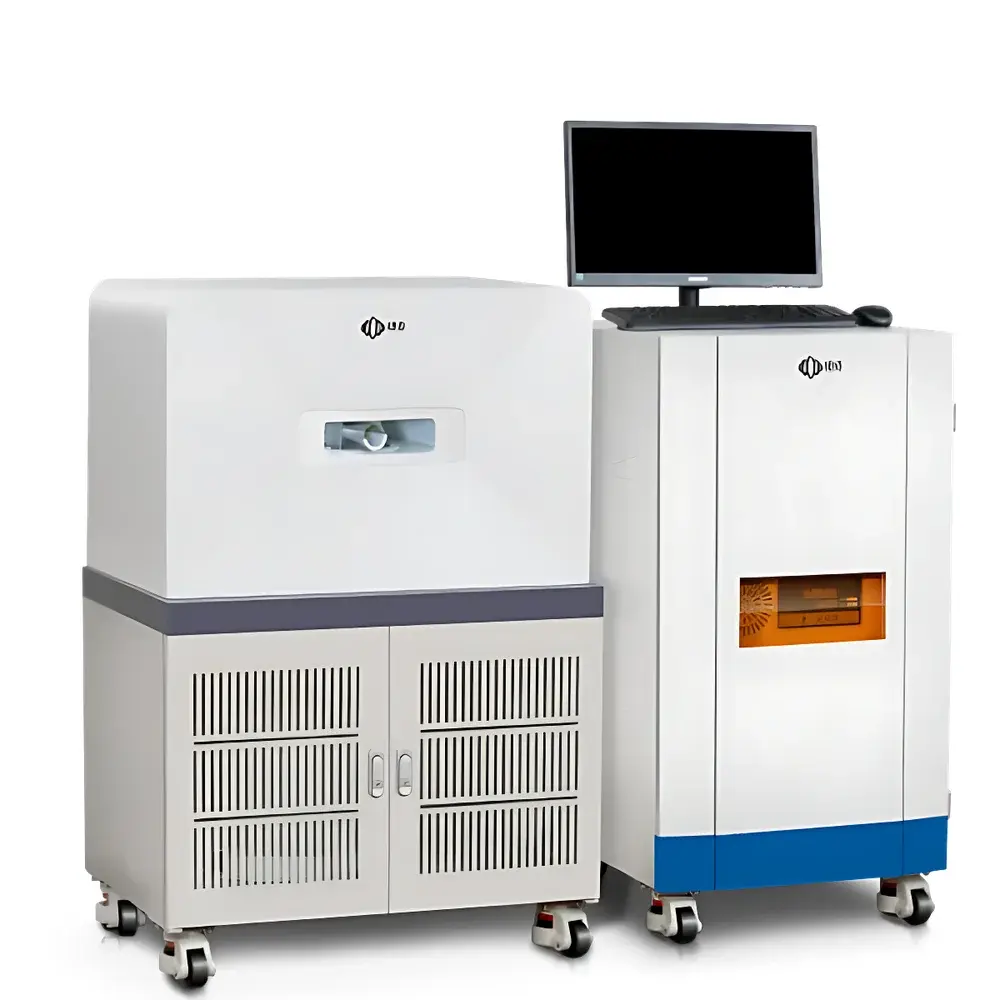
NIUMAG MesoMR Benchtop Low-Field Nuclear Magnetic Resonance (NMR) Analyzer for Rock Core Characterization
| Brand | NIUMAG |
|---|---|
| Origin | Jiangsu, China |
| Manufacturer Type | Authorized Distributor |
| Regional Classification | Domestic |
| Model | MesoMR |
| Instrument Type | Low-Field NMR Analyzer |
| Sample Compatibility | Solid-Liquid Dual-Mode |
| Operating Frequencies | 12 MHz or 23 MHz (selectable) |
| Data Acquisition Mode | Pulsed Fourier Transform |
| Magnet Type | Permanent Magnet |
| Magnetic Field Strength | 0.3 ± 0.03 T (12 MHz) or 0.5 ± 0.03 T (23 MHz) |
| Probe Coil Diameter | 60 mm |
Overview
The NIUMAG MesoMR is a compact, benchtop low-field nuclear magnetic resonance (NMR) analyzer engineered for quantitative and qualitative characterization of geological rock cores and porous media. Based on the fundamental principles of pulsed Fourier-transform NMR spectroscopy, the system detects hydrogen proton (¹H) spin relaxation signals—primarily T₂, T₁, and diffusion-weighted decay—to derive intrinsic petrophysical properties without destructive sample preparation. Unlike high-field superconducting NMR systems, the MesoMR leverages permanent magnet technology to deliver stable, maintenance-free operation at field strengths of 0.3 T (12 MHz) or 0.5 T (23 MHz), enabling robust signal acquisition under laboratory and field-deployable conditions. Its design emphasizes reproducibility in pore-scale analysis, making it suitable for routine QC/QA workflows in core laboratories, reservoir simulation centers, and academic geoscience departments.
Key Features
- Modular platform architecture supporting customizable configurations—including vertical/horizontal sample loading, temperature-controlled stages (–40 °C to +150 °C), and pressure-rated cells (up to 70 MPa) for in-situ reservoir condition simulation.
- Dual-frequency capability (12 MHz / 23 MHz) allows optimization between signal-to-noise ratio and spectral resolution depending on sample type, fluid viscosity, and required measurement time.
- 60 mm diameter RF probe coil accommodates standard cylindrical core plugs (up to Ø50 × 100 mm) and irregular fragments with minimal shimming requirements.
- Integrated pulse sequence library compliant with industry-standard NMR methods: CPMG (for T₂ distribution), IR (for T₁ mapping), and stimulated echo (for D–T₂ correlation).
- Self-shielded permanent magnet assembly ensures spatial field homogeneity better than 10 ppm over the active volume and eliminates cryogen dependency.
Sample Compatibility & Compliance
The MesoMR accepts both intact rock cores and crushed samples across lithologies including sandstone, carbonate, shale, and tight gas reservoir analogs. Its solid–liquid dual-mode operation enables simultaneous assessment of bound versus mobile fluid phases—critical for evaluating hydrocarbon saturation, clay-bound water content, and capillary pressure behavior. The system supports ASTM D7171-19 (Standard Test Method for Determination of Pore Size Distribution of Porous Materials by Low-Field NMR), ISO 17892-12 (Geotechnical investigation and testing — Laboratory testing of soil — Part 12: Determination of permeability using NMR), and aligns with GLP-compliant data integrity frameworks when paired with audit-trail-enabled software modules.
Software & Data Management
NIUMAG’s proprietary MesoMR Studio v5.x provides full control over pulse programming, real-time signal processing, and multi-parameter inversion. Key capabilities include non-negative least squares (NNLS) T₂ spectrum deconvolution, multi-exponential fitting, and automated porosity-permeability correlation modeling. All raw FID data, processed spectra, and metadata are stored in vendor-neutral HDF5 format. Software complies with FDA 21 CFR Part 11 requirements for electronic records and signatures when configured with role-based access control, electronic audit trails, and secure user authentication.
Applications
- Petrophysical property quantification: total porosity, effective porosity, irreducible water saturation (Swi), movable fluid fraction, and pseudo-permeability via Timur-Coates or SDR models.
- Pore structure analysis: T₂ cutoff calibration, pore size distribution (PSD) derivation, and pore geometry classification (e.g., ink-bottle vs. slit-shaped pores).
- Dynamic process monitoring: real-time tracking of imbibition, drainage, freeze–thaw cycling, CO₂ adsorption/desorption, and multiphase flow under controlled thermal and mechanical stress.
- Rock–fluid interaction studies: wettability evaluation via spontaneous imbibition kinetics and interfacial tension estimation from surface relaxivity trends.
- Microstructural imaging: 2D/3D NMR relaxometry mapping for fracture network visualization and heterogeneity quantification in unconventional reservoirs.
FAQ
What sample dimensions are supported?
Standard configuration accommodates cylindrical samples up to Ø50 mm × 100 mm in length; custom probe inserts enable analysis of irregular geometries and mini-cores down to Ø12 mm.
Is the system compatible with high-pressure core flooding experiments?
Yes—when integrated with NIUMAG’s HP-Cell accessory module, the MesoMR supports real-time NMR monitoring during dynamic displacement tests at pressures up to 70 MPa and temperatures up to 150 °C.
Can T₁–T₂ or D–T₂ correlation maps be generated?
Yes—the system includes pre-optimized 2D pulse sequences and dedicated inversion algorithms for joint relaxation–diffusion analysis, essential for distinguishing hydrocarbon types and identifying kerogen-bound hydrocarbons.
Does the software support automated report generation for regulatory submissions?
Yes—MesoMR Studio supports configurable PDF report templates with embedded metadata, instrument calibration logs, and digital signatures meeting ISO/IEC 17025 and API RP 40 documentation standards.
What maintenance is required for the permanent magnet?
None—NIUMAG’s temperature-compensated NdFeB magnet array requires no cryogens, power supply, or periodic re-shimming; annual field homogeneity verification is recommended for GLP compliance.





