
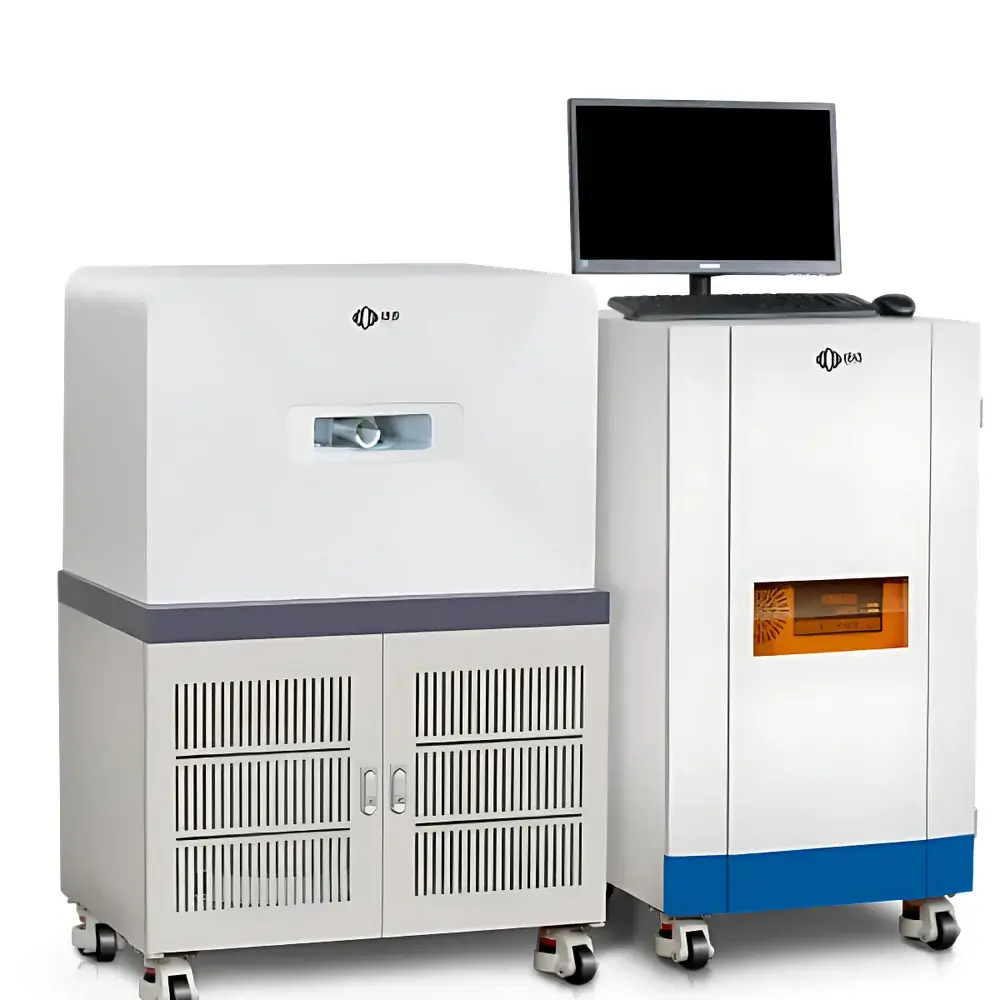
NIUMAG MESOMR+ Low-Field Nuclear Magnetic Resonance (LF-NMR) Fluid Migration Imaging Analyzer
| Brand | NIUMAG |
|---|---|
| Origin | Jiangsu, China |
| Manufacturer Type | Authorized Distributor |
| Regional Classification | Domestic |
| Model | MESOMR+ |
| Instrument Type | Low-Field NMR Analyzer |
| Sample Compatibility | Solid–Liquid Dual-Phase Samples |
| Operating Frequencies | 12.8 MHz / 21.3 MHz |
| Magnet Type | Permanent Magnet |
| Magnetic Field Strength | 0.5 ± 0.08 T |
| Probe Coil Diameter | 60 mm |
Overview
The NIUMAG MESOMR+ Low-Field Nuclear Magnetic Resonance (LF-NMR) Fluid Migration Imaging Analyzer is an integrated benchtop system engineered for quantitative characterization and spatially resolved dynamic monitoring of fluid transport processes in porous and heterogeneous materials. Based on the fundamental principles of pulsed NMR—specifically spin echo acquisition (e.g., CPMG, IR-CPMG) and diffusion-weighted imaging—the instrument enables non-invasive, label-free measurement of hydrogen-bearing fluid behavior under controlled environmental conditions. Unlike high-field NMR spectrometers optimized for molecular structure elucidation, the MESOMR+ operates at fixed low-field frequencies (12.8 MHz and 21.3 MHz), delivering robust signal-to-noise performance for macroscopic fluid distribution, mobility mapping, and time-resolved migration kinetics in geological, civil engineering, and energy-related samples. Its permanent magnet architecture ensures field stability, operational simplicity, and minimal infrastructure requirements—making it suitable for core laboratories, field-deployable research units, and long-term process monitoring environments.
Key Features
- Simultaneous NMR analysis and 2D/3D spatial imaging capability for real-time fluid migration visualization
- Dual-frequency operation (12.8 MHz and 21.3 MHz) to accommodate variable sample conductivity, relaxation time ranges, and resolution–penetration trade-offs
- 60 mm diameter RF probe optimized for standard rock cores (up to Ø50 mm × 100 mm), soil columns, cement specimens, and frozen/unfrozen geomaterials
- Modular hardware integration support: compatible with NIUMAG-developed temperature-controlled stages (–40 °C to +200 °C), pressure cells (up to 70 MPa), and freeze–thaw cycling modules
- Embedded pulse sequence library including CPMG, IR-CPMG, PGSE, and multi-echo gradient echo protocols for T₂, T₁, D, and T₁–T₂ correlation analysis
- Robust mechanical design with active shimming and temperature-compensated field stabilization for high reproducibility across extended experimental runs
Sample Compatibility & Compliance
The MESOMR+ supports solid–liquid dual-phase samples without destructive preparation or contrast agents. Validated applications include saturated/unsaturated soils, intact and fractured rock cores (sandstone, shale, limestone), hydrated cement pastes and concretes, frozen soils and permafrost analogs, and polymer–fluid composites. All hardware modules comply with IEC 61000-6-3 (EMC emission standards) and IEC 61000-6-2 (immunity). Data acquisition workflows adhere to GLP-compliant documentation practices; audit trails, user authentication, and electronic signature support are available via optional software licensing aligned with FDA 21 CFR Part 11 requirements. The system meets ASTM D7928 (soil particle size distribution by sedimentation), ISO 10119 (porous media permeability estimation from NMR), and USP guidance for analytical instrument qualification.
Software & Data Management
Control and analysis are performed using NIUMAG’s proprietary MesoMR Studio v4.x platform—a Windows-based application featuring intuitive experiment setup wizards, real-time signal preview, automated baseline correction, and batch processing pipelines. Core analysis modules include T₂ distribution deconvolution (NNLS and SVD), pore-size distribution inversion (using surface relaxivity models), water saturation mapping, and dynamic migration velocity quantification. Export formats include CSV, HDF5, and DICOM-compatible NIfTI for third-party image analysis (e.g., ImageJ, MATLAB, Avizo). Raw FID and k-space data are stored with full metadata (pulse sequence parameters, temperature/pressure logs, operator ID, timestamp), ensuring traceability and reprocessing capability. Remote access and centralized data archiving are supported via secure HTTPS API integration.
Applications
- Geotechnical & Environmental Engineering: Quantifying unfrozen water content and phase transition dynamics in freezing/thawing soils; monitoring infiltration fronts and capillary rise in unsaturated zones; evaluating contaminant transport pathways in aquifer analogs.
- Cementitious Materials Science: Tracking hydration kinetics via longitudinal relaxation (T₁) evolution; correlating pore network connectivity with compressive strength development; assessing chloride ingress depth and alkali–silica reaction progression through multi-echo imaging.
- Petroleum & Energy Geoscience: Measuring irreducible water saturation and relative permeability endpoints in reservoir rock analogs; visualizing multiphase flow (oil/water/gas) under simulated reservoir pressure–temperature conditions; characterizing fracture aperture evolution during hydraulic stimulation.
- Materials Durability Research: In situ imaging of acid/salt-induced microcracking in concrete; correlating moisture redistribution with thermal stress gradients in refractory ceramics; mapping ice lens formation in frost-susceptible aggregates.
FAQ
What is the primary magnetic field homogeneity specification for the MESOMR+?
The permanent magnet delivers ≤ 10 ppm over a 30 mm DSV (diameter spherical volume) after passive shimming—sufficient for reliable T₂ decay fitting and diffusion encoding in geophysical samples.
Can the system perform true 3D imaging, or is it limited to 2D slice selection?
The MESOMR+ supports both 2D multi-slice spin-echo imaging and 3D gradient-echo volumetric acquisition, with isotropic voxel resolution down to 0.5 mm³ under optimal SNR conditions.
Is calibration required before each experiment, and what reference standards are recommended?
A single-point gain calibration using a sealed doped water phantom (0.1% CuSO₄) is performed daily; T₂ reference gels (BAM-certified) are recommended for inter-laboratory validation.
Does the software support automated reporting compliant with ISO/IEC 17025 laboratory accreditation?
Yes—customizable report templates, digital signature fields, and raw data linkage are enabled when the GLP module is activated.
What safety certifications apply to the high-pressure and cryogenic modules?
All add-on modules carry CE marking per PED 2014/68/EU (pressure equipment) and EN 14747:2015 (cryogenic vessel design), with independent third-party type examination reports available upon request.
Related Products




