
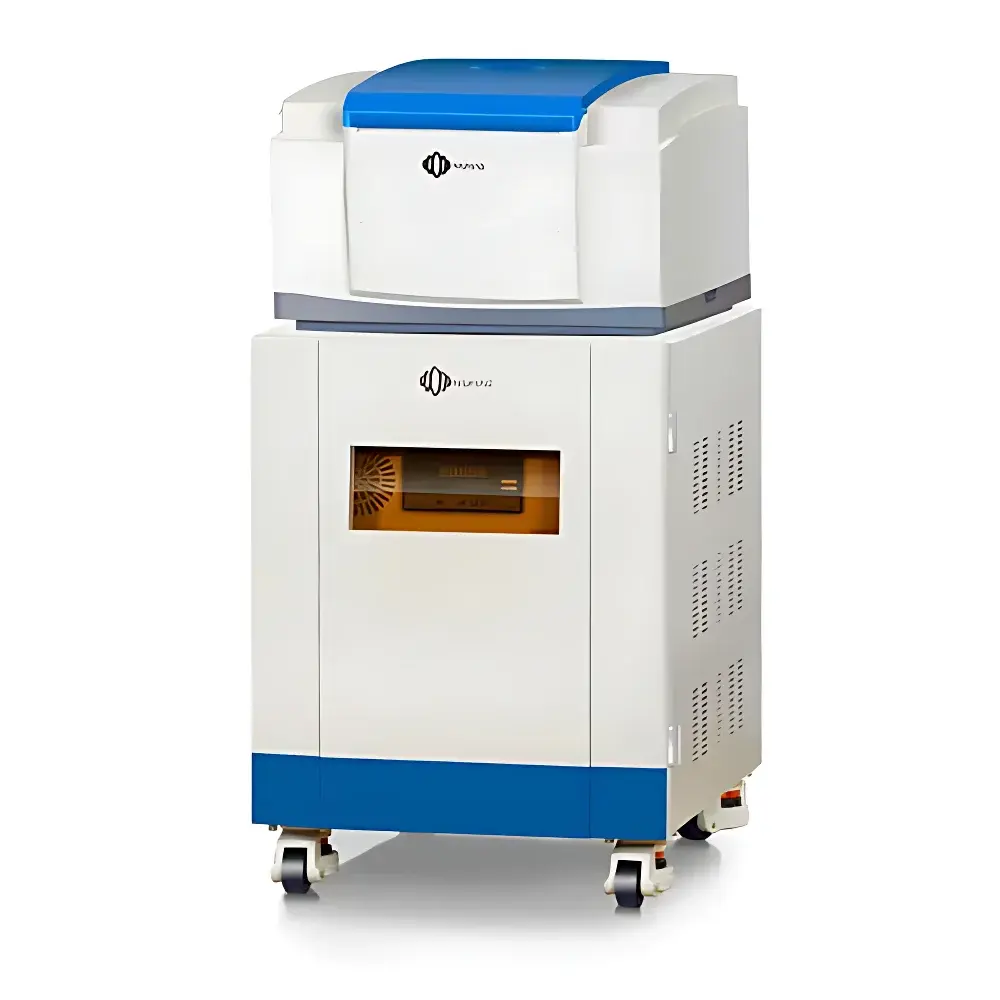
NIUMAG MicroMR12-40V Benchtop Low-Field NMR Core Analyzer (2 MHz / 12 MHz / 20 MHz Selectable)
| Brand | NIUMAG |
|---|---|
| Origin | Jiangsu, China |
| Manufacturer Type | Authorized Distributor |
| Product Origin | Domestic (China) |
| Model | MicroMR12-40V |
| Pricing | Available Upon Request |
| Operating Frequencies | 2 MHz / 12 MHz / 20 MHz (User-Selectable) |
| Standard Probe Diameter | 25.4 mm (1 inch) |
| Optional Probe | 38.1 mm (1.5 inch) |
| Form Factor | Benchtop, Compact Design |
Overview
The NIUMAG MicroMR12-40V is a compact, benchtop low-field nuclear magnetic resonance (NMR) analyzer engineered specifically for quantitative rock core characterization in petroleum geoscience laboratories. It operates on the fundamental principle of pulsed NMR—measuring transverse relaxation time (T2) distributions of hydrogen-bearing fluids (e.g., water, oil, hydrocarbons) within porous media. Unlike destructive or indirect methods (e.g., mercury intrusion porosimetry or resistivity logging), this instrument provides non-invasive, physics-based quantification of pore structure and fluid distribution under ambient conditions. Its selectable Larmor frequencies—2 MHz, 12 MHz, and 20 MHz—enable optimization for varying sample types: lower frequencies improve signal-to-noise ratio for large-diameter or low-permeability cores; higher frequencies enhance spectral resolution for fine-grained or clay-rich formations. The system integrates a permanent magnet, RF probe, console, and temperature-stabilized electronics into a single footprint (< 0.8 m²), eliminating cryogen dependency and reducing operational overhead.
Key Features
- Benchtop architecture with modular magnet design—no liquid helium or nitrogen required, minimizing infrastructure demands and long-term maintenance.
- User-selectable operating frequency (2 MHz / 12 MHz / 20 MHz) via software-controlled tuning, allowing method adaptation across heterogeneous reservoir samples.
- Standard 25.4 mm (1-inch) room-temperature solenoid probe optimized for routine core plug analysis (1″ × 2″ or 1″ × 1″); optional 38.1 mm (1.5-inch) probe supports larger-diameter whole-core sections or irregular drill-cuttings assemblies.
- High reproducibility: T2 decay acquisition repeatability < ±1.5% (RSD, n = 10, identical sample, same operator).
- Embedded pulse sequence library—including CPMG (Carr–Purcell–Meiboom–Gill), IR (inversion recovery), and diffusion-weighted variants—for comprehensive petrophysical parameter extraction.
- Robust mechanical housing with active thermal drift compensation, ensuring stable field homogeneity (< 50 ppm over 8 h at 25 °C ambient).
Sample Compatibility & Compliance
The MicroMR12-40V accommodates cylindrical rock core plugs (diameter up to 38.1 mm, length up to 100 mm), cuttings packs, and synthetic porous media. It supports both brine-saturated and hydrocarbon-saturated samples without pre-conditioning. All measurement protocols align with industry-standard petrophysical workflows referenced in API RP 40, ASTM D6988 (Standard Test Method for Determination of Pore Size Distribution of Membrane Filters Using Bubble Point and Gas Transport Tests), and ISO 17892-12 (Geotechnical investigation and testing — Laboratory testing of soil — Part 12: Determination of permeability). Data integrity complies with GLP (Good Laboratory Practice) requirements through audit-trail-enabled software logging (user actions, parameter changes, acquisition timestamps). While not FDA-certified, the system’s data export formats (CSV, ASCII, HDF5) are compatible with 21 CFR Part 11-compliant LIMS environments when deployed with validated third-party electronic signature modules.
Software & Data Management
NIUMAG’s proprietary MultiQ™ software provides full control over pulse programming, real-time signal visualization, and automated T2 inversion using non-negative least squares (NNLS) with regularization. Raw FID and echo train data are stored with metadata (sample ID, operator, date/time, RF power, temperature). Processed outputs include T2 spectra, porosity maps, movable-bound fluid ratios, saturation profiles, and wettability indices derived from T1/T2 ratio analysis. Batch processing supports up to 96 samples per queue with customizable reporting templates (PDF/Excel). Export options include standardized Petrophysics Markup Language (PML) schema for integration with Petrel, Techlog, or internal reservoir simulation platforms.
Applications
- Quantitative porosity and permeability estimation via Timur-Coates or SDR (Schlumberger-Doll Research) models calibrated against core flooding data.
- Determination of irreducible water saturation (Swirr) and movable hydrocarbon saturation (Smov) from T2 cutoff analysis.
- Wettability assessment through comparative T1/T2 ratio mapping—low ratios indicate water-wet systems; high ratios suggest mixed- or oil-wet behavior.
- Monitoring fluid redistribution during imbibition/drainage cycles in dynamic core flooding experiments.
- Quality control of enhanced oil recovery (EOR) agents by tracking changes in bound-fluid fraction before/after surfactant injection.
- Shale gas resource evaluation via organic matter–hosted pore volume differentiation using diffusion-relaxation correlation (D-T2).
FAQ
What NMR frequency should I select for tight sandstone cores?
For low-permeability sandstones ( 30 mm).
Can the system distinguish between clay-bound water and capillary-bound water?
Yes—via multi-exponential T2 inversion combined with centrifugation or controlled desaturation series, enabling classification of clay-bound (T2 < 2 ms), capillary-bound (2–50 ms), and free-fluid (T2 > 50 ms) components.
Is probe calibration required between sample runs?
No—probe tuning and matching are performed once during installation; subsequent runs use stored RF amplitude and phase correction tables generated during daily system verification.
Does the software support ASTM D7171-17 compliance for residual saturation measurement?
Yes—the built-in “Centrifuge-Simulated Drainage” module implements the procedural logic and reporting structure specified in ASTM D7171-17 for laboratory-derived residual oil saturation (Sorw).
What is the typical measurement time per core plug?
A full T2 spectrum acquisition requires 2–8 minutes depending on signal averaging needs, T2 range, and desired SNR—significantly faster than conventional core analysis methods requiring vacuum saturation or mercury injection.




