
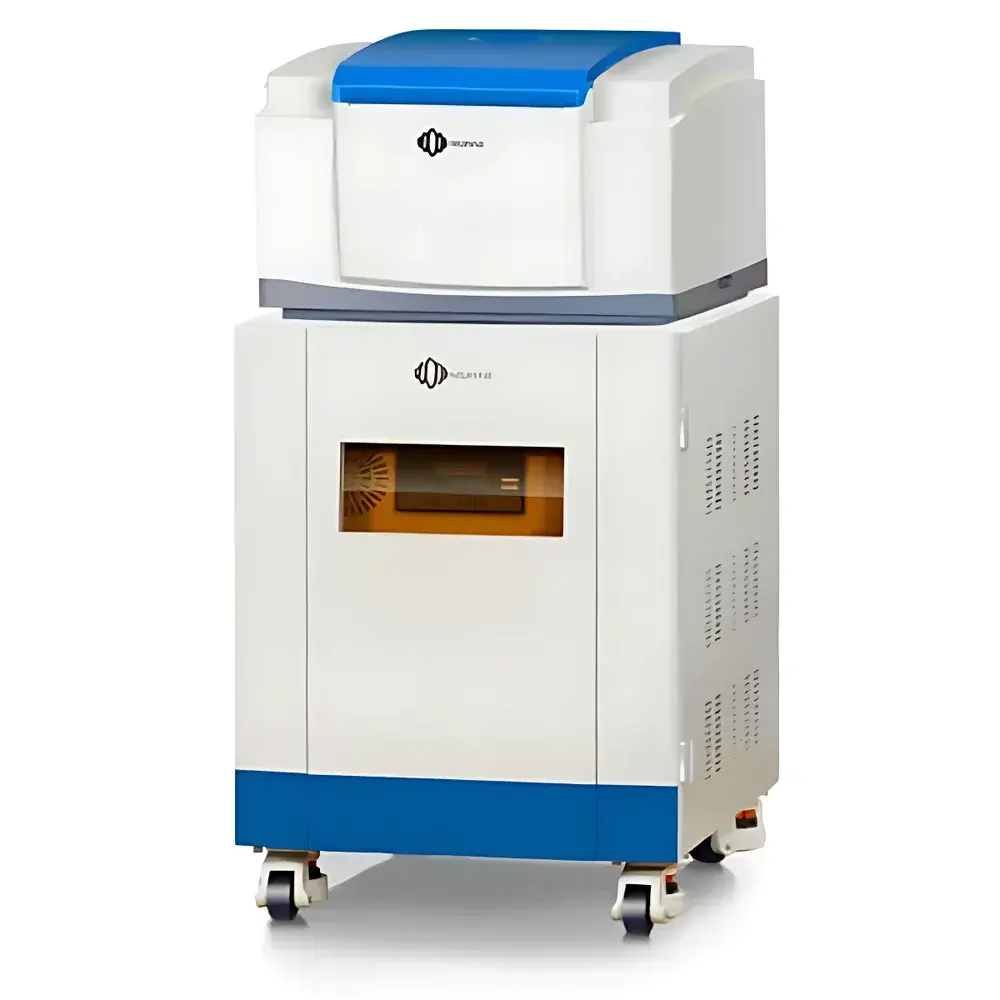
Niumag NMI20 Low-Field Nuclear Magnetic Resonance (LF-NMR) Analyzer for Adsorbed Water in Wood
| Brand | Niumag |
|---|---|
| Origin | Jiangsu, China |
| Manufacturer Type | Authorized Distributor |
| Region of Origin | Domestic (China) |
| Model | NMI20 |
| Pricing | Upon Request |
Overview
The Niumag NMI20 Low-Field Nuclear Magnetic Resonance (LF-NMR) Analyzer is a dedicated benchtop instrument engineered for non-destructive, quantitative characterization of water states in lignocellulosic materials—particularly adsorbed water in wood. Unlike conventional gravimetric or Karl Fischer methods, LF-NMR exploits the intrinsic magnetic properties of hydrogen nuclei (1H) in water molecules to differentiate water populations based on their molecular mobility and local microenvironment. In wood, this enables discrimination among free water (bulk-like, high mobility), adsorbed water (bound to cellulose/hemicellulose hydroxyl groups and confined within microcapillary networks of the cell wall), and bound (chemically associated) water—though the latter contributes minimally to total moisture content. The NMI20 operates at a static magnetic field strength of ~0.5 T (21.3 MHz 1H Larmor frequency), optimized for robust signal-to-noise ratio in heterogeneous, low-mobility samples while maintaining compact footprint and operational stability under ambient laboratory conditions.
Key Features
- Integrated T2 relaxometry and 1D/2D magnetic resonance imaging (MRI) capability for spatially resolved moisture mapping
- Custom-designed 25 mm diameter RF probe coil with homogeneous B1 field distribution, optimized for small-volume solid wood specimens (typical sample volume: 10 mL)
- Time-domain NMR acquisition with CPMG (Carr–Purcell–Meiboom–Gill) pulse sequence for accurate transverse relaxation time (T2) distribution analysis
- Non-invasive, non-destructive measurement—samples remain intact before, during, and after analysis; repeatable measurements on identical specimens across hydration/dehydration cycles
- Temperature-controlled sample compartment (optional accessory) supporting controlled hygroscopic experiments from 5 °C to 60 °C
- Pre-calibrated T2–moisture content correlation models for common wood species (e.g., Pinus sylvestris var. mongolica), validated against ASTM D4442 and ISO 3130 reference methods
Sample Compatibility & Compliance
The NMI20 accommodates solid, anisotropic, and hygroscopically active samples including raw timber, sawn lumber, veneer, bamboo, particleboard, MDF, and fiberboard—provided dimensional fit within the 25 mm coil aperture and minimal metallic contamination. Sample preparation requires only uniform cross-sectioning (e.g., 20 × 20 × 10 mm prisms) without drying, coating, or chemical treatment. The system complies with IEC 61000-6-3 (EMC emission standards) and meets CE safety directives. Data acquisition protocols align with GLP principles: full audit trail, user authentication, electronic signatures (via optional software module), and compliance-ready reporting for ISO/IEC 17025-accredited laboratories. While not FDA 21 CFR Part 11–certified out-of-the-box, the software architecture supports configuration for regulated environments upon validation.
Software & Data Management
Controlled via Niumag’s proprietary MultiQ™ NMR Analysis Suite (Windows-based), the NMI20 provides real-time spectral visualization, automated T2 inversion (non-negative least squares), peak deconvolution, and moisture quantification using area-integrated T2 distributions. Calibration curves (e.g., T2 spectral area vs. gravimetric moisture content) are stored per material type and can be exported in CSV, TXT, or HDF5 formats. Raw FID data and processed spectra are archived with metadata (date/time, operator ID, temperature, pulse sequence parameters). The software supports batch processing, comparative overlay of multiple samples, and generation of moisture gradient profiles across 2D MRI slices—enabling longitudinal studies of moisture migration kinetics during drying or conditioning.
Applications
- Quantifying adsorbed water content and its hysteresis behavior during sorption/desorption isotherms (per ISO 13061-1)
- Delineating the free water–adsorbed water transition point via bimodal T2 distribution analysis
- Evaluating cell wall saturation level as a predictor of dimensional stability and mechanical property degradation
- Validating predictive models of wood drying stress and checking for case-hardening onset
- Assessing efficacy of preservative treatments or surface modifications on water ingress resistance
- Supporting development of moisture-responsive smart wood composites and bio-based sensors
FAQ
How does the NMI20 distinguish adsorbed water from free water?
It resolves distinct T2 relaxation components: free water exhibits longer T2 (>50 ms), while adsorbed water shows shorter T2 (1–20 ms) due to restricted mobility and enhanced dipolar coupling near polysaccharide surfaces.
Can the NMI20 analyze green timber with high moisture content?
Yes—its dynamic range accommodates moisture contents from 5% to >200% (oven-dry basis), with no upper limit imposed by signal saturation.
Is calibration required for each wood species?
Initial species-specific calibration is recommended for highest accuracy; however, transfer functions between anatomically similar species (e.g., softwoods) can be applied with ≤±1.2% absolute moisture error.
What maintenance does the NMI20 require?
No cryogens or vacuum systems—only periodic shimming verification, RF coil tuning, and routine environmental monitoring (temperature/stability); annual performance qualification per ISO/IEC 17025 Annex A.3 is advised.





