
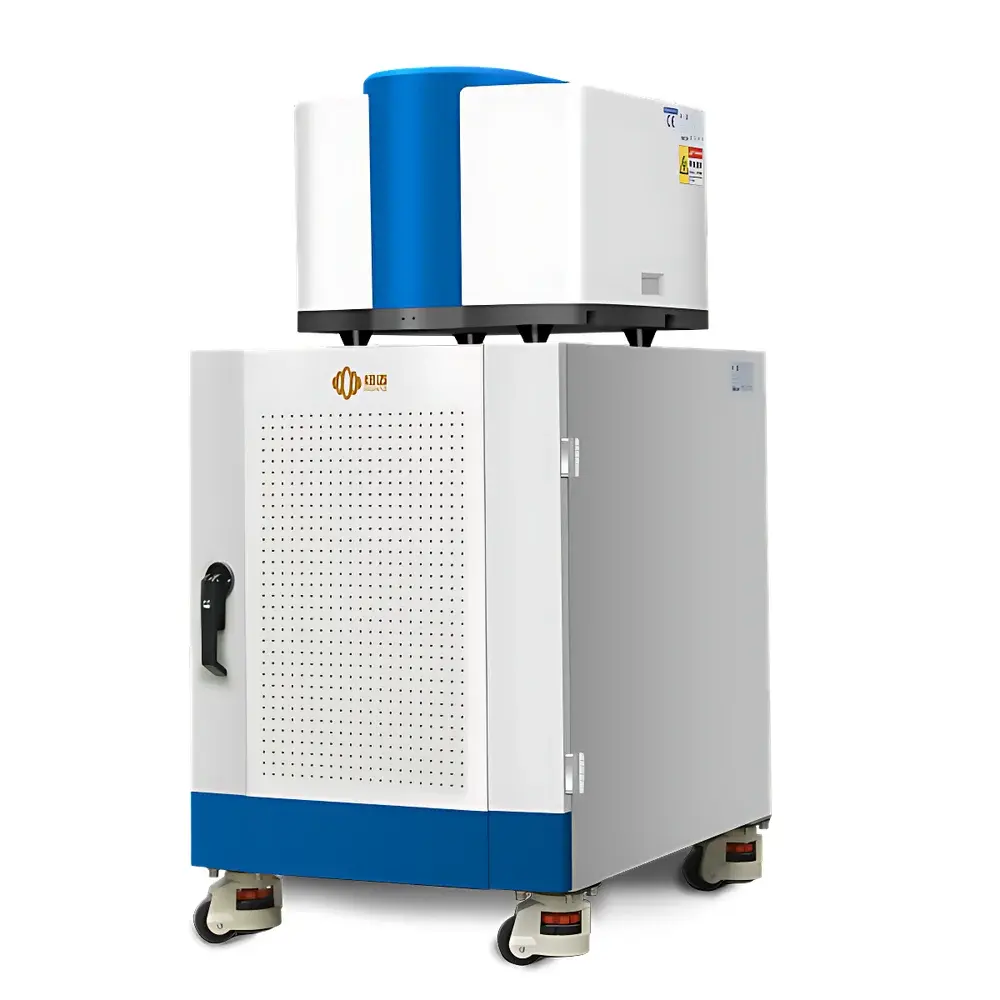
NIUMAG PQ001-17 Low-Field Nuclear Magnetic Resonance Hydrogen Content Analyzer for Sustainable Aviation Fuel (SAF)
| Brand | NIUMAG |
|---|---|
| Origin | Jiangsu, China |
| Instrument Type | Low-Field NMR Spectrometer |
| Model | PQ001-17 |
| Magnet Type | Permanent Magnet |
| Static Magnetic Field Strength | 0.5 T ± 0.03 T |
| Magnetic Field Homogeneity | ≤30 ppm |
| Sample Compatibility | Solid-Liquid Dual-Mode |
| Applicable Standards | ASTM D3701, SH/T 0658–1998 |
| Application Scope | Petroleum distillates (naphtha to vacuum gas oil), aviation turbine fuels, middle distillate fuels |
Overview
The NIUMAG PQ001-17 Low-Field Nuclear Magnetic Resonance (LF-NMR) Hydrogen Content Analyzer is engineered for rapid, non-destructive, and quantitative determination of total hydrogen content in Sustainable Aviation Fuel (SAF) and related hydrocarbon-based liquid fuels. Unlike conventional combustion-based or elemental analysis methods, this instrument leverages the intrinsic magnetic resonance properties of 1H nuclei under a stable, low-intensity static magnetic field (0.5 T). When exposed to a precisely tuned radiofrequency (RF) pulse sequence, hydrogen protons in the fuel matrix undergo excitation and subsequent relaxation—emitting detectable RF signals whose integrated amplitude correlates linearly with the number of hydrogen atoms present. This physical principle eliminates dependence on chemical reagents, sample digestion, or destructive thermal decomposition. The system is calibrated using reference standards with certified hydrogen mass fractions, enabling traceable, repeatable quantification across diverse SAF feedstocks—including hydroprocessed esters and fatty acids (HEFA), Fischer–Tropsch synthetic paraffinic kerosene (SPK), and alcohol-to-jet (ATJ) blends.
Key Features
- Non-invasive measurement: Requires only 2–5 mL of neat liquid fuel; no derivatization, dilution, or solvent addition.
- High throughput: Typical analysis time per sample is under 90 seconds, supporting real-time process monitoring and high-volume batch screening.
- Robust permanent magnet architecture: Delivers stable field homogeneity (≤30 ppm over 10 mm DSV) without cryogens or active shimming.
- Dual-mode capability: Validated for both liquid-phase fuels and semi-solid intermediates (e.g., hydrotreated bio-oils, wax-containing SPK fractions).
- ASTM D3701-compliant methodology: Fully aligned with industry-accepted standard test method for hydrogen content in aviation turbine fuels.
- Integrated temperature control (±0.1 °C): Ensures signal stability across ambient fluctuations during extended operation.
Sample Compatibility & Compliance
The PQ001-17 accommodates a broad range of petroleum-derived and bio-synthetic hydrocarbon liquids, including Jet A-1, Jet A, JP-8, HEFA-SAF, FT-SPK, and blended SAF formulations up to 50% v/v. It is validated for samples with kinematic viscosity ≤8 mm²/s at 20 °C and density between 750–840 kg/m³. All measurements comply with ASTM D3701 (Standard Test Method for Hydrogen Content of Aviation Turbine Fuels by Low-Field Pulsed NMR) and Chinese standard SH/T 0658–1998. Data integrity adheres to GLP-aligned practices: audit trails record operator ID, calibration history, pulse sequence parameters, and raw FID acquisition metadata. While not FDA 21 CFR Part 11-certified out-of-the-box, the software architecture supports configurable electronic signatures and data export formats compatible with regulated laboratory information management systems (LIMS).
Software & Data Management
Control and analysis are performed via NIUMAG’s proprietary NMIView™ software suite (v4.2+), running on Windows 10/11 platforms. The interface provides real-time visualization of free induction decay (FID) curves, T2 distribution spectra, and integrated signal amplitude plots. Calibration models are stored as encrypted .cal files with version timestamps and user-defined uncertainty budgets. Raw data (.dat) and processed reports (.pdf/.xlsx) are automatically archived with ISO 8601 timestamps and SHA-256 checksums. Batch reporting supports customizable templates compliant with internal QA documentation requirements. Remote diagnostics and firmware updates are enabled via secure TLS 1.2 channels; all communications are logged for traceability.
Applications
- SAF production QC: Rapid verification of hydrogen content against specification limits (e.g., ASTM D7566 Annex A1, D1655 Table 1) prior to blending or certification.
- Feedstock screening: Discrimination of hydrogen saturation levels in crude bio-oils from different lipid sources (used cooking oil, camelina, tallow) to predict hydrotreating severity requirements.
- Process optimization: In-line monitoring of hydrogenation degree during catalytic hydrodeoxygenation (HDO) of pyrolysis oils or Fischer–Tropsch wax fractionation.
- Blending ratio validation: Quantitative assessment of hydrogen content deviation in 10–50% SAF/jet fuel blends to ensure combustion stability and soot index compliance.
- Research & development: Correlation studies between 1H NMR signal intensity, molecular H/C ratio, net heat of combustion (MJ/kg), and particulate matter emissions in combustor rig testing.
FAQ
Is the PQ001-17 suitable for measuring hydrogen content in solid or highly viscous SAF precursors?
Yes — the instrument supports solid-liquid dual-mode operation. Samples with Brookfield viscosity up to 500 cP at 40 °C can be analyzed using optimized CPMG echo train parameters and extended signal averaging.
How frequently must the system be recalibrated?
Calibration stability is verified daily using a sealed reference standard. Full multi-point calibration is recommended every 30 days or after hardware maintenance, following ASTM D3701 Section 8 procedures.
Does the analyzer require external cooling or compressed air?
No — the permanent magnet design operates passively at ambient temperatures between 15–30 °C. No auxiliary utilities beyond standard AC power (220 V ±10%, 50 Hz) are required.
Can raw NMR data be exported for third-party spectral processing?
Yes — time-domain FID data (.txt format) and processed T2 distributions (.csv) are fully exportable without license restrictions.
What service coverage does NIUMAG provide outside mainland China?
NIUMAG partners with authorized regional service providers in Southeast Asia, the Middle East, and Latin America. On-site support timelines vary by territory and are detailed in the international service agreement.



