
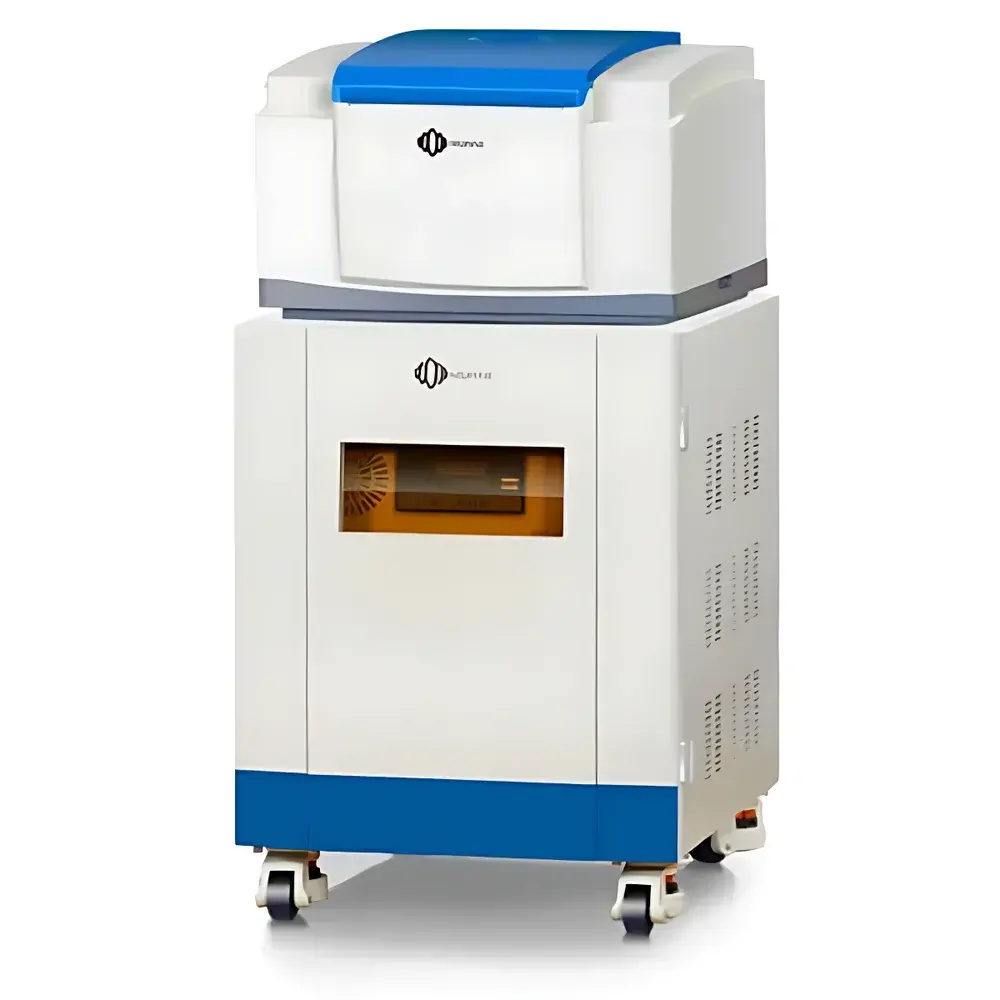
NIUMAG PQ001 Low-Field Nuclear Magnetic Resonance Analyzer for Gelation and Curing Kinetics in Semi-Solid-State Battery Electrolytes
| Brand | NIUMAG |
|---|---|
| Origin | Jiangsu, China |
| Instrument Type | Low-Field NMR Spectrometer |
| Sample Mode | Solid–Liquid Hybrid (Gel-State Electrolytes) |
| Operating Principle | Pulsed Fourier Transform NMR |
| Magnetic Field Strength | 0.5 T |
| Probe Coil Diameter Options | 25 mm |
| Sample Restriction | Ferromagnetic Content < 5% wt |
Overview
The NIUMAG PQ001 is a purpose-built low-field nuclear magnetic resonance (LF-NMR) analyzer engineered for quantitative, non-invasive characterization of gelation and curing dynamics in semi-solid-state battery electrolytes. Unlike high-field NMR systems optimized for molecular structure elucidation, the PQ001 leverages robust 0.5 T permanent magnet architecture and pulsed Fourier transform (PFT) methodology to resolve hydrogen proton (1H) spin–lattice (T1) and spin–spin (T2) relaxation behaviors in heterogeneous polymer–solvent networks. In gel-forming electrolyte systems—such as polyacrylonitrile (PAN), polyethylene oxide (PEO), or polyvinylidene fluoride–hexafluoropropylene (PVDF-HFP) blended with lithium salts—the mobility and local environment of hydrogen-bearing species (e.g., –CH2–, –OH, solvent molecules) evolve systematically during crosslinking, phase separation, or thermal curing. These changes directly modulate transverse relaxation times (T2 distributions), enabling precise, time-resolved tracking of sol–gel transition, network formation, and degree of crosslinking—without chemical labeling or destructive sectioning.
Key Features
- Optimized for in situ and real-time monitoring of gelation kinetics under controlled temperature (optional integrated Peltier stage) and time-course conditions
- Dual-probe compatibility: Interchangeable 25 mm and 40 mm diameter radiofrequency coils to accommodate vial-based small-volume samples (0.5–3 mL) or larger-format pouch-cell mockups (with custom fixtures)
- Pulse sequence flexibility: Supports CPMG (Carr–Purcell–Meiboom–Gill) for high-fidelity T2 mapping, inversion recovery for T1 quantification, and diffusion-weighted sequences for probing segmental mobility
- Non-destructive analysis: Enables repeated measurements on identical sample batches across multiple curing stages—critical for DoE (Design of Experiments) workflows in formulation development
- Robust hardware architecture: Permanent magnet system with passive shimming; no cryogens, no superconducting infrastructure; operational stability compliant with ISO/IEC 17025 environmental tolerance specifications
Sample Compatibility & Compliance
The PQ001 accepts gel-state electrolyte samples in standard NMR tubes (5 mm OD), sealed glass vials, or custom aluminum sample holders. Samples must contain <5% ferromagnetic impurities by weight to prevent field distortion and signal dephasing. Compatible chemistries include but are not limited to: lithium-ion conductive gels (e.g., LiTFSI in PEO–EC/PC blends), sodium-ion gel electrolytes (e.g., NaPF6 in PAN–DMF), and solid–liquid hybrid catholytes. The instrument meets electromagnetic compatibility (EMC) requirements per IEC 61326-1 and safety standards per IEC 61010-1. Data acquisition and processing protocols support audit-ready documentation aligned with GLP and GMP principles, including user authentication, electronic signatures, and full audit trail logging per FDA 21 CFR Part 11 guidelines.
Software & Data Management
Controlled via NIUMAG’s proprietary MesoMR Studio software (v4.2+), the PQ001 provides integrated pulse programming, automated parameter optimization, and multi-exponential T2 inverse Laplace transformation using non-negative least squares (NNLS) algorithms. Raw FID data and processed relaxation spectra are stored in vendor-neutral HDF5 format. Batch processing supports statistical comparison across formulation libraries, with built-in tools for correlation analysis between T2 centroid shifts, distribution width (polydispersity index), and external metrics (e.g., ionic conductivity, DSC onset temperature, rheological G′). Export options include CSV, MATLAB .mat, and PDF reports compliant with internal QA/QC templates.
Applications
- Quantitative evaluation of gelation onset time and completion kinetics under varying thermal profiles (e.g., 40–80 °C ramping)
- Screening of crosslinker concentration, initiator type, and monomer ratio effects on network homogeneity
- Correlating T2 distribution parameters with electrochemical performance indicators: interfacial resistance (EIS), cycle life retention, and dendrite suppression efficacy
- Accelerated aging studies: Monitoring structural degradation of cured gels under elevated temperature/humidity stress
- Supporting ASTM D7904 (Standard Practice for NMR Analysis of Polymer Gels) and ISO 18473-3 (Fillers for elastomers — Silica — Part 3: Determination of surface area by NMR)
FAQ
What sample volume is required for reliable T2 quantification?
Minimum recommended volume is 0.8 mL for the 25 mm coil and 1.5 mL for the 40 mm coil. Signal-to-noise ratio scales linearly with active sample volume within the RF coil’s homogeneous region.
Can the PQ001 distinguish between bound and free solvent fractions?
Yes—multi-component T2 decay analysis resolves at least three distinct proton populations: immobilized polymer-bound protons (T2 < 1 ms), intermediate-chain segment protons (T2 = 1–50 ms), and bulk-like solvent protons (T2 > 50 ms), enabling calculation of effective solvation number per repeat unit.
Is calibration required before each measurement series?
No routine calibration is needed. System stability is verified daily using a reference glycerol–water phantom; drift in T2 baseline remains <±0.3% over 8-hour operation.
Does the instrument support temperature-controlled curing experiments?
Yes—when paired with the optional Peltier-based sample holder (–10 to +120 °C, ±0.1 °C stability), time-resolved T2 acquisition can be synchronized with programmable thermal ramps.
How does LF-NMR compare to rheology for gel point detection?
While rheology measures macroscopic mechanical response (G′ = G″), LF-NMR detects nanoscale mobility transitions earlier—often identifying incipient network formation 5–15 minutes prior to crossover in oscillatory shear, making it ideal for early-stage screening.





