
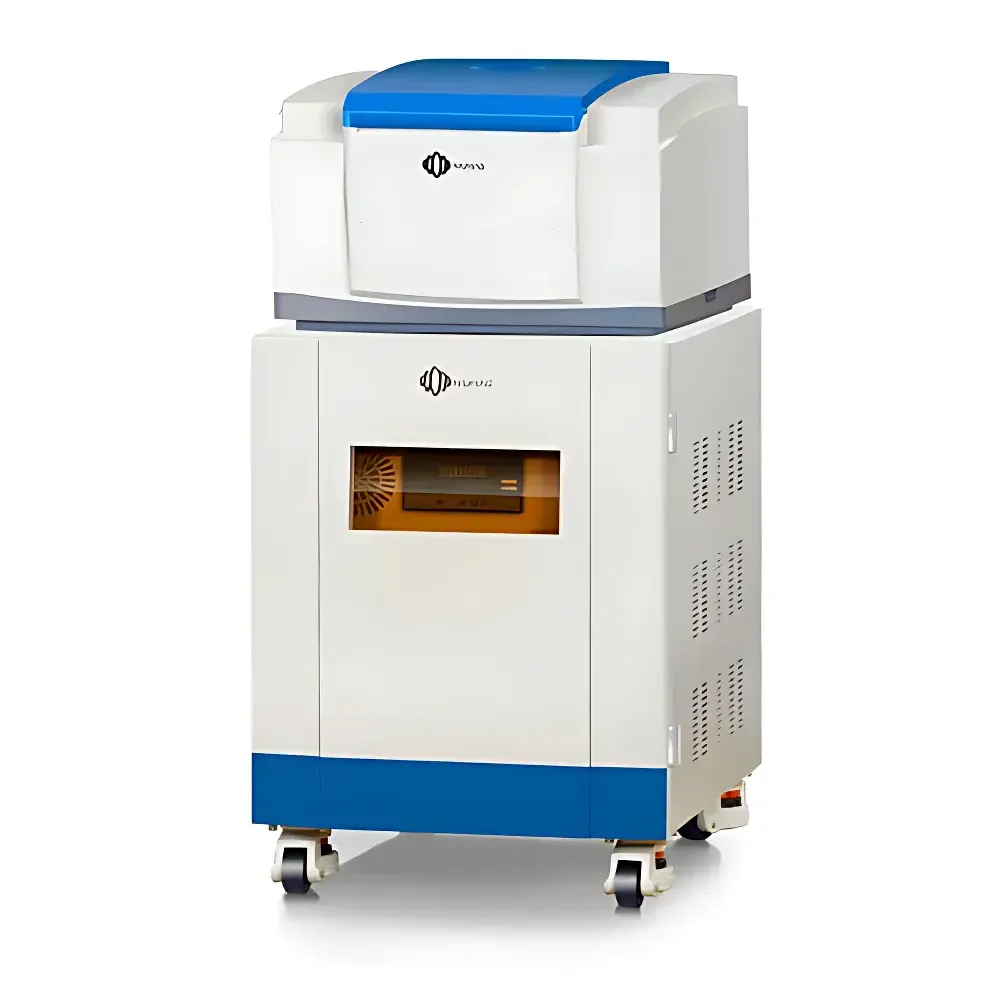
NIUMAG PQ001-N Low-Field Nuclear Magnetic Resonance Analyzer for Simultaneous Fat and Moisture Quantification in Infant Formula and Dairy Powders
| Brand | NIUMAG |
|---|---|
| Origin | Shanghai, China |
| Manufacturer Type | Authorized Distributor |
| Regional Classification | Domestic (PRC) |
| Model | PQ001-N |
| Instrument Category | Low-Field NMR Analyzer |
| Sample Compatibility | Solid-Liquid Hybrid (Powdered Dairy Products) |
| Magnet Type | Permanent Magnet |
| Static Magnetic Field Strength | 0.5 ± 0.08 T |
| RF Probe Coil Diameter | 25 mm |
Overview
The NIUMAG PQ001-N is a dedicated low-field nuclear magnetic resonance (LF-NMR) analyzer engineered for rapid, non-destructive, and reagent-free quantification of fat and moisture content in infant formula, skimmed milk powder, whole milk powder, and related dairy-based powdered products. Operating on the fundamental principles of spin–lattice (T₁) and spin–spin (T₂) relaxation time analysis, the instrument exploits the distinct proton mobility differences between bound water, free water, and triglyceride protons in dry powder matrices. Under a stable 0.5 T permanent magnetic field, hydrogen nuclei (¹H) in fat and water phases exhibit measurably different transverse relaxation decay profiles—enabling unambiguous spectral deconvolution via multi-exponential fitting algorithms. This physical measurement approach eliminates reliance on solvent extraction (e.g., AOAC 991.36), gravimetric drying (AOAC 937.01), or near-infrared calibration drift, delivering intrinsic method robustness across batch-to-batch variability in particle size, crystallinity, and thermal history.
Key Features
- Permanent magnet architecture ensures field stability without cryogens, power supply fluctuations, or active shimming—ideal for QC laboratories with limited infrastructure.
- 25 mm diameter RF probe optimized for standard 15 mm OD glass or plastic NMR tubes, accommodating 0.5–2.0 g of homogeneous powdered samples with minimal packing density sensitivity.
- Integrated temperature-controlled sample chamber (±0.5 °C) minimizes relaxation time drift during sequential analysis, supporting GLP-compliant repeatability.
- Pre-calibrated fat/moisture quantification modules based on traceable reference standards (NIST SRM 1549a, AOCS Cd 1c-92 certified powders) reduce method development time.
- Rugged industrial-grade electronics with Ethernet and USB 3.0 interfaces support integration into LIMS environments and automated production line deployment.
Sample Compatibility & Compliance
The PQ001-N accepts intact, unprocessed dairy powders—including fortified formulas, whey protein isolates, and lactose-reduced blends—without grinding, sieving, or solvent addition. Its solid–liquid hybrid detection capability accommodates residual surface moisture (< 0.5% w/w) and bulk lipid phase distribution simultaneously. Method validation aligns with ISO 10565:1998 (oil and water content in oilseeds via NMR) and ASTM D7269-18 (low-field NMR for polymer moisture analysis), with documented correlation to AOAC Official Methods for dairy fat (989.02) and moisture (925.09). Full audit trail functionality complies with FDA 21 CFR Part 11 requirements for electronic records and signatures when paired with NIUMAG’s validated NMR-Studio v4.2 software.
Software & Data Management
NMR-Studio v4.2 provides ISO/IEC 17025-aligned workflow management: user-defined SOP templates, automatic baseline correction, T₂ decay inversion using non-negative least squares (NNLS), and dual-component peak area integration (fat vs. water proton pools). All raw FID data, processed T₂ spectra, calibration curves, and operator metadata are stored in encrypted SQLite databases with configurable retention policies. Export options include CSV, PDF analytical reports, and XML files compatible with enterprise SAP QM and LabWare LIMS platforms. Software validation packages—including IQ/OQ documentation, security configuration guides, and change control logs—are available upon request.
Applications
- Real-time release testing (RRT) of finished formula batches prior to packaging, reducing hold times by >70% versus traditional wet chemistry.
- Raw material screening of incoming milk powder lots for moisture-induced Maillard reaction risk (via T₂ shortening kinetics).
- Stability studies tracking lipid oxidation onset through progressive T₁/T₂ ratio shifts in accelerated shelf-life testing (ASLT) protocols.
- Process optimization of spray-drying parameters by correlating inlet/outlet air temperatures with measured surface hydration states.
- Regulatory submission support for health claims (e.g., “low-fat” or “reduced moisture”) under EFSA Panel on Dietetic Products guidelines.
FAQ
Does the PQ001-N require liquid nitrogen or helium cooling?
No. It utilizes a passively stabilized permanent magnet system operating at ambient temperature.
Can it differentiate between free water and bound water in奶粉 matrices?
Yes—via multi-exponential T₂ relaxation analysis, resolving components with characteristic decay times of ~1–10 ms (bound water), ~50–200 ms (capillary water), and ~300–800 ms (triglyceride protons).
Is method transfer possible between PQ001-N units across different sites?
Yes—provided identical probe geometry, field homogeneity verification (shim map upload), and standardized sample preparation SOPs are implemented.
What sample preparation is required for routine QC testing?
Minimal: 1.0 ± 0.1 g of representative powder is loaded into a standard 15 mm NMR tube and tapped gently to ensure consistent packing density.
How often does calibration verification need to be performed?
Daily system suitability checks using a sealed reference standard (NIUMAG RM-PF01) are recommended; full recalibration every 6 months or after major hardware maintenance.
Related Products





