
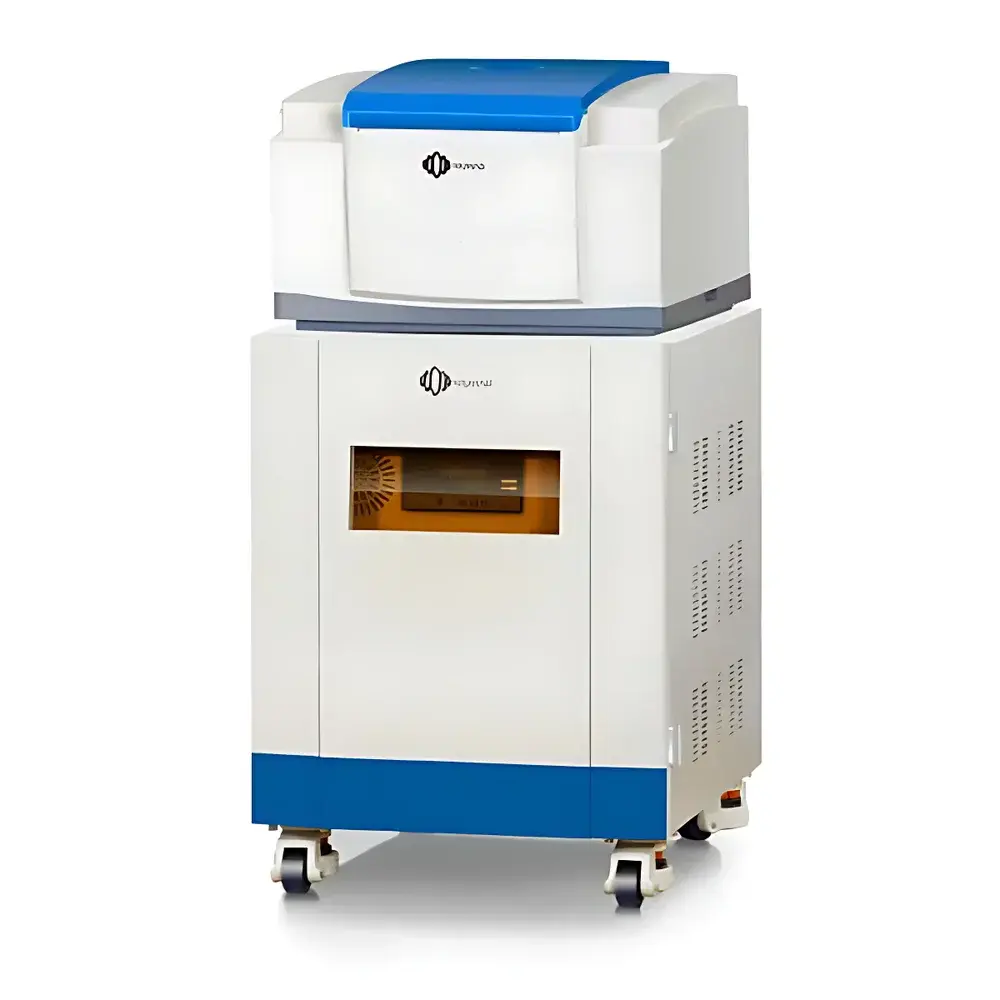
NIUMAG PQ001 Low-Field Nuclear Magnetic Resonance (LF-NMR) Gel Content Analyzer
| Brand | NIUMAG |
|---|---|
| Origin | Jiangsu, China |
| Manufacturer Type | Authorized Distributor |
| Instrument Type | Low-Field NMR Analyzer |
| Sample Type | Solid-Liquid Hybrid |
| Effective Detection Volume | Ø8.5 mm × H20 mm |
| Magnet Type | Permanent Magnet |
| Static Field Strength | 0.5 ± 0.05 T |
| Standard Temperature Range | Ambient to 130 °C |
| Optional High-Temp Module | Ambient to 200 °C |
| Optional Imaging Capability | Yes |
Overview
The NIUMAG PQ001 is a dedicated low-field nuclear magnetic resonance (LF-NMR) analyzer engineered for quantitative gel content determination in polymeric systems—including synthetic rubbers, thermoplastic elastomers, crosslinked polymers, and composite materials. Unlike destructive solvent extraction methods (e.g., ASTM D3616 or ISO 1795), the PQ001 leverages the fundamental principle of transverse relaxation time (T2) contrast between mobile (soluble) and immobilized (gel-phase) proton populations. In crosslinked networks, polymer chains restrict molecular mobility; this restriction shortens the observed T2 decay of bound protons, enabling robust discrimination without chemical dissolution. The system operates at a static field strength of 0.5 ± 0.05 T—optimized to balance signal-to-noise ratio, thermal stability, and cost-effective permanent magnet architecture. Its compact benchtop design supports integration into QC laboratories, R&D facilities, and production environments where rapid, non-invasive assessment of crosslink density and network integrity is critical.
Key Features
- Non-destructive, solvent-free analysis: Eliminates hazardous solvent use, disposal costs, and inter-laboratory variability associated with gravimetric extraction.
- Rapid turnaround: Full gel content quantification completed in ≤120 seconds per sample, supporting high-throughput screening of formulation batches.
- Temperature-controlled measurement: Standard temperature stage enables testing from ambient to 130 °C; optional extended-range module extends operational capability to 200 °C for high-Tg elastomers and thermosets.
- Robust solid–liquid compatibility: Accommodates heterogeneous samples—including rubber compounds with fillers (e.g., carbon black, silica), plasticized blends, and hydrogel matrices—within a defined detection volume of Ø8.5 mm × 20 mm height.
- Modular expandability: Optional NMR imaging (MRI) add-on permits spatial mapping of gel distribution, phase segregation, or moisture migration in layered or anisotropic materials.
Sample Compatibility & Compliance
The PQ001 accepts intact solid specimens, granules, pellets, and viscous suspensions without preprocessing. Its RF coil geometry and pulse sequence calibration are validated for heterogeneous polymer systems compliant with ISO 1795 (rubber—determination of gel content), ASTM D6204 (standard test method for rubber—determination of gel content by solvent extraction), and internal QC protocols aligned with GLP principles. While not a regulated medical device, its data acquisition architecture supports audit-ready operation: all acquisitions are timestamped, user-logged, and stored with full metadata (pulse sequence parameters, temperature setpoint, shimming status). When integrated with enterprise LIMS, raw FID data and processed T2 distributions meet traceability requirements under FDA 21 CFR Part 11 when paired with appropriate electronic signature controls.
Software & Data Management
The instrument is operated via NIUMAG’s proprietary MesoMR software suite, which provides intuitive workflow-driven interfaces for method setup, real-time acquisition monitoring, and automated T2 inversion analysis using non-negative least squares (NNLS) algorithms. Calibration curves are generated from reference standards (e.g., known gel fractions prepared via solvent extraction) and stored with version control. All datasets—including raw time-domain signals, inverted T2 spectra, and derived gel content percentages—are exportable in CSV, TXT, and HDF5 formats. Software logs retain full experimental history, including operator ID, environmental conditions, and hardware diagnostic flags—facilitating root-cause analysis during method validation or regulatory review.
Applications
- Quality control of SBR, BR, EPDM, and silicone rubber compounds during compounding and vulcanization.
- Accelerated aging studies: Monitoring gel fraction evolution under thermal or oxidative stress.
- Formulation optimization: Screening crosslinking agents (peroxides, sulfur systems) and accelerator packages.
- Recycled rubber characterization: Quantifying residual crosslink density in devulcanized crumb rubber.
- Hydrogel and biomaterial development: Assessing network homogeneity and swelling kinetics via T2 mapping.
FAQ
What physical property does the PQ001 measure to determine gel content?
It measures the transverse relaxation time (T2) distribution of hydrogen nuclei (¹H) to distinguish between mobile (sol fraction) and restricted (gel fraction) proton populations.
Can the PQ001 replace ASTM D3616 or ISO 1795 in regulatory submissions?
It serves as a validated alternative method when correlated against reference extraction procedures; formal method equivalence requires in-house correlation studies per ICH Q2(R2) guidelines.
Is sample preparation required before measurement?
No cutting, drying, or solvent treatment is needed—samples are placed directly into the standard 10 mm OD tube compatible with the Ø8.5 mm × 20 mm detection zone.
Does the system require liquid helium or cryogens?
No—its permanent magnet design eliminates cryogenic maintenance, reducing total cost of ownership and facility infrastructure requirements.
How is temperature uniformity ensured across the sample volume?
A calibrated Peltier-based heating/cooling stage with dual-point RTD feedback maintains ±0.5 °C stability within the active detection region during dynamic temperature ramps.
Related Products




