
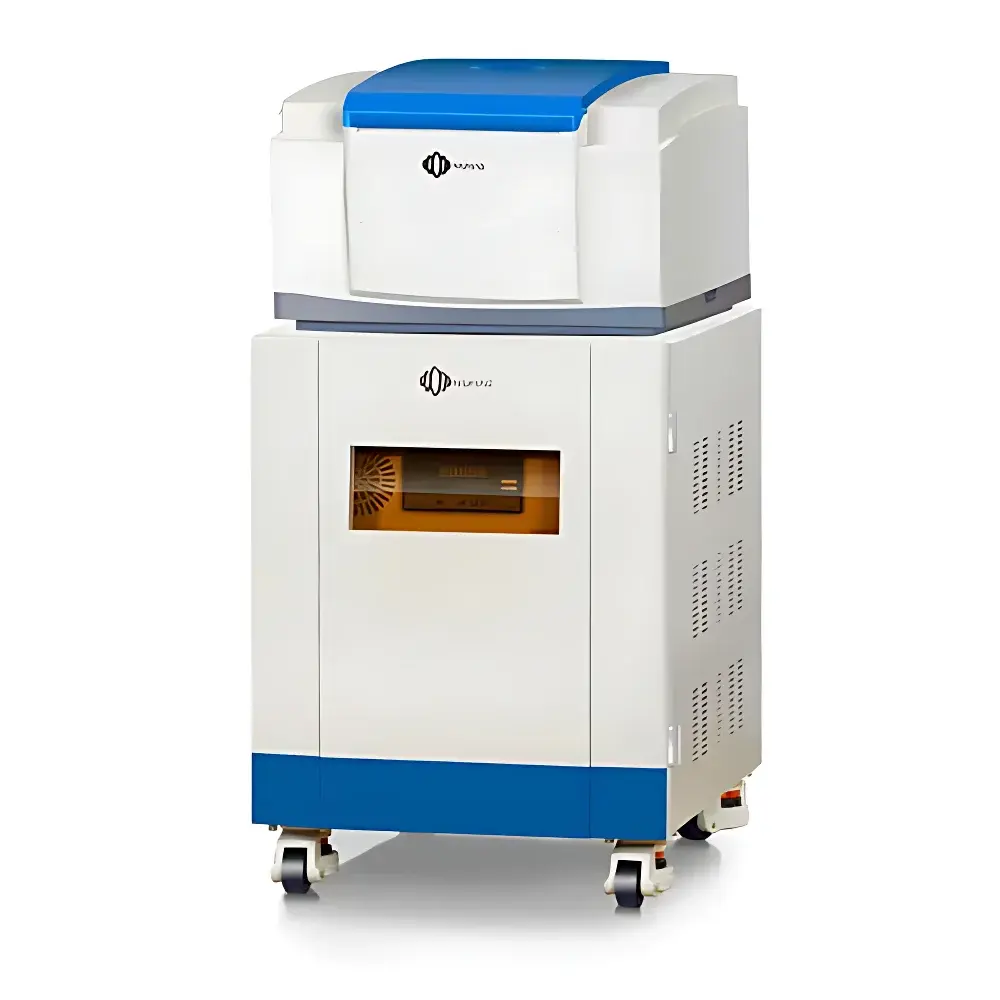
NIUMAG PQ001-NMR01 Benchtop Low-Field NMR Analyzer for API Polymorph Quantification
| Brand | NIUMAG |
|---|---|
| Origin | Jiangsu, China |
| Manufacturer Type | Authorized Distributor |
| Origin Category | Domestic |
| Model | PQ001-NMR01 |
| Pricing | Upon Request |
| Magnet Type | Permanent Magnet |
| Static Magnetic Field Strength | 0.5 ± 0.08 T |
| Larmor Frequency (¹H) | 21.3 MHz |
| Probe Coil Diameter | 10 mm |
| Effective Sample Volume | Ø10 mm × H20 mm |
| Nuclei Supported | ¹H, ¹⁹F |
| Quantification Range | 10–90 wt% per component |
| Sample Form | Solid APIs (powders, granules, compacts), no requirement for homogeneity or mechanical uniformity |
Overview
The NIUMAG PQ001-NMR01 is a benchtop low-field nuclear magnetic resonance (LF-NMR) analyzer engineered specifically for quantitative polymorph characterization of active pharmaceutical ingredients (APIs). Unlike high-field NMR systems requiring cryogenic cooling and specialized infrastructure, this instrument operates at a static magnetic field of 0.5 ± 0.08 T (21.3 MHz for 1H), enabling robust, routine quantification of crystalline and amorphous phases in solid-state drug substances without sample dissolution or derivatization. Its core measurement principle relies on spin-lattice relaxation time (T1) saturation recovery (SR) profiling — a technique sensitive to molecular mobility, crystal lattice rigidity, and hydrogen-bonding environments. By acquiring reference T1 decay curves from pure polymorphic standards and applying multivariate curve resolution (MCR) or linear superposition modeling, the system delivers reproducible, calibration-based quantitation of coexisting polymorphs in binary or ternary solid mixtures. Designed for integration into pharmaceutical development labs, QC/QA units, and formulation R&D workflows, the PQ001-NMR01 supports ICH Q5A and Q6A guidance frameworks for structural characterization and specification setting of solid dosage forms.
Key Features
- Benchtop footprint (W × D × H ≈ 450 × 380 × 320 mm) with integrated magnet, probe, and console — requires no external chiller, helium refills, or RF-shielded room.
- Permanent magnet architecture ensures long-term field stability (<±0.01% drift/year) and eliminates dependency on power-supplied electromagnets.
- Dual-nucleus capability (¹H and ¹⁹F) via interchangeable probe coils — particularly valuable for fluorinated APIs (e.g., fluoroquinolones, corticosteroids) where ¹⁹F offers enhanced chemical shift dispersion and negligible background interference.
- No sample preparation required: raw powders, milled granules, tablet cores, or lyophilized cakes can be loaded directly into standard 10-mm OD glass tubes; no grinding, sieving, or solvent exposure needed.
- Quantitative accuracy validated across 10–90 wt% concentration range with typical repeatability (RSD) <2.5% for inter-day measurements under GLP-aligned operating conditions.
- Embedded temperature control module (ambient to +60 °C, ±0.5 °C) enables thermal stability profiling — e.g., monitoring polymorphic transitions during controlled heating ramps.
Sample Compatibility & Compliance
The PQ001-NMR01 accepts solid-phase API samples in powder, pellet, or compacted form, accommodating heterogeneous matrices such as co-processed excipients, spray-dried dispersions, or hot-melt extrudates. It does not require optical transparency, electrical conductivity, or mechanical isotropy — making it suitable for real-world manufacturing intermediates. The instrument complies with ISO/IEC 17025:2017 general requirements for competence of testing and calibration laboratories. Data acquisition and reporting modules support audit trails, electronic signatures, and user access levels aligned with FDA 21 CFR Part 11 and EU Annex 11 expectations. All calibration protocols and SR curve libraries are documented per ICH Q2(R2) guidelines for analytical procedure validation.
Software & Data Management
The proprietary NMIQ software suite features an English/Chinese bilingual interface with role-based access control (administrator, analyst, reviewer). Core modules include: (1) Pulse sequence editor for custom SR, CPMG, or inversion-recovery experiments; (2) Reference library builder for storing and managing polymorph-specific T1 fingerprints; (3) Quantitative analysis engine using constrained non-negative least squares (NNLS) fitting; (4) Batch processing dashboard for multi-sample throughput; and (5) PDF report generator compliant with ALCOA+ principles (Attributable, Legible, Contemporaneous, Original, Accurate, Complete, Consistent, Enduring, Available). Raw FID data and processed parameter sets (.nmiq format) are stored with embedded metadata (operator ID, timestamp, instrument serial, environmental conditions).
Applications
- Quantification of Form I vs. Form II ratios in crystalline API batches during polymorph screening and selection.
- Stability-indicating assay for detecting amorphous content growth during accelerated storage (40 °C/75% RH) or mechanical stress (milling, compression).
- In-process monitoring of solvent-mediated phase transformation during crystallization or antisolvent precipitation.
- Verification of polymorphic identity and purity in API release testing against pharmacopoeial monographs (USP , Ph. Eur. 2.2.47).
- Supporting regulatory submissions with orthogonal, non-destructive data complementary to PXRD, DSC, and FTIR.
FAQ
Can the PQ001-NMR01 distinguish between hydrates and anhydrates?
Yes — differences in proton mobility and hydrogen-bonding networks yield distinct T1 and T2 relaxation signatures, enabling discrimination of stoichiometric hydrates (e.g., monohydrate vs. dihydrate) and detection of residual solvates.
Is method transfer possible from high-field NMR to this low-field platform?
While absolute chemical shift values differ, the underlying relaxation contrast mechanisms are physically conserved; validated methods can be re-optimized using reference standards without redeveloping full analytical procedures.
Does the system require daily shimming or lock channel adjustment?
No — the permanent magnet design provides inherent field homogeneity sufficient for T1-based quantitation; no active shimming or deuterium lock is implemented or necessary.
What is the minimum sample mass required for reliable quantitation?
For 10-mm diameter tubes, ≥150 mg of representative bulk material is recommended to ensure adequate signal-to-noise ratio and statistical representativeness across heterogeneous lots.
How is instrument performance verified over time?
NIUMAG supplies a certified reference standard (e.g., polyethylene glycol blend with known polymorph composition) for quarterly system suitability testing; results are logged in the instrument’s maintenance history database.
Related Products




