
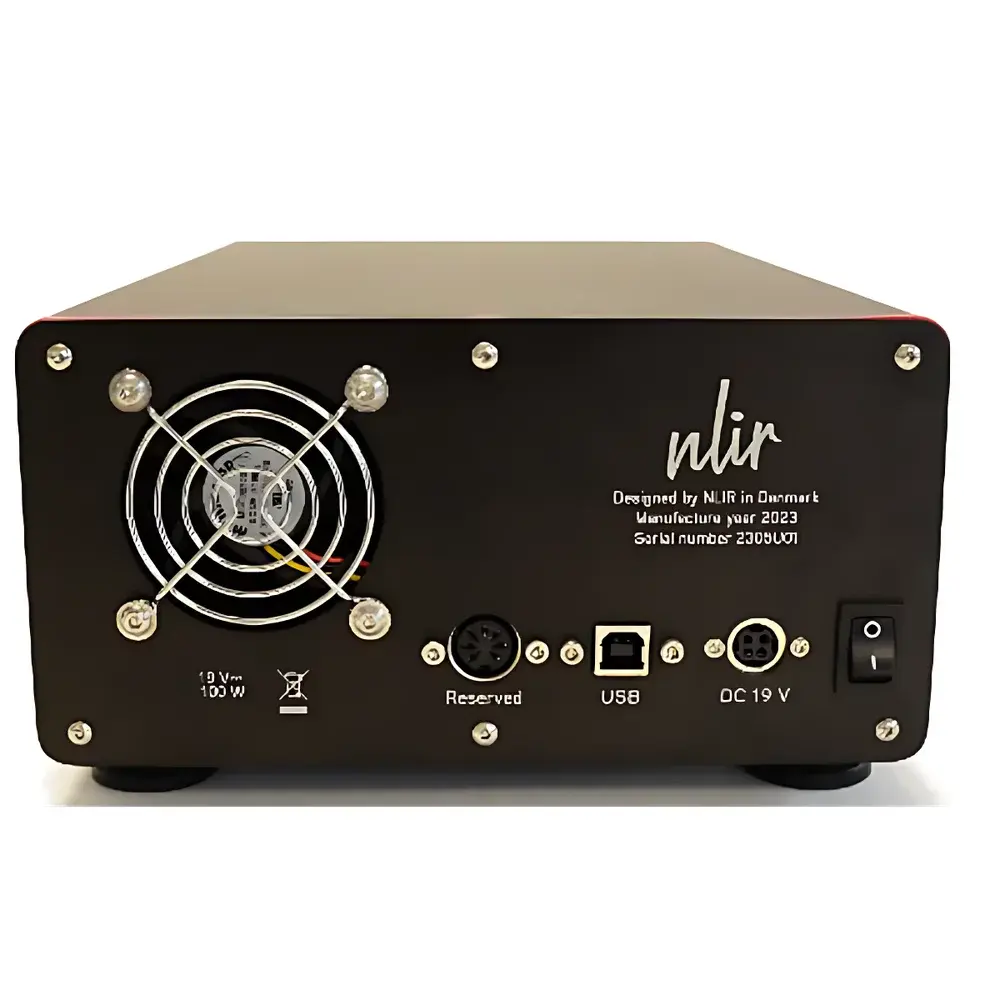
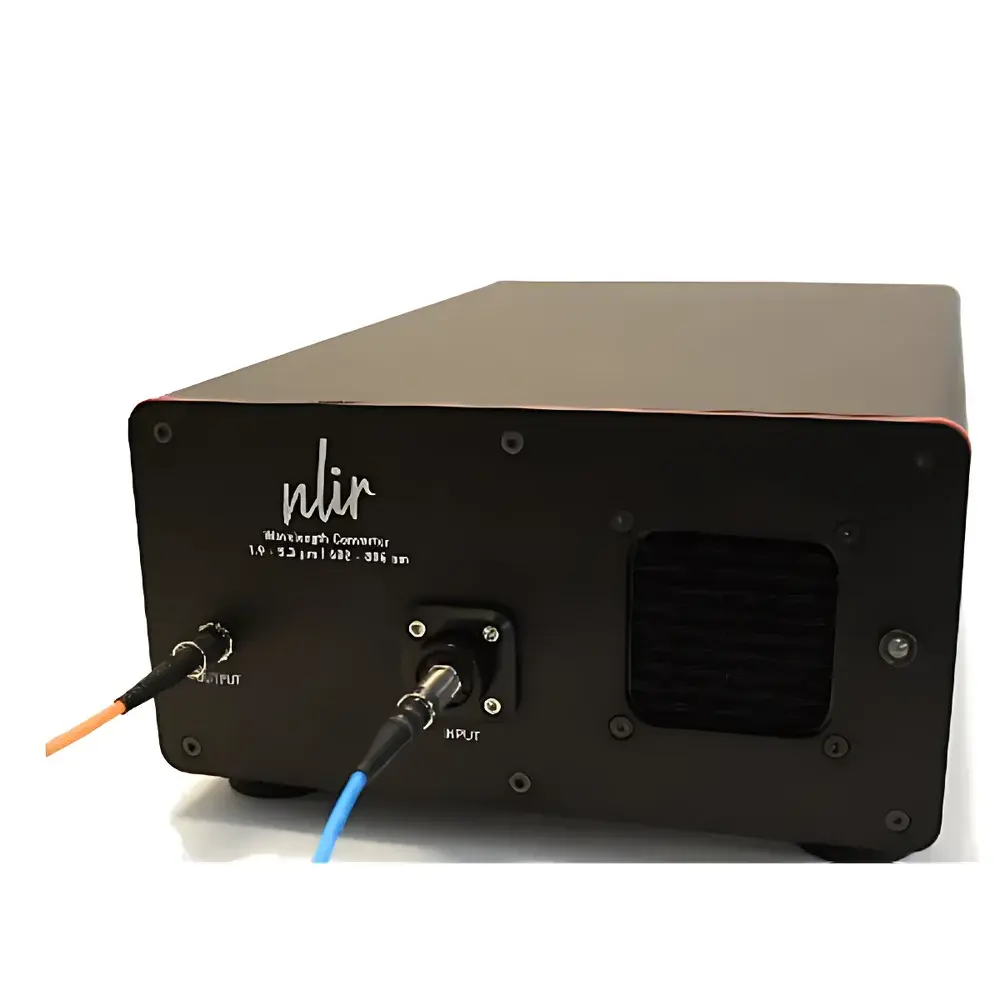
NLIR Mid-Infrared Wavelength Conversion Module for Near-Infrared Detection
| Brand | NLIR |
|---|---|
| Origin | Denmark |
| Manufacturer Type | Authorized Distributor |
| Origin Category | Imported |
| Price | USD 1 (Reference Only) |
Overview
The NLIR Mid-Infrared Wavelength Conversion Module is an optically engineered nonlinear frequency upconversion device designed to bridge the performance gap between mid-infrared (MIR) photon detection and high-speed, low-noise visible/NIR silicon- and GaAs-based photodetectors. Operating on the principle of sum-frequency generation (SFG) in periodically poled lithium niobate (PPLN), the module coherently mixes incident MIR radiation (1.9–5.3 µm) with a fixed 1064 nm pump laser to generate upconverted signal photons in the 682–886 nm spectral band. This enables diffraction-limited spectral resolution, sub-microsecond temporal response, and shot-noise-limited detection—capabilities unattainable with conventional thermal or photoconductive MIR detectors. The architecture is optimized for laboratory-grade spectroscopic applications requiring high dynamic range, real-time acquisition, and compatibility with standard fiber-coupled detection chains.
Key Features
- Nonlinear optical upconversion based on PPLN crystal with integrated 1064 nm pump source
- Input spectral range: 1.9–5.3 µm (tunable via crystal temperature and poling period)
- Output spectral range: 682–886 nm (post-filtered to suppress residual pump and broadband background)
- Input polarization sensitivity: vertical linear polarization only (ensures phase-matching fidelity and reduces parasitic noise by ~50%)
- Conversion efficiency: 1×10⁻¹ for narrowband input (~50 nm FWHM), down to 5×10⁻³ (3.3–5.3 µm) and 5×10⁻⁴ (full 1.9–5.3 µm band)
- Fiber-coupled output interface compatible with SMF-28 or HI1060 fibers
- No cryogenic cooling required; operates at ambient temperature with active thermal stabilization
- Designed for integration into FTIR, laser heterodyne, or time-resolved MIR spectroscopy platforms
Sample Compatibility & Compliance
The module is compatible with free-space and fiber-delivered MIR sources including quantum cascade lasers (QCLs), interband cascade lasers (ICLs), synchrotron beamlines, and globar-based broadband emitters. It supports both continuous-wave (CW) and pulsed operation (repetition rates up to 100 MHz). All optical coatings and crystal mounts comply with ISO 10110 surface quality standards. The mechanical housing conforms to DIN 31670 mounting interfaces and includes vacuum-compatible flanges (CF-35 optional). While not a medical or industrial safety-certified instrument per se, the module meets IEC 60825-1:2014 Class 1 laser product requirements when operated within specified pump power limits. Its design facilitates traceable calibration against NIST-traceable blackbody sources and supports GLP-compliant spectral data acquisition when paired with validated software workflows.
Software & Data Management
The module functions as a hardware-transparent spectral transducer: no proprietary drivers or firmware are embedded. Output signals are acquired via standard photodetector interfaces (e.g., SMA, LEMO, or fiber-pigtailed TIA outputs). When integrated with third-party DAQ systems (e.g., National Instruments PXI, Thorlabs Kinesis, or Python-controlled ADALM2000), spectral calibration is performed using polynomial or spline-based wavelength-to-pixel mapping derived from reference gas absorption lines (e.g., CO, N₂O, CH₄). Raw intensity data streams support HDF5 and FITS formats for long-term archival. Audit trails, user-defined metadata tagging, and timestamp synchronization (PTPv2 or GPS-disciplined clocks) are fully supported in compliant laboratory information management systems (LIMS) under FDA 21 CFR Part 11 and ISO/IEC 17025 frameworks.
Applications
- Real-time process monitoring of polymer curing, pharmaceutical tablet coating, and semiconductor thin-film deposition
- High-speed laser diagnostics for QCL linewidth measurement and mode-hop analysis
- Fiber-optic MIR sensing using hollow-core photonic crystal fibers (HC-PCF) coupled to remote probes
- Time-resolved spectroscopy of ultrafast molecular vibrations (e.g., C=O stretch dynamics in proteins)
- Free-space optical communications in the 3–5 µm atmospheric window
- Colorimetric analysis of hydrocarbon blends and biofluids via MIR fingerprint region interrogation
- Low-light spectral imaging for astronomical MIR source characterization (e.g., exoplanet atmosphere modeling)
FAQ
What is the maximum input power the module can handle without damage?
The module accepts up to 50 mW average MIR power (CW) or 10 µJ/pulse (pulsed) at the crystal input face, assuming proper collimation and alignment.
Can the output be coupled directly into a spectrometer?
Yes—the 682–886 nm output is spectrally clean and spatially coherent, enabling direct coupling into Czerny-Turner or transmission grating spectrometers with <0.1 nm resolution.
Is temperature tuning required for different MIR wavelengths?
Yes. Crystal temperature must be stabilized within ±0.1 °C to maintain phase-matching across the full 1.9–5.3 µm range; a PID-controlled thermoelectric cooler is included.
Does the module support polarization diversity detection?
No—it is intrinsically sensitive only to vertically polarized MIR input due to its quasi-phase-matched geometry; orthogonal components require external polarization optics.
How is spectral calibration validated?
Calibration is verified using certified gas cells (e.g., NIST SRM 2509a) with known rovibrational absorption features at 2.7 µm, 4.3 µm, and 4.7 µm, referenced to the upconverted 720–840 nm output band.





