
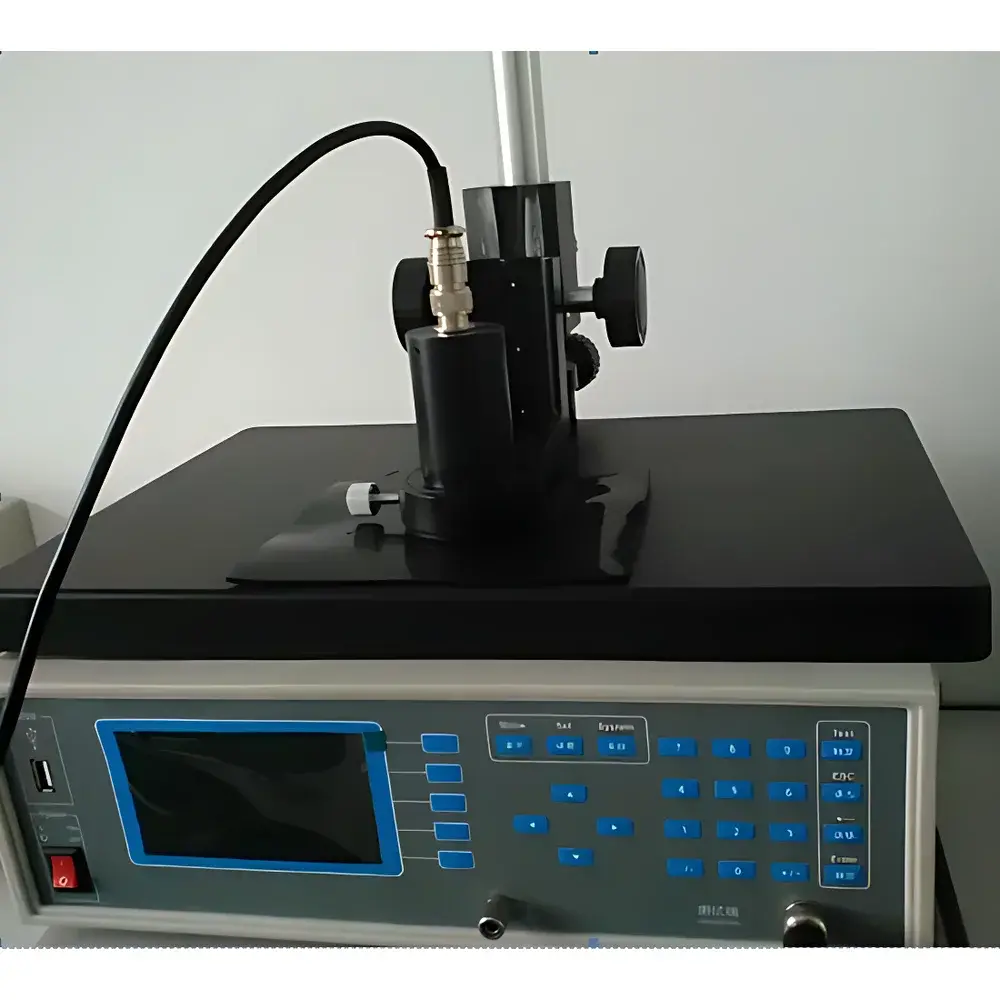
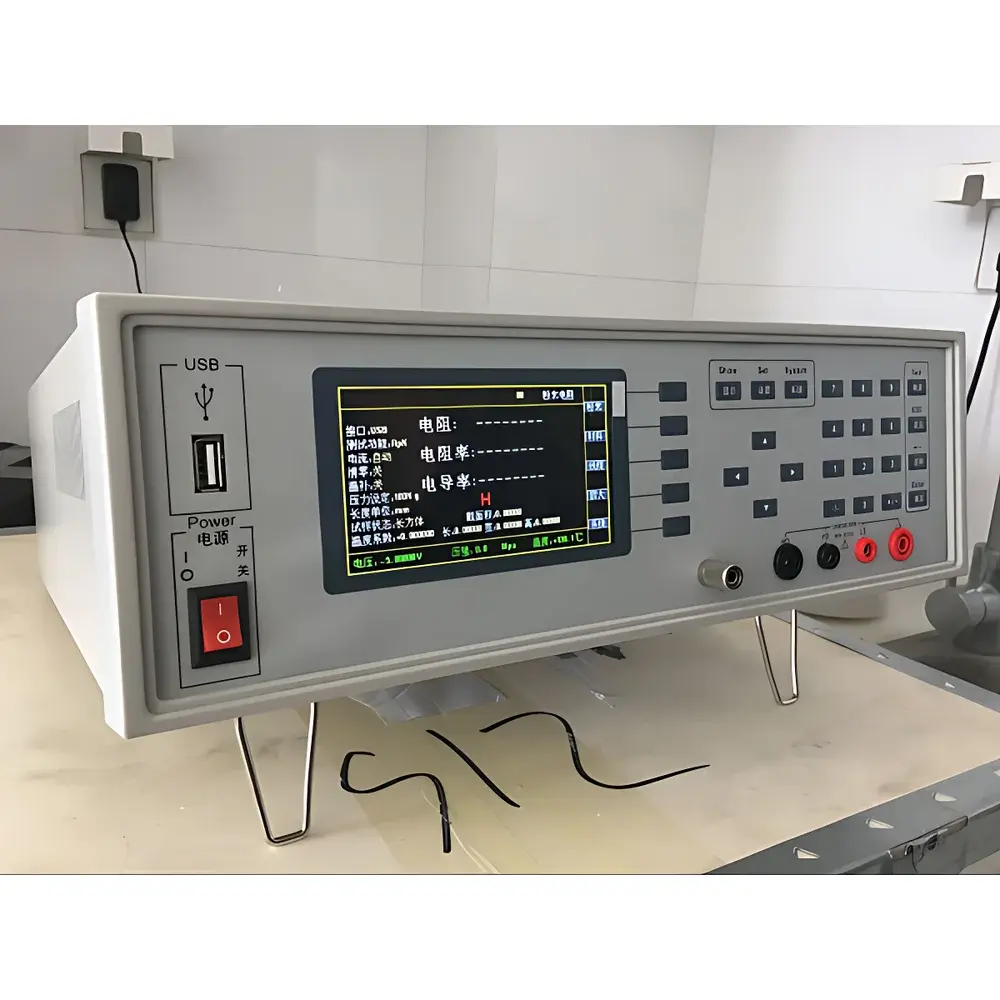
North Guangjing Precision BES-300C Semiconductor Shielding Resistance Tester for Wire & Cable Materials
| Brand | North Guangjing Precision Instrument |
|---|---|
| Origin | Beijing, China |
| Manufacturer Type | Direct Manufacturer |
| Model | BES-300C |
| Form Factor | Benchtop |
| Conductivity Range | 5 × 10⁻⁶ – 1 × 10⁸ mS/cm |
| Resistivity Range | 1 × 10⁻⁸ – 2 × 10⁶ Ω·cm |
| Resistance Range | 1 × 10⁻⁸ – 2 × 10⁶ Ω |
| Minimum Resolution | 0.1 μΩ |
| Accuracy | ±(0.05% of reading ± 5 digits) |
| Voltage Measurement Ranges | 2 mV / 20 mV / 200 mV / 2 V (Resolution: 0.1–100 μV |
| Accuracy | ±0.1% of reading) |
| Current Output | 0–1000 mA DC adjustable (Ranges: 1 μA to 1000 mA |
| Accuracy | ±0.2% of reading ± 2 digits) |
| Temperature Compensation | Yes |
| Display | 4.3-inch LCD with auto-unit conversion (resistance, resistivity, sheet resistance, conductivity, temperature, pressure) |
| Interface | Dual-language (English/Chinese) GUI |
| Data Export | PC-controlled operation via optional software with automated report generation, charting, and audit-trail-capable data logging |
Overview
The North Guangjing Precision BES-300C Semiconductor Shielding Resistance Tester is a dedicated benchtop instrument engineered for precise volumetric resistivity and conductivity characterization of semiconductive rubber and plastic shielding layers used in power and communication cables. It implements the four-terminal (Kelvin) measurement principle to eliminate lead and contact resistance errors—critical for accurate evaluation of low-resistivity materials (down to 1 × 10⁻⁸ Ω·cm) where conventional two-probe methods introduce significant systematic bias. Designed in strict compliance with GB/T 3048.3—“Electrical Properties of Electric Cables and Wires — Part 3: Test Methods for Volume Resistivity of Semiconductive Elastomeric and Plastic Materials”, the BES-300C automates calculation workflows per standardized test protocols, eliminating manual transcription and arithmetic errors associated with thickness-dependent resistivity derivation. Its microprocessor-controlled architecture ensures stable current sourcing, high-resolution voltage sensing, and real-time temperature compensation—enabling traceable, repeatable measurements under laboratory or QC environment conditions.
Key Features
- Four-terminal (Kelvin) measurement topology for contact-resistance-free resistivity determination across 14 decades (1 × 10⁻⁸ – 2 × 10⁶ Ω·cm)
- Auto-ranging conductance/resistance measurement with seamless unit conversion (Ω, Ω·cm, S/m, mS/cm) displayed simultaneously on a 4.3-inch high-contrast LCD
- Integrated temperature sensor with automatic temperature compensation (ATC) aligned to ASTM D257 and IEC 60093 reference models
- Programmable DC current source (0–1000 mA), offering six precision ranges (1 μA to 1000 mA) with ±0.2% full-scale accuracy and 2-digit offset correction
- Dual-language interface (English/Chinese) supporting international deployment without firmware modification
- Built-in thickness-input prompt enabling immediate volumetric resistivity calculation post-resistance measurement—fully compliant with GB/T 3048.3 Annex A
- Modular electrode compatibility: supports solid disc electrodes (standard), liquid/gel cells, and custom fixtures for extruded shields, molded samples, or coated substrates
Sample Compatibility & Compliance
The BES-300C is validated for use with elastomeric and thermoplastic semiconductive compounds—including EPDM, EVA, carbon-black-loaded polyethylene, and silicone-based shielding gels—commonly applied as cable jacketing, insulation screening, or grounding layers. Its measurement methodology satisfies the physical and procedural requirements of multiple national and international standards: GB/T 3048.3 (China), GB 11210 (rubber antistatic products), ISO 1853 (conductive rubber), ISO 3915 (conductive plastics), GB 2439, GB/T 15662, JT 230–95 (automotive static-dissipative drag straps), and ASTM D991 (volume resistivity of conductive elastomers). All electrical calibrations are traceable to national metrology institutes via documented internal verification routines. The system architecture supports GLP-compliant operation when paired with the optional PC software, including electronic signatures, user access control, and 21 CFR Part 11–ready audit trails.
Software & Data Management
An optional Windows-compatible software suite enables remote instrument control, real-time data streaming, and structured data archiving. The application provides configurable test templates aligned with GB/T 3048.3 test sequences—including sample ID entry, thickness input, ambient temperature logging, and operator annotation. Acquired datasets are stored in encrypted SQLite databases with immutable timestamps and user attribution. Reporting modules generate PDF/CSV outputs containing raw readings, calculated resistivity values, statistical summaries (mean, SD, CV%), pass/fail flags against specification limits, and XY scatter plots (e.g., resistivity vs. thickness or temperature). All data exports include metadata headers confirming instrument ID, calibration status, and environmental conditions at time of measurement.
Applications
- Quality assurance of semiconductive cable shielding layers during incoming raw material inspection and final product release testing
- R&D validation of novel conductive filler formulations (e.g., graphene-, CNT-, or metal-oxide-doped polymers) for volume resistivity stability across processing temperatures
- Process monitoring of extrusion line consistency—tracking resistivity drift correlated with carbon black dispersion homogeneity or crosslink density
- Failure analysis of shield degradation due to thermal aging, moisture ingress, or UV exposure per IEC 60502-2 accelerated aging protocols
- Educational laboratories conducting standardized experiments on conduction mechanisms in disordered polymer composites
- Third-party certification labs performing accredited testing per CNAS-CL01 (ISO/IEC 17025) requirements
FAQ
What measurement principle does the BES-300C employ, and why is it preferred for semiconductive materials?
It uses the four-terminal (Kelvin) method to isolate voltage-sensing leads from current-carrying leads—eliminating parasitic contact and lead resistance that dominate error budgets below 1 Ω·cm. This is essential for accurate volumetric resistivity assessment of cable shielding compounds, which typically fall between 10⁻³ and 10² Ω·cm.
Does the instrument support automated compliance reporting per GB/T 3048.3?
Yes. Upon entering sample thickness and selecting “Volume Resistivity Mode”, the device computes ρ = R × t / A (where t = thickness, A = electrode area) in real time and displays results in Ω·cm with appropriate SI prefix scaling. Test records include all required parameters for regulatory submission.
Can the BES-300C measure liquid or paste-like semiconductive materials?
With optional liquid-cell fixtures (e.g., parallel-plate or cylindrical conductivity cells), the instrument measures bulk conductivity of conductive gels, ink dispersions, or slurry formulations—provided electrode geometry and cell constant are defined in software.
Is temperature compensation based on material-specific coefficients or a fixed reference?
The system applies a linear temperature coefficient model derived from ASTM D257 Annex A, using user-configurable α-values (typically 0.003–0.005 /°C for carbon-filled polymers) or default reference curves for common compound families.
How is measurement traceability maintained for ISO/IEC 17025 accreditation?
Internal verification is performed daily using NIST-traceable standard resistors (100 mΩ to 10 MΩ). Calibration certificates document uncertainty budgets per ISO/IEC 17025 Clause 6.5, covering current source stability, voltage measurement linearity, and thermal EMF contributions.





