
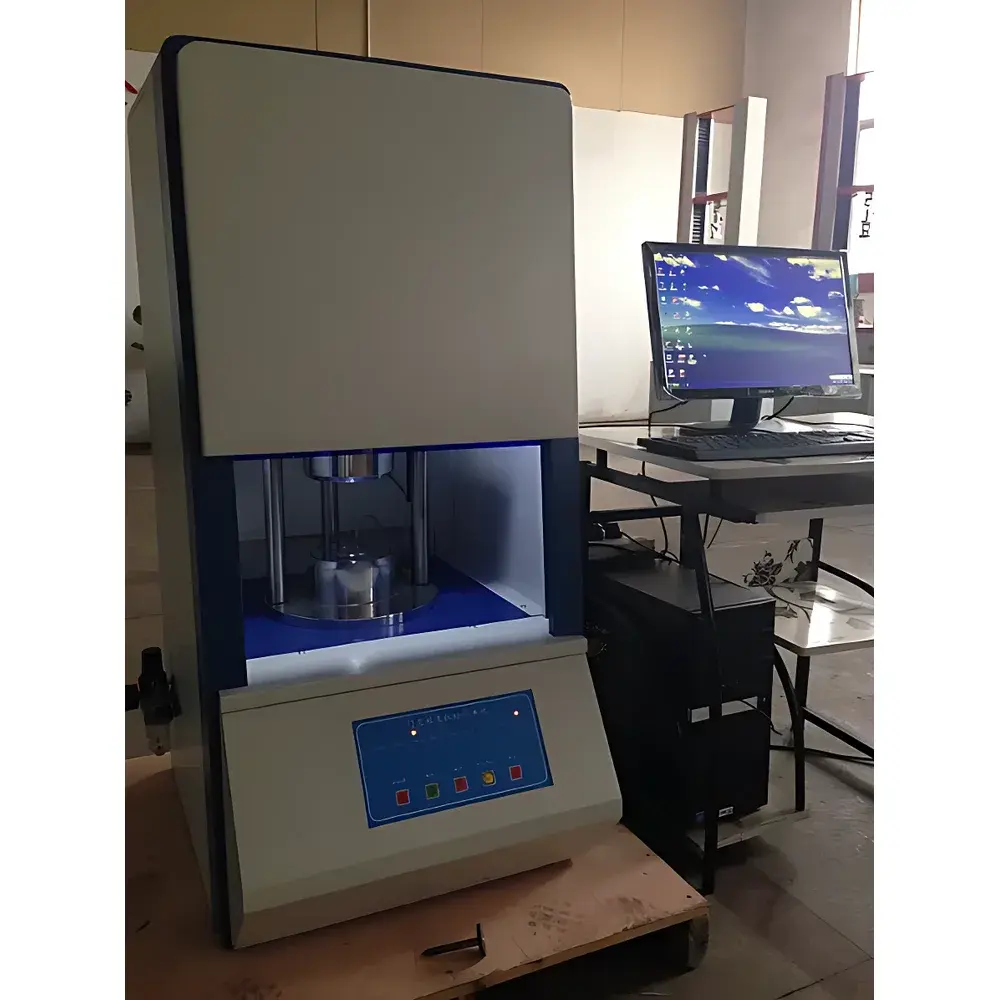
North Guangjingyi BG-8005 Mooney Viscometer for Rubber Processing
| Brand | North Guangjingyi / All Precision Instrument |
|---|---|
| Origin | Beijing, China |
| Manufacturer Type | Direct Manufacturer |
| Product Origin | Domestic (China) |
| Model | BG-8005 |
| Temperature Control Range | Ambient to 200 °C |
| Temperature Accuracy | ≤ ±0.5 °C |
| Temperature Resolution | 0.1 °C |
| Torque Range | 0–100 Mooney Units (MU) |
| Calibration Accuracy | 100 ± 0.5 MU |
| Rotor Speed | 2.00 ± 0.02 rpm |
| Test Duration | 0–200 min (1 s resolution) |
| Cavity Pressure | 11.5 ± 0.5 kN |
| Operating Air Pressure | 0.45–0.6 MPa |
| Dimensions (W×D×H) | 540 × 660 × 1100 mm |
| Weight | 180 kg |
| Compliance | GB/T 1232, GB/T 1233, ISO 289, ISO 667 |
Overview
The North Guangjingyi BG-8005 Mooney Viscometer is a precision-engineered instrument designed specifically for the rubber and elastomer industry to quantify the viscoelastic behavior of uncured rubber compounds. It operates on the principle of rotational shear deformation under controlled thermal conditions: a standardized rotor rotates at 2.00 ± 0.02 rpm within a sealed, heated cavity containing a sample of raw or compounded rubber. The torque resistance exerted by the material—expressed in Mooney Units (MU)—is measured continuously over time, enabling determination of key processability parameters including Mooney viscosity (ML1+4), scorch time (t5, t35), and vulcanization rate index (VRI). This method conforms strictly to internationally recognized test protocols, including ASTM D1646, ISO 289-1:2018, ISO 667:2017, GB/T 1232.1–2016, and GB/T 1233–2019, ensuring data comparability across global R&D labs, quality control departments, and compound formulation centers.
Key Features
- High-stability temperature control system with ±0.5 °C accuracy across ambient to 200 °C range, utilizing imported digital PID controllers and precision-sensor feedback loops;
- Integrated pneumatic actuation system featuring Sino-Japanese joint-venture cylinder (SDPC Group) and Chint/DeliXi pneumatic components for repeatable cavity closure and consistent 11.5 kN clamping force;
- Monolithic cavity mold manufactured via CNC machining—eliminating assembly-induced dimensional variance and enhancing thermal uniformity and torque reproducibility;
- High-precision rotor shaft with square-drive interface fabricated via wire EDM (slow-speed wire-cut), ensuring concentricity <0.005 mm and minimizing mechanical hysteresis;
- Dual-channel real-time data acquisition architecture with 1-second temporal resolution, supporting full-curve capture from initiation through full vulcanization;
- Industrial-grade embedded controller with military-spec electronic components and wide-input switching power supply (100–240 VAC, 50/60 Hz), optimized for continuous operation in production lab environments;
- Automated safety interlocks including motor cutoff upon door opening, pressure monitoring, and thermal runaway protection per IEC 61000-6-2 EMC requirements.
Sample Compatibility & Compliance
The BG-8005 accommodates standard 45 g rubber specimens (diameter 45 mm, thickness 5.5 mm) as defined in ISO 289-1 and GB/T 1232. It supports natural rubber (NR), styrene-butadiene rubber (SBR), ethylene-propylene-diene monomer (EPDM), nitrile rubber (NBR), chloroprene (CR), and reclaimed rubber formulations. All test sequences comply with GLP-aligned data integrity practices: timestamps are hardware-embedded, raw torque and temperature values are stored unaltered in non-volatile memory, and calibration events—including verification against NIST-traceable reference standards—are logged with operator ID and audit trail. The system meets essential requirements for ISO/IEC 17025-accredited laboratories and supports documentation packages for FDA 21 CFR Part 11 readiness when paired with validated software configurations.
Software & Data Management
Control and analysis are executed via Windows-compatible application software (Windows 10/11 x64 native), offering dual-mode operation: automated sequence execution (predefined test templates) and manual parameter override. The interface provides real-time overlay of multiple curves (torque vs. time, dM/dt vs. time), automatic detection of scorch onset (t5) and optimum cure time (t90), and export of ASCII CSV, PDF reports, and image-based curve snapshots. All data files include embedded metadata: instrument serial number, calibration date, operator name, environmental conditions (ambient T/RH), and full version-controlled software build ID. Audit logs record every user action—including method edits, result deletions, and calibration adjustments—with immutable timestamps, satisfying traceability mandates under ISO 9001:2015 Clause 8.5.2 and IATF 16949 Section 8.5.1.2.
Applications
- Rubber compound development: screening filler dispersion effects, plasticizer efficiency, and accelerator synergy;
- Batch-to-batch consistency verification in tire tread, sidewall, and innerliner production;
- Raw material acceptance testing for natural rubber bales and synthetic polymer shipments;
- Process optimization of internal mixer discharge temperature and drop time;
- Accelerated aging studies assessing pre-vulcanization stability during storage and transport;
- Regulatory submission support for automotive OEM specifications (e.g., GMW15634, Ford WSS-M99P1111-A);
- Academic research on structure–property relationships in filled elastomer nanocomposites.
FAQ
What standards does the BG-8005 Mooney Viscometer comply with?
It fully implements ISO 289-1:2018, ISO 667:2017, ASTM D1646, GB/T 1232.1–2016, and GB/T 1233–2019.
Is the instrument suitable for QC labs operating under ISO/IEC 17025?
Yes—its hardware-level timestamping, non-volatile raw data storage, and configurable audit logging meet clause 7.5.2 and 7.7.1 requirements for measurement traceability and record retention.
Can test methods be password-protected and locked for routine use?
Yes—the software supports role-based access control (operator, supervisor, administrator) with encrypted method libraries and tamper-evident change logs.
What maintenance intervals are recommended for long-term accuracy?
Annual calibration of torque transducer and RTD sensor against certified reference standards is advised; quarterly verification using Mooney standard reference materials (SRMs) is recommended for high-throughput labs.
Does the system support integration with LIMS or MES platforms?
Yes—via TCP/IP socket communication and configurable ASCII command protocol, enabling bidirectional data exchange with LabVantage, Thermo Fisher SampleManager, and Siemens Opcenter.






