
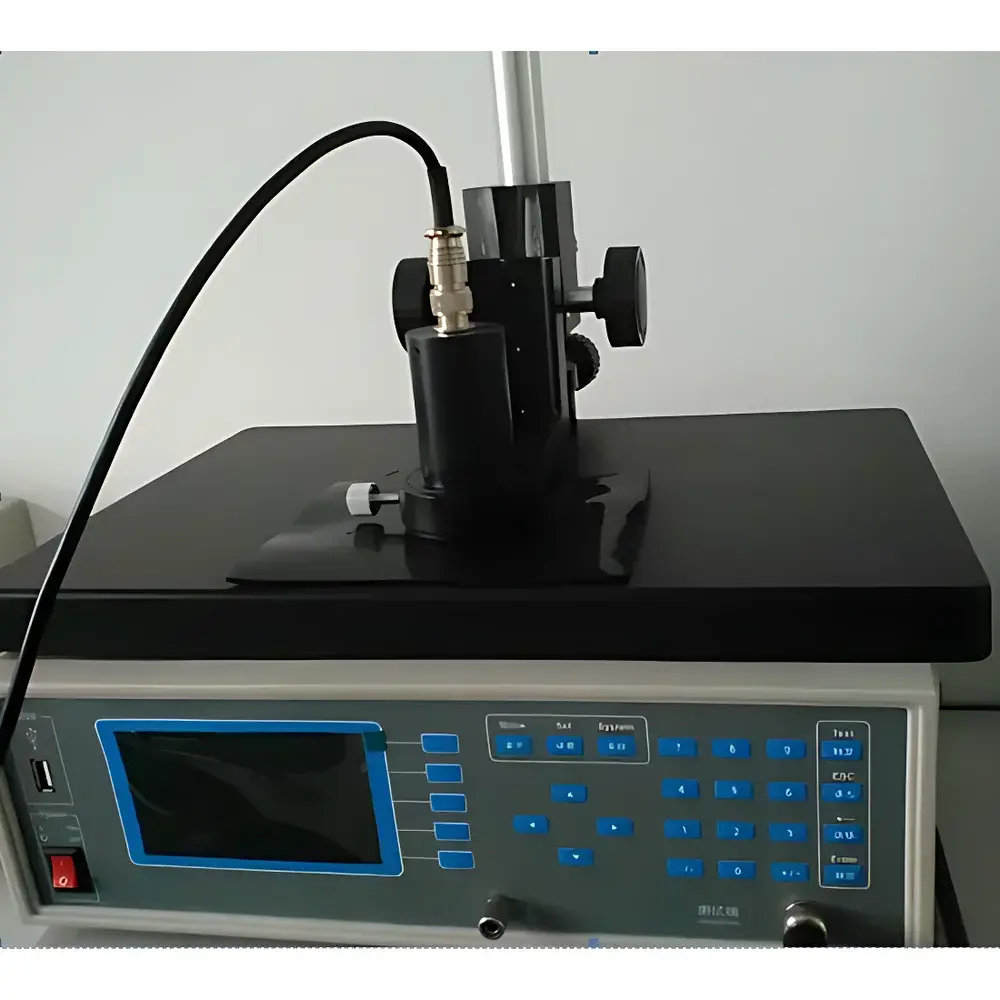
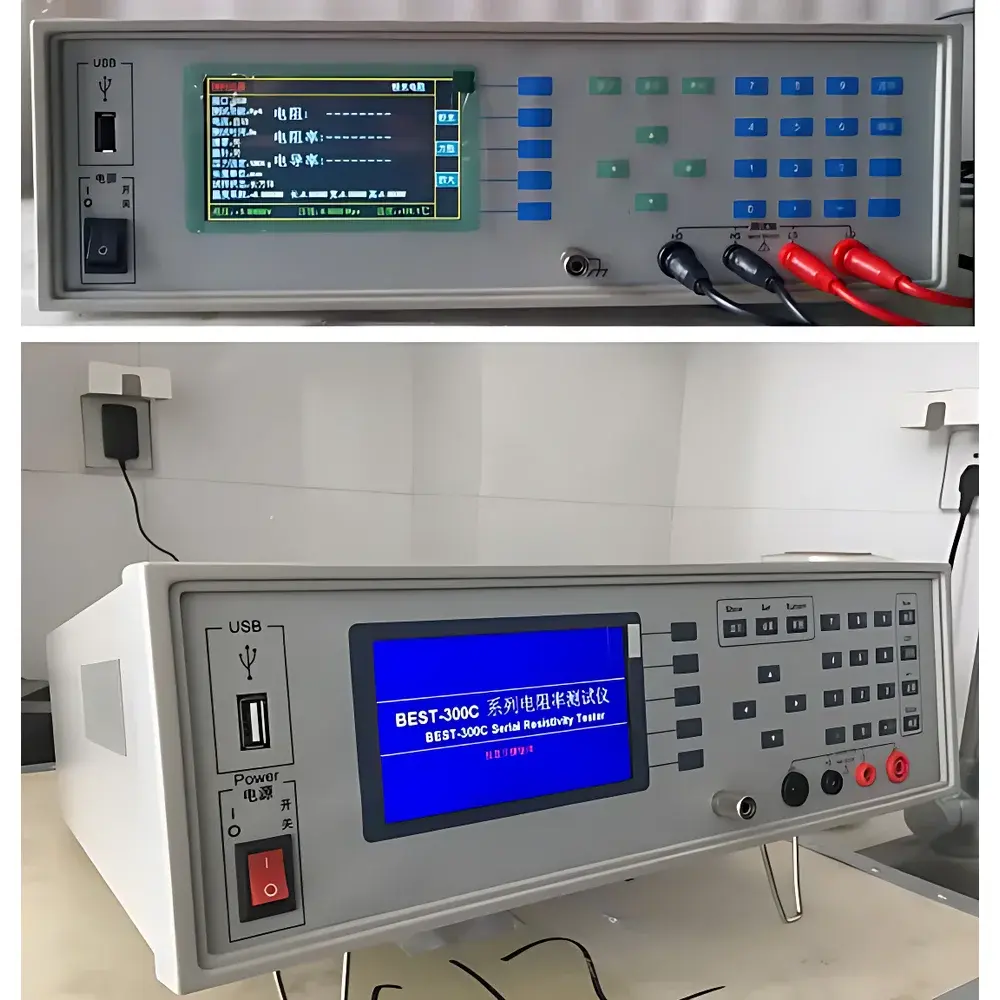
North Guangjingyi BEST-300C Four-Terminal Resistivity and Conductivity Tester
| Brand | North Guangjingyi / All Precision Instrument |
|---|---|
| Origin | Beijing, China |
| Manufacturer Type | Direct Manufacturer |
| Regional Category | Domestic (China) |
| Model | BEST-300C |
| Price | USD 2,100 (FOB China) |
| Resistance Range | 1×10⁻⁵–2×10⁵ Ω |
| Resistivity Range | 1×10⁻⁶–2×10⁶ Ω·cm |
| Conductivity Range | 5×10⁻⁶–1×10⁸ S/cm |
| Resolution | 1 μΩ (resistance), 0.1 μV–100 μV (voltage), 1 μA–1000 mA (current) |
| Measurement Accuracy | ±5% (resistivity/resistance), ±0.1% reading + 0.1 μV (voltage), ±0.2% reading ±2 digits (current) |
| Temperature Compensation | Yes |
| Display | 4.3-inch TFT LCD with dual-language UI (English/Chinese) |
| Dimensions | 330 × 340 × 120 mm |
| Power Supply | 220 V ±10%, 50/60 Hz |
| Standard Accessories | Four-terminal test platform, main unit, power & data cables |
| Optional | PC control software with GLP-compliant data logging, chart generation, and report export (PDF/CSV/XLSX) |
Overview
The North Guangjingyi BEST-300C Four-Terminal Resistivity and Conductivity Tester is an engineered solution for precise volumetric and sheet resistivity characterization of conductive and semiconductive solid materials. It operates on the four-wire (Kelvin) measurement principle—eliminating lead and contact resistance errors—to deliver high reproducibility in low-resistance (<100 mΩ) and moderate-resistivity (up to 2 MΩ·cm) regimes. Designed for R&D laboratories, QC/QA departments, and academic materials science programs, the instrument supports standardized resistivity evaluation per ASTM D257, IEC 60093, and GB/T 1410. Its integrated temperature compensation algorithm enables real-time correction of resistivity values based on user-input or optional external thermocouple readings—critical for evaluating thermal dependence in carbon composites, metal alloys, conductive polymers, and sintered ceramics.
Key Features
- Four-terminal (Kelvin) configuration ensures measurement integrity by separating current sourcing and voltage sensing paths—essential for eliminating contact resistance artifacts in bulk and thin-film samples.
- Auto-ranging resistance measurement across seven decades (10−5–105 Ω) with selectable current excitation (1 μA–1000 mA DC), enabling optimized signal-to-noise ratio for diverse material classes—from copper foils to doped silicon wafers.
- Simultaneous multi-parameter display: resistance (Ω), resistivity (Ω·cm), sheet resistance (Ω/sq), conductivity (S/cm), ambient temperature (°C), and applied pressure (kPa)—all rendered on a 4.3-inch high-contrast TFT LCD with configurable English/Chinese UI.
- Programmable voltage measurement range (2 mV–2 V) with 0.1 μV minimum resolution at 2 mV range; combined with ±0.1% reading accuracy, this supports trace-level potential drop detection in low-impedance specimens.
- Onboard temperature compensation engine compliant with standard α-coefficient models (e.g., copper: 0.00393/°C); supports manual coefficient entry or auto-recall from material library presets.
- Rugged industrial-grade chassis (330 × 340 × 120 mm) with EMI-shielded analog front-end and isolated digital bus architecture—designed for stable operation in shared lab environments with variable electromagnetic loads.
Sample Compatibility & Compliance
The BEST-300C accommodates solid, isotropic, and homogeneous samples via interchangeable four-point probe fixtures—including spring-loaded collinear probes (for bulk rods), guarded two-point electrodes (for insulating substrates), and vacuum-assisted sample holders (for powder compacts). It meets fundamental metrological requirements for ISO/IEC 17025-accredited labs when operated with certified reference standards (e.g., NIST SRM 3130a). While not intrinsically FDA 21 CFR Part 11–compliant, its optional PC software implements audit-trail logging, electronic signatures, and data immutability—enabling alignment with GLP/GMP documentation protocols in regulated manufacturing settings (e.g., battery electrode QA, PCB substrate validation).
Software & Data Management
The optional BEST-Link PC software (Windows 10/11 compatible) provides full remote instrument control via USB virtual COM port. It captures timestamped measurement sequences—including raw voltage/current pairs, derived resistivity values, temperature metadata, and operator annotations—and stores them in encrypted SQLite databases. Export functions support CSV (for statistical analysis in Python/R), XLSX (for internal QA reporting), and PDF (for regulatory submission). Charting tools generate XY plots (e.g., resistivity vs. temperature), histograms (batch uniformity assessment), and trend lines with linear/nonlinear regression—fully traceable to NIST-traceable calibration certificates supplied with each unit.
Applications
- Quality control of conductive fillers in polymer composites (e.g., carbon black–EPDM, graphene–PA6)
- Resistivity mapping of sintered metal powders (Cu, Al, Ni-based alloys) pre- and post-heat treatment
- Sheet resistance verification of transparent conductive oxides (ITO, FTO) on glass or PET substrates
- Process validation of electroplated coatings (Ni, Cu, Au) on PCBs and semiconductor interconnects
- Research-grade characterization of novel 2D materials (MXenes, antimonene) under controlled environmental conditions
- Educational use in undergraduate solid-state physics and materials engineering laboratories
FAQ
What standards does the BEST-300C comply with for resistivity measurement?
It supports methodology alignment with ASTM D257 (DC resistance of insulating materials), IEC 60093 (methods of test for volume and surface resistivity), and Chinese national standard GB/T 1410—though final compliance requires user implementation of traceable calibration and documented SOPs.
Can the instrument measure anisotropic materials such as graphite or layered perovskites?
Yes—when paired with directional four-point probe fixtures and rotational sample stages (sold separately), it enables directional resistivity profiling along crystallographic axes, provided sample geometry permits uniform current injection.
Is temperature compensation mandatory during measurement?
No—it is user-selectable; however, disabling compensation is only recommended for isothermal experiments where ambient drift is <±0.5°C over measurement duration.
How is calibration performed, and what documentation is included?
Each unit ships with a factory calibration certificate referencing NIST-traceable standards; annual recalibration is advised using certified shunts (10 mΩ, 100 Ω, 10 kΩ) and thermistor references—procedures detailed in the English-language technical manual.
Does the PC software support automated pass/fail decision logic against user-defined tolerances?
Yes—the software allows definition of upper/lower limits per parameter (e.g., resistivity ≤ 1.8×10⁻⁶ Ω·cm for oxygen-free copper); results are color-coded and flagged in reports with deviation magnitude and timestamp.
Related Products



