
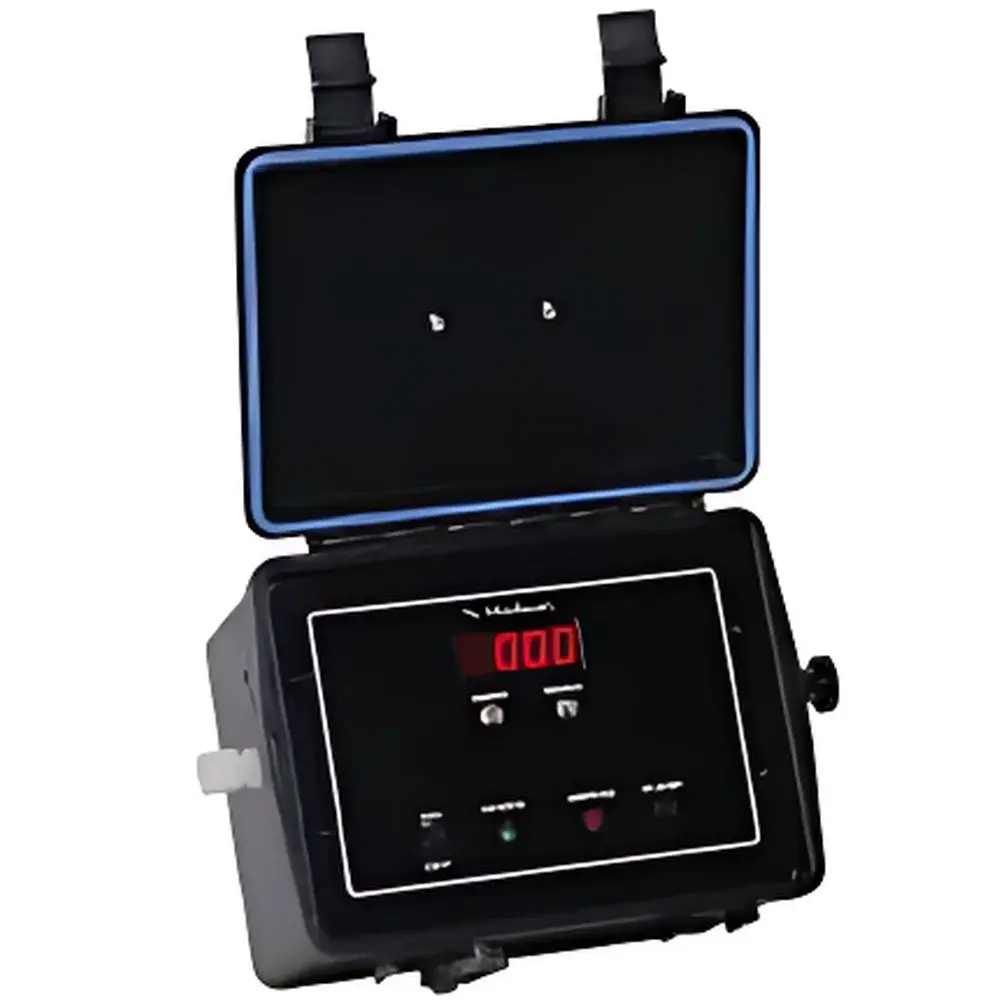
Nova 317 Portable Hydrocarbon Analyzer
| Brand | Nova |
|---|---|
| Origin | Canada |
| Model | 317 |
| Detection Principle | NDIR (Non-Dispersive Infrared) |
| Measurement Range | 0–100.0% propane (C₃H₈) equivalent |
| Resolution | 0.1% propane |
| Accuracy & Repeatability | ±2% of full scale |
| Drift | <2% of full scale per week |
| Response Time (T₉₀) | 10–15 s |
| Operating Temperature | 0–50 °C |
| Linearity | ±2% of full scale |
| Dimensions (WP Type) | 25.5 × 19 × 16.5 cm |
| Weight | 3.6 kg |
| Power | AC/DC operation |
| Output Options | 4–20 mA or 0–1 VDC |
| Alarm | Optional high-hydrocarbon alarm |
| Enclosure | WP-rated housing with transparent cover |
| Sensor | Solid-state infrared detector (no moving parts) |
| Integrated Components | Built-in sample pump, particulate filter, precision flowmeter, stainless steel probe, and coiled sampling hose |
Overview
The Nova 317 Portable Hydrocarbon Analyzer is an intrinsically robust, field-deployable instrument engineered for quantitative measurement of hydrocarbon vapor concentrations—primarily propane (C₃H₈) and gasoline vapors—in confined or semi-enclosed environments. It employs non-dispersive infrared (NDIR) spectroscopy, a mature and highly selective detection method that exploits the characteristic absorption bands of C–H bonds in the mid-infrared region (typically 3.3–3.5 µm). Unlike catalytic bead or PID-based sensors, the solid-state NDIR detector contains no consumables, moving parts, or optical alignment requirements—ensuring long-term stability, minimal calibration drift, and immunity to poisoning by silicones, sulfides, or halogenated compounds. The analyzer draws sample gas via an integrated diaphragm pump through a stainless steel probe and calibrated sampling hose, passes it sequentially through a particulate filter and laminar flowmeter to ensure consistent volumetric flow, and delivers it to the measurement cell where absorbance is converted into a digital propane-equivalent concentration reading. Its design adheres to fundamental principles of gas-phase photometry and conforms to measurement traceability frameworks used in industrial hygiene and environmental compliance workflows.
Key Features
- True portable architecture with integrated rechargeable battery supporting up to 5 hours of continuous operation; device remains fully functional during charging
- Visual status indicators: red LED signals low battery, green LED confirms active charging—enabling real-time power management without instrumentation interruption
- Backlit digital display for clear readability under low-light or outdoor conditions, including confined-space entry scenarios
- Modular internal layout facilitates rapid field servicing: filter replacement, flowmeter verification, and detector inspection require no specialized tools
- WP-rated enclosure with transparent polycarbonate cover allows visual confirmation of internal component integrity without disassembly
- Stainless steel sampling probe and chemically resistant silicone/PVC composite sampling hose compatible with saturated hydrocarbon vapors and moderate solvent exposure
- Factory-calibrated for propane; cross-sensitivity compensation coefficients available for gasoline vapor quantification per ASTM D5191 and ISO 8573-5 conventions
Sample Compatibility & Compliance
The Nova 317 is validated for use in ambient air, headspace analysis of fuel storage tanks, vapor recovery systems, and leak detection surveys across petroleum distribution, aviation refueling, and marine bunkering operations. It meets IP65 ingress protection standards and operates reliably across 0–50 °C, making it suitable for seasonal deployment in temperate and subtropical climates. While not certified for Class I Division 1 hazardous locations, its low-power NDIR architecture and absence of ignition sources align with safe-use protocols outlined in OSHA 1910.120 and EPA Method 21 for fugitive emission monitoring. Data output (4–20 mA or 0–1 VDC) supports integration into SCADA or DCS platforms compliant with ISA-84 and IEC 61511 safety lifecycle requirements. Though not inherently 21 CFR Part 11 compliant, audit-ready data logging can be achieved when paired with validated third-party software meeting GLP/GMP record retention criteria.
Software & Data Management
The 317 operates as a standalone analog-output instrument with no embedded firmware-based data storage. However, its analog outputs are fully compatible with industry-standard data acquisition systems (e.g., Campbell Scientific CR1000X, National Instruments CompactDAQ) configured for time-stamped, temperature-compensated recording. When connected to a host system with appropriate configuration, it supports trend analysis, alarm event tagging, and export to CSV or XML formats for inclusion in environmental management information systems (EMIS). Optional analog-to-digital converters with built-in linearization algorithms correct for minor nonlinearity inherent in broad-band NDIR response curves, ensuring reported values remain within ±2% full-scale linearity specifications across the entire 0–100% range.
Applications
- Fugitive emission monitoring at aboveground storage tanks (ASTs), loading racks, and vapor recovery units per EPA LDAR protocols
- Confined space entry pre-testing for hydrocarbon vapor hazards prior to hot work or personnel entry (OSHA 1910.146)
- Verification of purge effectiveness in fuel system maintenance and aircraft ground support equipment
- Field validation of fixed hydrocarbon monitors during routine calibration checks
- Environmental site assessments involving soil vapor intrusion or subsurface fuel plume delineation
- Training and competency assessment for HAZWOPER-certified technicians requiring hands-on instrument familiarity
FAQ
Can the Nova 317 measure methane or other alkanes directly?
No—it is factory-calibrated for propane and provides gasoline vapor readings using empirically derived equivalence factors; methane requires a separate NDIR channel optimized at 3.3 µm and is not supported.
Is the instrument suitable for use in explosive atmospheres?
It is not ATEX- or IECEx-certified; operation in classified hazardous areas requires additional engineering controls and risk assessment per NFPA 70E.
How often does the unit require recalibration?
Annual calibration against certified propane standard gas (NIST-traceable) is recommended; field zero checks with clean, dry air should be performed before each shift.
Does the built-in pump support negative-pressure sampling from ducts or manifolds?
Yes—the diaphragm pump delivers consistent flow at up to –25 kPa differential pressure, enabling representative sampling from low-velocity exhaust streams.
Can the analog output be scaled to represent different hydrocarbon species?
Output scaling is fixed to the configured range (e.g., 0–100% propane); custom scaling requires external signal conditioning hardware or DCS-side configuration.
Related Products







