
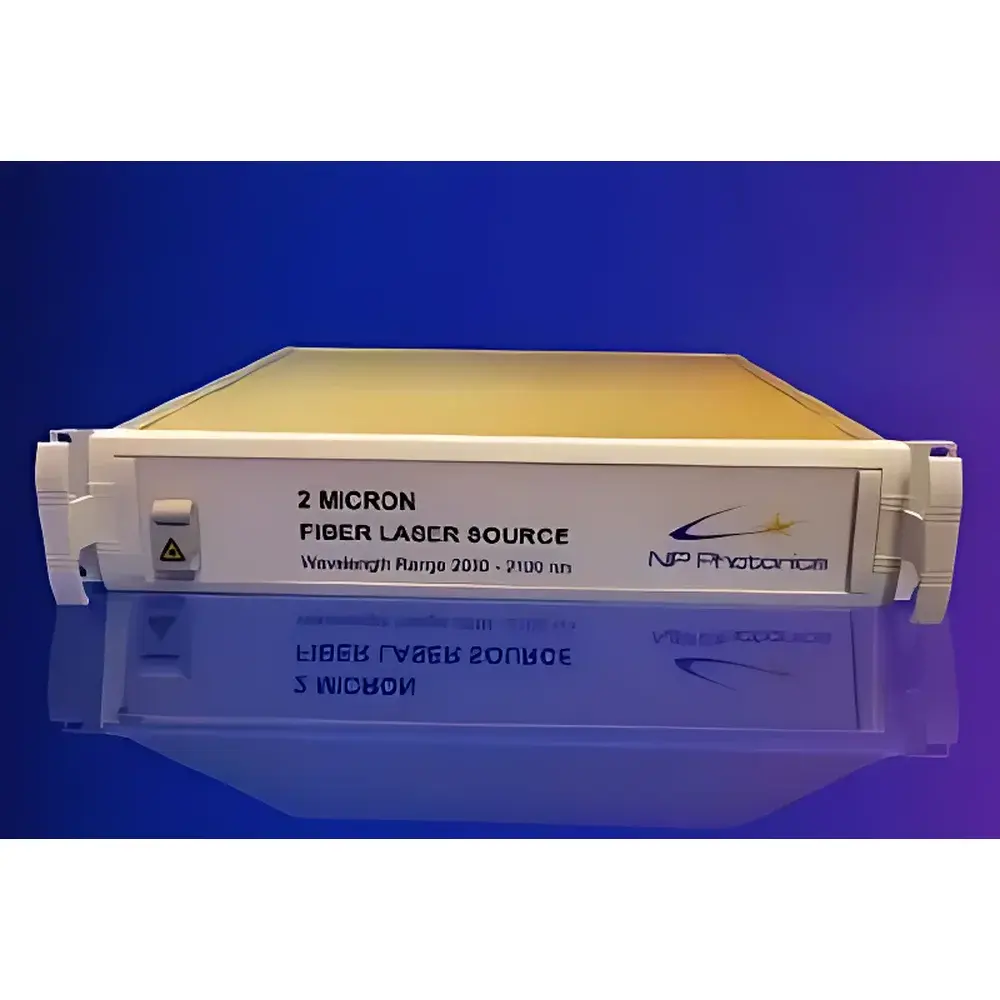
NP Photonics 2 µm Single-Frequency Ultra-Narrow Linewidth Fiber Laser
| Origin | USA |
|---|---|
| Manufacturer Type | Authorized Distributor |
| Origin Category | Imported |
| Model | NP-2UM-SF |
| Price | Upon Request |
Overview
The NP Photonics 2 µm Single-Frequency Ultra-Narrow Linewidth Fiber Laser is a high-performance, diode-pumped holmium-doped (Ho3+) fiber laser engineered for demanding coherent lidar, differential absorption lidar (DIAL), and high-resolution molecular spectroscopy applications. Operating at a fundamental wavelength centered at 2050 nm—with customizable tuning across 2030–2100 nm—the laser leverages a monolithic short-cavity distributed Bragg reflector (DBR) architecture to ensure robust single-longitudinal-mode (SLM) emission. Its core design principle follows Couette-type cavity stabilization: low-noise thulium-doped (Tm3+) fiber laser pumping minimizes quantum defect heating and pump-induced phase noise, while integrated acoustic damping isolates the DBR cavity from environmental mechanical perturbations. This results in intrinsic frequency stability of <50 MHz/hour (after 30-min warm-up, ΔT < 2 °C) and an ultra-narrow heterodyne linewidth of <50 kHz—corresponding to a coherence length exceeding 6 km. The laser serves as a precision seed source for master oscillator power amplifier (MOPA) systems in Doppler wind lidar, where narrow linewidth, low relative intensity noise (RIN), and long-term frequency fidelity are non-negotiable for accurate velocity retrieval via optical heterodyning.
Key Features
- Single-frequency operation with guaranteed SLM output and >60 dB side-mode suppression ratio (SMSR)
- Ultra-narrow linewidth: <50 kHz (heterodyne measurement), enabling kilometer-scale coherence length
- Low-frequency noise floor: <50 MHz/hour drift under stabilized thermal conditions
- Low RIN performance: –90 dB/Hz at ~1 MHz; shot-noise-limited above 50 MHz
- Wide thermal tuning range: up to 10 GHz across operational temperature span
- High-speed piezoelectric frequency modulation: ±150 MHz range, bandwidth up to 30 kHz
- Polarization-maintaining output with PER >17 dB (optional)
- Compact OEM-ready form factor: 382 × 480 × 88 mm (laser head only), air-cooled
- FC/APC panel-mounted output connector with narrow key alignment for polarization-sensitive setups
Sample Compatibility & Compliance
The laser is designed for integration into Class 1 or Class 1M optical systems per IEC 60825-1:2014 and complies with RoHS 2015/863/EU directives. Its 2 µm emission window aligns with strong CO2 absorption lines near 2050 nm and atmospheric transparency windows ideal for tropospheric and stratospheric remote sensing. As a seed source in MOPA-based coherent lidar, it meets functional requirements defined in ASTM E2852–22 (Standard Guide for Coherent Lidar Performance Metrics) and supports traceable calibration workflows compliant with ISO/IEC 17025:2017 for metrology-grade atmospheric monitoring systems. No hazardous optical coatings or rare-earth bulk crystals are used—fiber-integrated construction ensures inherent alignment stability and eliminates degradation risks associated with free-space resonators.
Software & Data Management
The laser operates via analog/digital interface (0–10 V modulation input, TTL sync trigger, RS-232 or optional USB-C control). While no proprietary GUI is bundled, comprehensive SCPI-compatible command sets enable seamless integration into LabVIEW, Python (PyVISA), or MATLAB-based data acquisition platforms. All critical operating parameters—including output power, cavity temperature setpoint, modulation bias, and internal photodiode monitor readings—are accessible in real time. Audit-trail-capable logging (timestamped, CSV-exportable) supports GLP/GMP-aligned validation protocols when deployed in regulated environmental monitoring or aerospace qualification environments. Firmware updates are performed via secure signed binaries, preserving configuration integrity across maintenance cycles.
Applications
- Doppler coherent wind lidar (CW and pulsed): providing stable seed radiation for injection-seeded amplifiers in ground-based, airborne, and spaceborne platforms
- Differential Absorption Lidar (DIAL): selective detection of CO2, H2O vapor, and aerosol backscatter profiles in atmospheric science missions
- High-resolution laser spectroscopy: saturated absorption, cavity ring-down, and frequency-comb-referenced measurements of molecular transitions in the 2 µm band
- Coherent optical time-domain reflectometry (C-OTDR) for distributed fiber sensing with sub-meter spatial resolution
- Quantum optics experiments requiring long coherence lengths and low phase noise at eye-safe wavelengths
- Free-space optical communications testing under simulated atmospheric turbulence conditions
FAQ
What is the typical coherence length of this laser?
With a measured heterodyne linewidth <50 kHz, the theoretical coherence length exceeds 6,000 meters—enabling long-path interferometric and coherent detection schemes.
Can the laser be wavelength-tuned during operation?
Yes—continuous thermal tuning over 10 GHz is possible via PID-controlled cavity temperature adjustment; fast piezo-based frequency dithering (±150 MHz) supports lock-in detection and active stabilization.
Is optical isolation included in the standard configuration?
No—output isolation is optional. The specified 25 mW output power assumes direct coupling without an integrated isolator; users integrating into amplifiers must specify external isolators rated for 2 µm operation.
Does the laser meet FDA 21 CFR Part 11 requirements for electronic records?
While the device itself is not a standalone regulated system, its digital interface and audit-trail logging capability support Part 11 compliance when embedded within validated software-controlled measurement platforms.
What is the warm-up time required to achieve specified frequency stability?
30 minutes under stable ambient conditions (temperature variation ≤2 °C); full specification compliance is guaranteed only after this stabilization period.




