
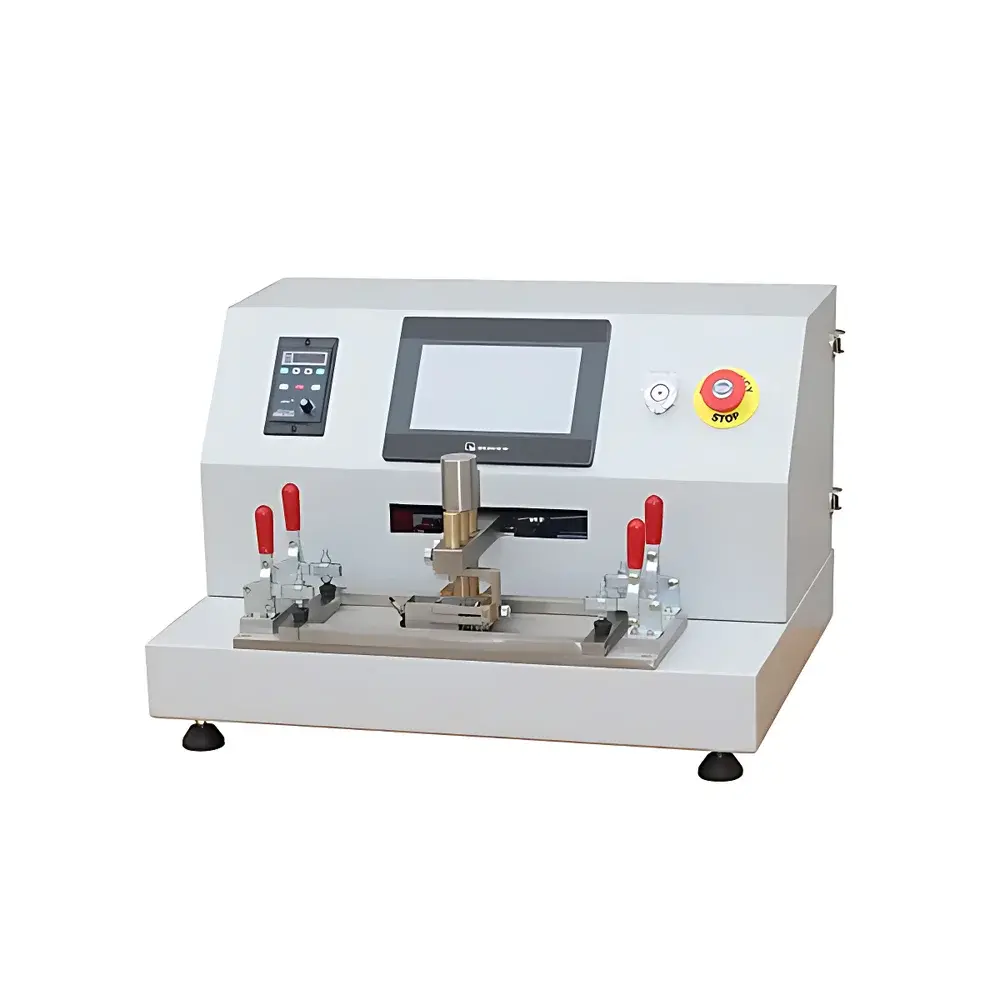
NYX HY-767E Wallcovering Wipe and Wash Resistance Tester
| Brand | NYX |
|---|---|
| Origin | Tianjin, China |
| Manufacturer Type | Direct Manufacturer |
| Region of Origin | Domestic (China) |
| Model | HY-767E |
| Pricing | Available Upon Request |
| Abrasion Head Dimensions | 50 mm × 29 mm |
| Mass Configurations | 100 ± 5 g (for wipe resistance, with soft polyurethane foam), 550 ± 10 g (for wash and special wash resistance, with felt pad), 600 ± 10 g (for scrub resistance, with brush assembly) |
| Overall Dimensions (L×W×H) | 65 × 40 × 46 cm |
| Net Weight | 55 kg |
| Power Supply | AC 220 V, 50 Hz, 500 W |
| Operating Environment | 10–35 °C, 10–85 % RH |
| Installation Requirement | Stable laboratory bench |
Overview
The NYX HY-767E Wallcovering Wipe and Wash Resistance Tester is a precision-engineered mechanical abrasion instrument designed to quantitatively evaluate the surface durability of decorative wallcoverings under standardized wet and dry mechanical stress conditions. It operates on the principle of controlled linear reciprocating motion, where a defined abrasive element—configured with calibrated mass and geometry—is applied to a conditioned wallpaper specimen under regulated pressure, stroke frequency, and cycle count. The device complies with QB/T 4034–2010 (“Test Method for Wipe and Wash Resistance of Wallcoverings”) and QB/T 3805–1999 (“Test Methods for Decorative Wallcoverings”), both national light industry standards issued by the People’s Republic of China. Its purpose is not merely pass/fail assessment but generation of reproducible, comparative data for quality control, formulation development, and regulatory documentation in manufacturing environments governed by ISO 9001 or internal GLP-aligned protocols.
Key Features
- Modular abrasion head system supporting three distinct test configurations: wipe (100 ± 5 g with polyurethane foam), wash/special wash (550 ± 10 g with industrial-grade felt), and scrub (600 ± 10 g with standardized nylon bristle brush), each aligned with corresponding clauses in QB/T 4034.
- Precisely adjustable stroke speed via electronic controller, enabling consistent cycle timing across test modes and facilitating method transfer between laboratories.
- Fixed geometry abrasion interface: 50 mm × 29 mm contact footprint ensures uniform pressure distribution and eliminates edge-effect variability during specimen evaluation.
- Robust steel frame construction (55 kg total mass) minimizes vibration-induced measurement drift and supports long-term stability in high-throughput QC labs.
- Integrated safety interlock and emergency stop button compliant with IEC 61000-6-2 electromagnetic compatibility and basic functional safety requirements for laboratory equipment.
Sample Compatibility & Compliance
The HY-767E accommodates standard wallpaper specimens sized 100 mm × 100 mm (minimum), mounted on rigid backing substrates per QB/T 4034 Section 5.2. It supports evaluation of vinyl-coated, non-woven, fabric-backed, and paper-based wallcoverings. Test liquids—including distilled water, alkaline detergent solution (pH 10.5 ± 0.2), and acidic cleaning agent (pH 4.0 ± 0.2)—are applied manually prior to each cycle, as specified in QB/T 4034 Annex A. While the instrument itself does not include fluid delivery automation, its mechanical design permits integration with external dispensing systems for enhanced repeatability. All test procedures are traceable to QB/T 4034 and referenced in enterprise quality manuals aligned with ISO/IEC 17025 competency criteria for testing laboratories.
Software & Data Management
The HY-767E operates via embedded microcontroller logic with digital LED display for real-time cycle count, preset stroke duration, and elapsed time. No proprietary software is required; however, raw test logs—including start/stop timestamps, total cycles executed, and operator ID (manually entered)—can be exported via RS-232 serial interface to external LIMS or Excel-based QA databases. Audit trail functionality meets minimum documentation requirements for internal quality audits. For laboratories operating under FDA-regulated environments (e.g., suppliers to healthcare facility interior contractors), the unit may be validated per IQ/OQ protocols using documented calibration certificates for mass weights (traceable to NIM, China) and timer accuracy (±0.5 s per 100 cycles).
Applications
- Quality assurance of commercial-grade wallcoverings prior to shipment to hospitality, healthcare, and educational institutions.
- Formulation screening for ink adhesion, topcoat hardness, and substrate–coating interfacial strength in R&D labs.
- Comparative benchmarking against competitor products using identical QB/T 4034 test parameters.
- Supporting technical documentation for CE marking dossiers where surface durability data is requested under EN 15102 (wallcovering performance classification).
- Training platform for ISO/IEC 17025 internal auditors evaluating method validation elements such as repeatability (within-lab), intermediate precision (day-to-day), and operator influence.
FAQ
Does the HY-767E comply with international standards such as ISO or ASTM?
The instrument is specifically engineered to execute QB/T 4034–2010 and QB/T 3805–1999. While no direct ISO or ASTM equivalent exists for wallpaper wipe/wash resistance, its mechanical configuration aligns with general principles in ISO 11644 (adhesive tape abrasion) and ASTM D2486 (scrub resistance of paints), permitting cross-method correlation studies.
Can the stroke speed be programmed for different test durations?
Yes—the electronic controller allows independent setting of strokes per minute (SPM) and total cycle count, enabling customization for accelerated aging protocols or extended durability verification beyond standard QB/T 4034 requirements.
Is calibration certification included with delivery?
A factory calibration report is provided, covering mass verification (NIM-traceable weights) and timer accuracy. Full metrological calibration per ISO/IEC 17025 requires third-party service, which NYX supports through authorized regional partners.
What maintenance is required for long-term operational reliability?
Monthly inspection of abrasion head mounting hardware, biannual lubrication of linear guide rails, and annual verification of motor torque consistency are recommended. Replacement brushes, felt pads, and foam inserts are available as consumables with batch-specific conformity documentation.



