
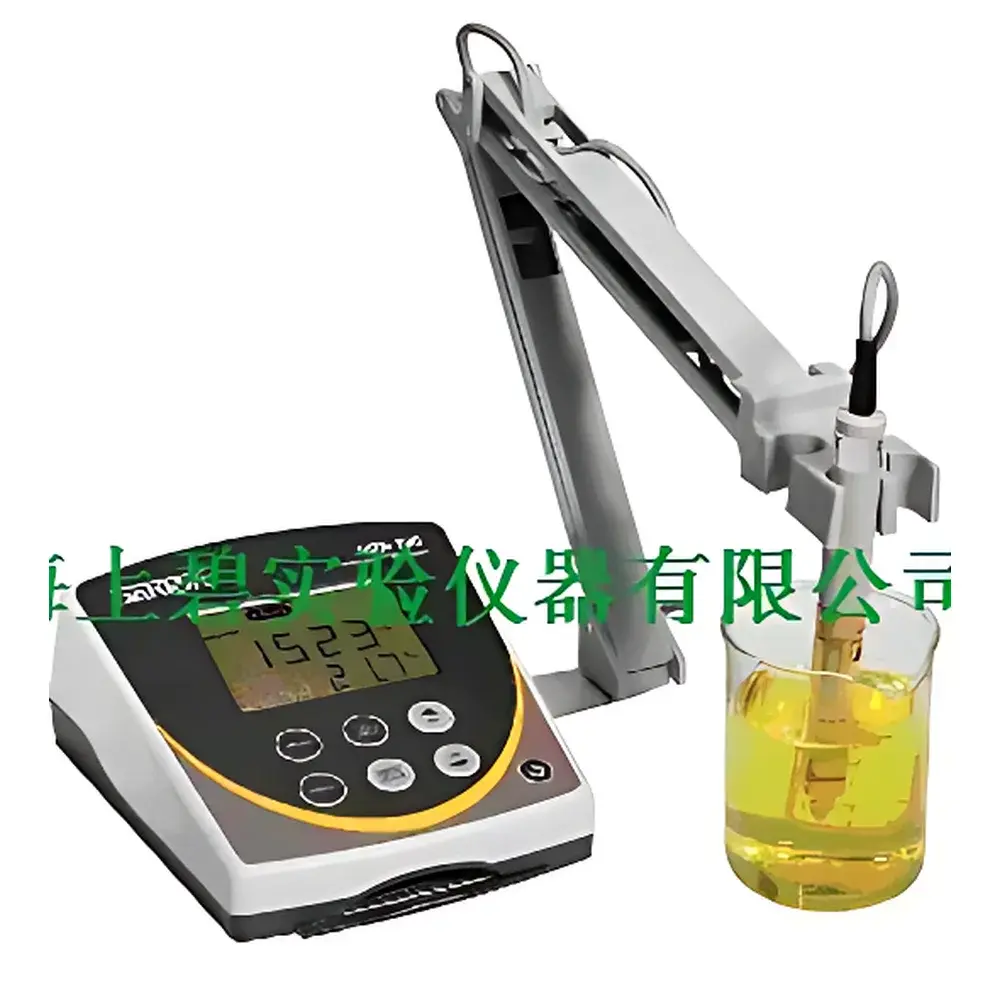
Oakton DO700 Dissolved Oxygen Meter (Model 35419-10)
| Origin | USA |
|---|---|
| Instrument Type | Laboratory Benchtop |
| Measurement Principle | Galvanic Cell Electrochemical Probe |
| Range | 0.00–80.00 mg/L |
| Accuracy | ±0.2 mg/L |
| Repeatability | ±0.05% of reading |
| Detection Limit | 0.00 mg/L (±2 digits at zero) |
| Temperature Compensation | Automatic or Manual (0–50 °C) |
| Atmospheric Pressure Compensation | Automatic or Manual (450–825 mmHg) |
| Salinity Compensation | Automatic or Manual (0–50 ppt) |
| Data Storage | 100 readings |
| Dimensions | 15.5 × 17.5 × 6.9 cm (L×W×H) |
Overview
The Oakton DO700 Dissolved Oxygen Meter (Model 35419-10) is a precision-engineered, benchtop laboratory instrument designed for reliable and traceable measurement of dissolved oxygen (DO) concentration in aqueous samples using galvanic cell electrochemical probe technology. Unlike polarographic sensors requiring polarization time and external voltage, the galvanic cell operates autonomously—generating a current proportional to oxygen partial pressure via spontaneous redox reaction between oxygen and a consumable anode (typically lead or zinc) and noble metal cathode (e.g., gold or silver). This architecture delivers rapid response (<60 s to 95% of final value), zero warm-up delay, and stable baseline performance across variable temperature and salinity conditions. The DO700 platform is calibrated per ASTM D888 and ISO 5814 standards for dissolved oxygen determination in natural waters, wastewater, and process streams, supporting compliance with EPA Method 360.1 and APHA Standard Methods 4500-OG. Its integrated temperature, atmospheric pressure, and salinity compensation algorithms ensure metrological rigor across diverse environmental and regulatory testing environments.
Key Features
- Galvanic cell probe interface compatible with Oakton’s 35642-50 DO sensor—designed for long-term stability and minimal drift (typical drift <0.1 mg/L/week under routine calibration)
- Simultaneous display of DO concentration (mg/L), % saturation, temperature (°C), atmospheric pressure (mmHg), and salinity (ppt)
- Automatic temperature compensation (0–50 °C) with NTC thermistor embedded in probe housing; manual override available
- Real-time barometric pressure correction using built-in sensor or user-entered value (range: 450–825 mmHg)
- Salinity compensation algorithm compliant with Winkler-derived solubility models (Weiss equation implementation)
- Non-volatile memory storing up to 100 data points with timestamp, DO value, temperature, and compensation parameters
- Large backlit LCD with dual-line readout and intuitive menu navigation—no software dependency for basic operation
- Rugged ABS housing rated IP54 for splash resistance; CE, RoHS, and FCC compliant
Sample Compatibility & Compliance
The DO700 is validated for use with freshwater, seawater, wastewater effluents, aquaculture systems, bioreactor broths, and drinking water distribution samples. It meets the functional requirements of ISO/IEC 17025-accredited laboratories when operated within defined uncertainty budgets—including calibration traceability to NIST-traceable DO standards (e.g., air-saturated water at known temperature/pressure/salinity). The instrument supports GLP-compliant workflows through user-defined calibration logs, operator ID entry (via keypad), and audit-ready data export protocols. While not FDA 21 CFR Part 11–certified out-of-the-box, its data integrity features—including immutable timestamping and non-editable storage—facilitate validation for GMP-regulated applications involving environmental monitoring or clean-in-place (CIP) verification.
Software & Data Management
Data retrieval is performed via RS232 serial interface (cable included) to PC-based terminal emulators or custom LabVIEW/Python scripts. No proprietary software is required; ASCII-formatted output includes DO (mg/L), % sat, temp (°C), pressure (mmHg), salinity (ppt), and date/time stamp per record. Each stored reading is assigned a unique sequential ID and cannot be overwritten or deleted without full memory reset—a design feature aligned with ALCOA+ principles (Attributable, Legible, Contemporaneous, Original, Accurate). Calibration history (date, standard used, slope/mV offset) is retained separately and accessible via menu navigation. Optional third-party LIMS integration is achievable using Modbus RTU over RS232 with appropriate protocol mapping.
Applications
- Regulatory compliance testing per US EPA Clean Water Act (CWA) Section 402 discharge monitoring
- Biochemical oxygen demand (BOD5) incubation tracking in municipal and industrial wastewater labs
- Aquatic ecosystem assessment—monitoring hypoxic zones in estuaries, reservoirs, and coastal zones
- Pharmaceutical water system qualification (PW, WFI) per USP and EP 2.2.43
- Bioprocess development—real-time DO trending during upstream fermentation and cell culture
- Educational laboratory instruction on gas solubility, Henry’s law, and aquatic chemistry fundamentals
- Field-deployable lab verification—paired with portable DO probes for cross-validation of in-situ sensor networks
FAQ
What type of electrochemical sensor does the DO700 support?
The DO700 is engineered exclusively for galvanic cell DO probes (e.g., Oakton 35642-50). It does not support polarographic or optical (luminescence-based) sensors.
Is temperature compensation mandatory for accurate DO measurement?
Yes—oxygen solubility varies nonlinearly with temperature. The DO700 requires either automatic compensation (via integrated probe thermistor) or manual entry; omission invalidates compliance with ASTM D888.
Can the DO700 be used for seawater analysis?
Yes—its salinity compensation function (0–50 ppt) applies the Weiss equation to correct for chloride ion effects on oxygen solubility, enabling accurate reporting in marine and brackish matrices.
How often should the galvanic DO probe be calibrated?
Daily calibration is recommended for high-precision work; weekly calibration suffices for routine monitoring when probe maintenance (membrane replacement, electrolyte refill) follows Oakton’s specified intervals (typically every 2–4 weeks depending on usage intensity).
Does the DO700 meet ISO/IEC 17025 documentation requirements?
It provides all essential metadata (timestamp, compensation parameters, calibration reference) needed for uncertainty budgeting and traceability—but formal accreditation requires lab-specific SOPs, equipment qualification (IQ/OQ), and periodic verification against certified reference materials.







