
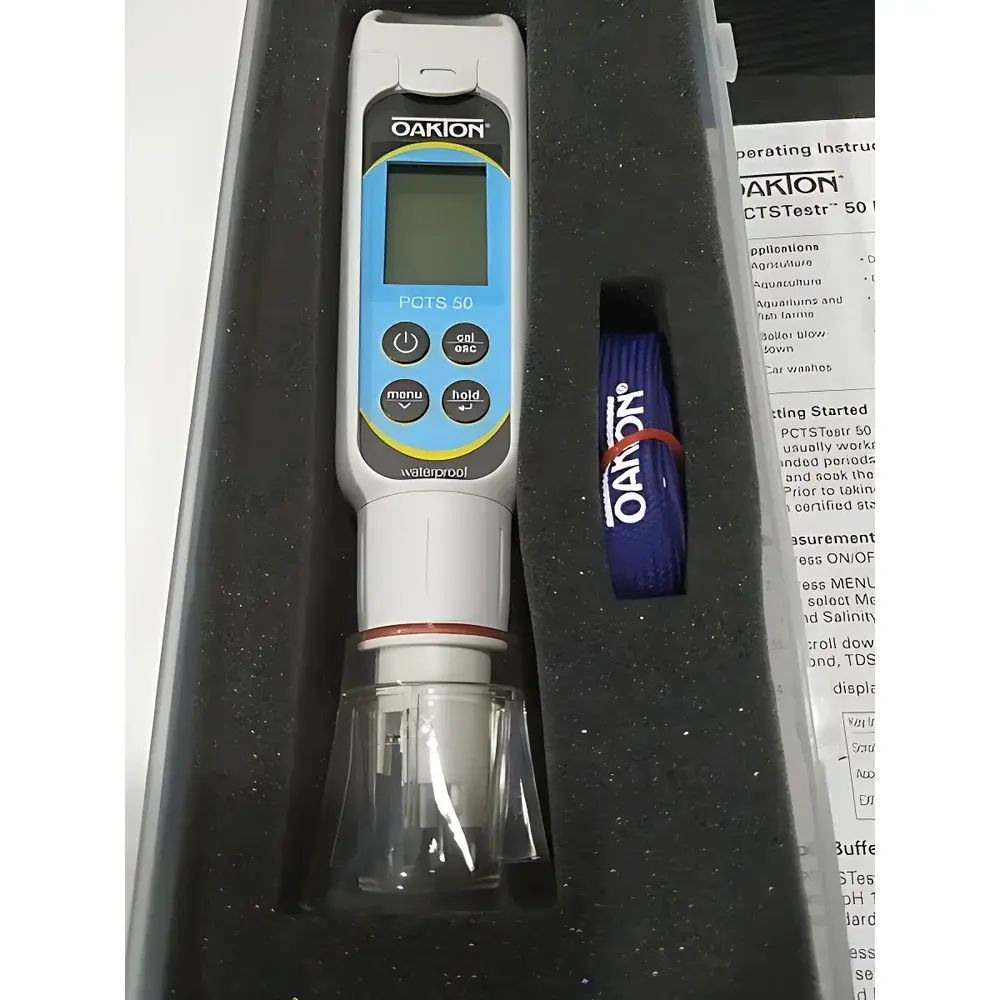
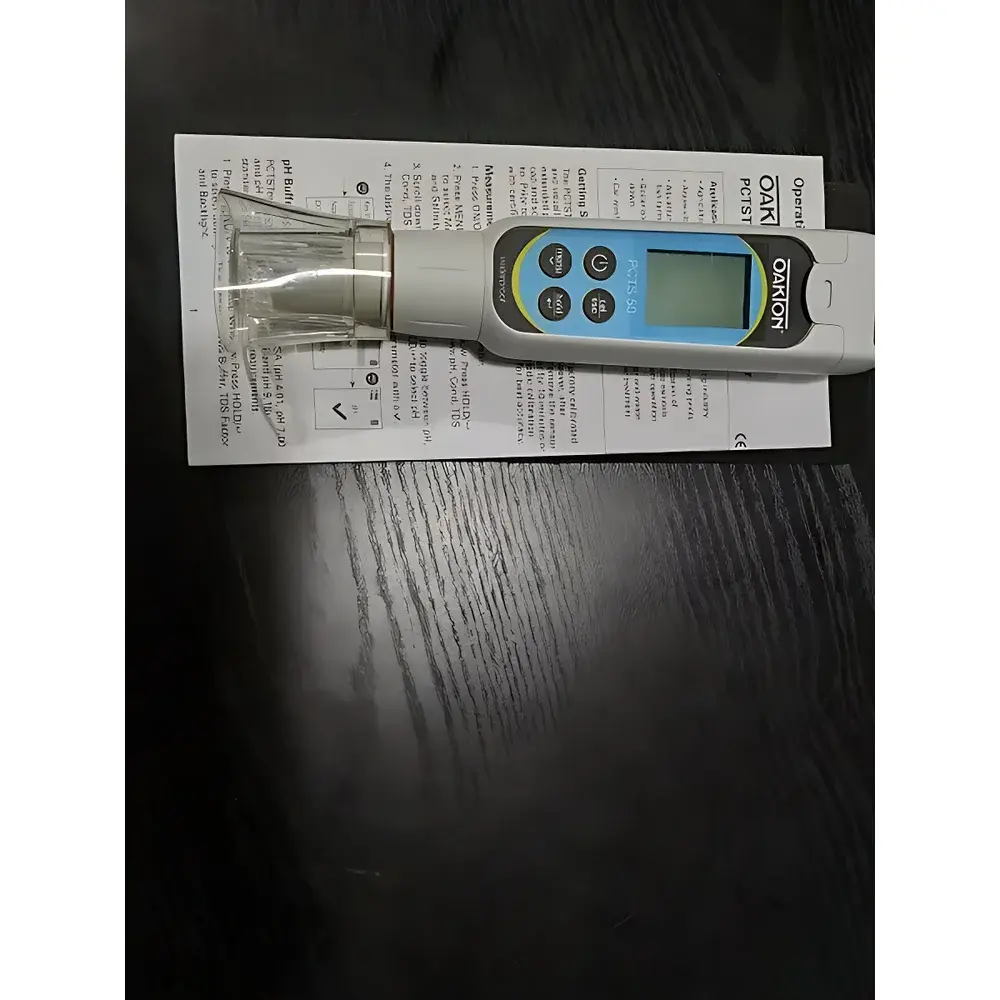
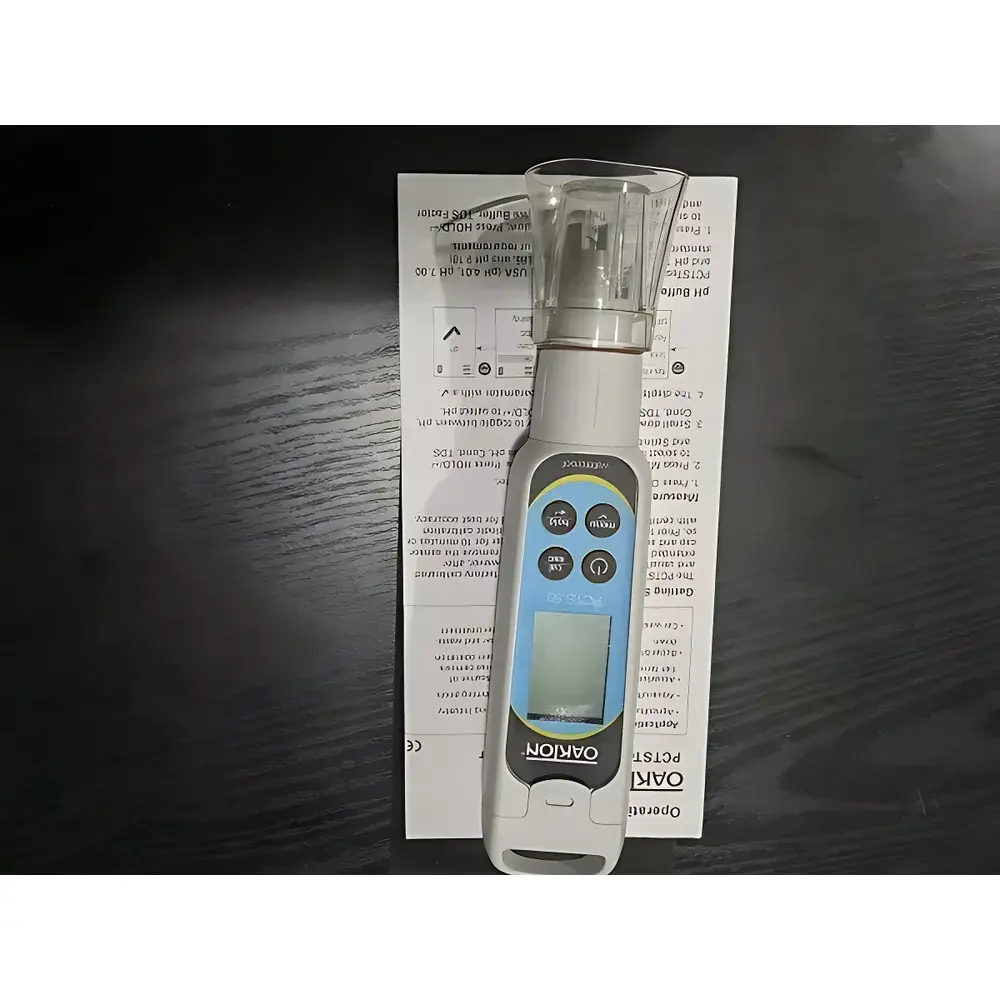
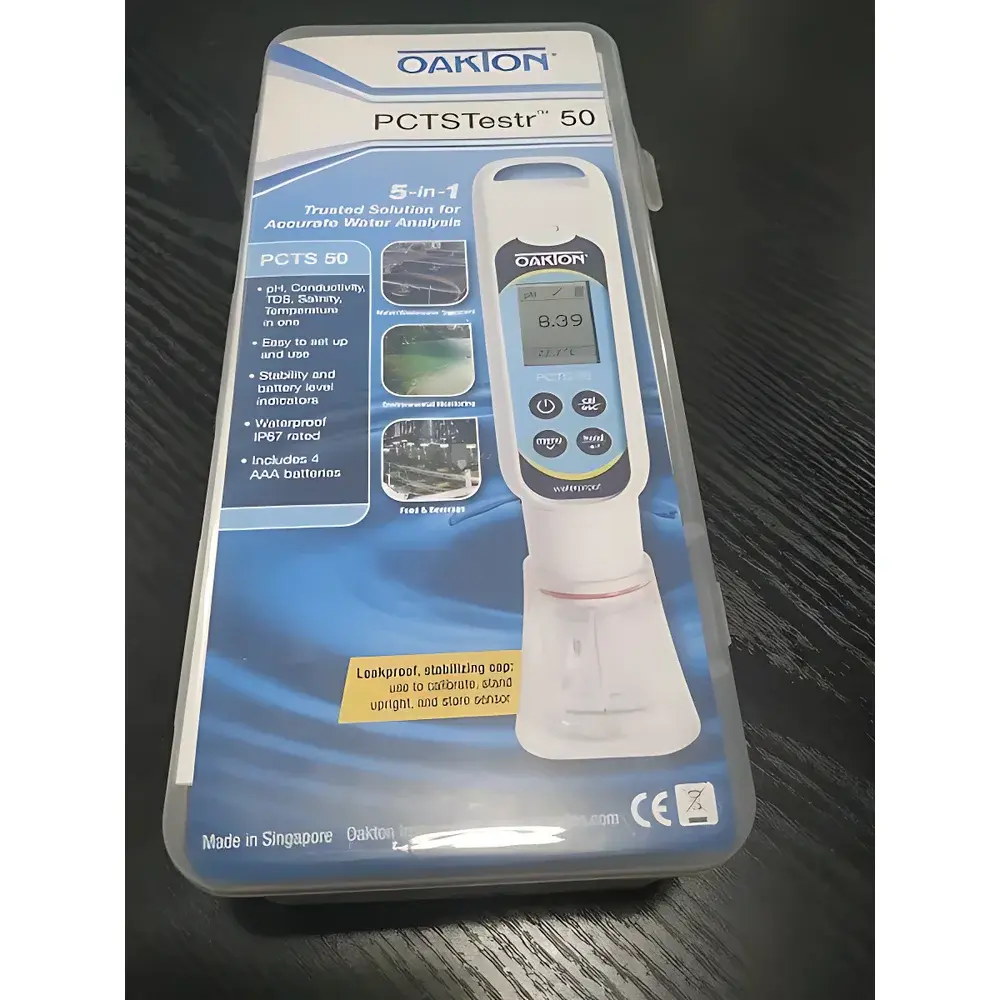
Oakton PCTSTestr 50 Waterproof Pocket pH/Conductivity/TDS/Salinity/Temperature Tester
| Brand | Oakton |
|---|---|
| Origin | Singapore |
| Model | PCTSTestr 50 |
| Instrument Type | Portable Handheld Water Quality Analyzer |
| Measured Parameters | pH (–1.00 to 15.00), Conductivity (0 to 20 mS/cm), TDS (0 to 10.0 ppt), Salinity (0.00 to 10.00 ppt), Temperature (0 to 60 °C / 32 to 140 °F) |
| pH Resolution | 0.01 |
| pH Accuracy | ±0.01 |
| Conductivity Accuracy | ±1% FS |
| TDS & Salinity Accuracy | ±1% FS |
| Temperature Accuracy | ±0.5 °C (0–50 °C), ±1.0 °C (50–60 °C) |
| Auto Temperature Compensation | Yes |
| Calibration | Up to 3-point pH with USA/NIST buffer recognition |
| IP Rating | IP67 |
| Power | 4 × 1.5 V button cells (CR2032), ~150 h battery life |
Overview
The Oakton PCTSTestr 50 is a rugged, field-deployable multiparameter water quality tester engineered for precision and operational continuity in demanding environmental, industrial, and laboratory settings. Designed around a modular sensor architecture, it integrates electrochemical pH measurement with conductometric determination of conductivity, total dissolved solids (TDS), salinity, and temperature—all within a single compact, waterproof housing. Its measurement principle relies on potentiometric pH sensing using a long-life glass electrode and two-electrode conductometric cell technology for conductivity, with linear conversion algorithms compliant with ASTM D1125 and ISO 7888 for TDS and salinity estimation. The instrument operates across a broad thermal range (0–60 °C), features automatic temperature compensation (ATC) based on integrated thermistor feedback, and delivers stable readings in freshwater, brackish water, wastewater effluents, and process streams—without requiring recalibration between sample types.
Key Features
- IP67-rated enclosure ensures full dust ingress protection and submersion resistance up to 1 m for 30 minutes; unit remains buoyant if accidentally dropped into water
- Modular, user-replaceable sensor cartridges—pH and conductivity/TDS/salinity modules are independently swappable, extending instrument service life and reducing long-term cost of ownership
- High-precision pH measurement with ±0.01 accuracy and 0.01 resolution over a wide range (–1.00 to 15.00 pH), supported by intelligent auto-buffer recognition for both USA (4.01, 7.00, 10.01) and NIST (4.01, 6.86, 9.18) standards
- Stainless-steel pin-type conductivity cell optimized for chemical resistance and mechanical durability in abrasive or fouling-prone matrices
- Configurable TDS and salinity conversion factors—user-adjustable to match sample-specific ionic composition (e.g., NaCl vs. KCl vs. natural seawater equivalents)
- Auto power-off after 8 minutes of inactivity; low-battery indicator provides advance warning prior to voltage depletion
- LCD display with dual-parameter simultaneous readout (e.g., pH + °C or µS/cm + ppt), backlight-free for extended battery efficiency
Sample Compatibility & Compliance
The PCTSTestr 50 demonstrates robust compatibility across heterogeneous aqueous matrices—including potable water, surface runoff, municipal wastewater, aquaculture systems, cooling tower fluids, and pretreated industrial effluents. Its pH electrode design minimizes junction clogging in suspended-solids-rich samples, while the stainless-steel conductivity probe resists passivation in chlorinated or sulfide-containing environments. From a regulatory standpoint, the instrument supports GLP-compliant data acquisition workflows when paired with external logging protocols. While not intrinsically 21 CFR Part 11–certified, its calibration traceability to NIST-traceable buffers and documented ATC behavior aligns with ISO/IEC 17025 method validation requirements for routine water quality screening. It meets IEC 60529 for IP67 classification and conforms to RoHS Directive 2011/65/EU for hazardous substance restrictions.
Software & Data Management
As a standalone handheld tester, the PCTSTestr 50 does not include onboard data logging or Bluetooth/Wi-Fi connectivity. However, its stable analog output stability and repeatable endpoint response enable seamless integration with external recording systems via manual transcription or optional RS-232 adapters (sold separately). All calibration events—including date/time stamp, buffer IDs used, slope/mV offset values, and temperature at calibration—are retained in non-volatile memory for audit readiness. The device supports user-defined temperature coefficient (α) adjustment for conductivity measurements, facilitating adherence to site-specific correction models required under EPA Method 120.1 or APHA Standard Methods 2510B. Firmware updates are not field-upgradable; calibration verification and performance checks follow manufacturer-recommended quarterly intervals per ISO 17025 Clause 6.4.
Applications
- Field-based compliance monitoring for NPDES permits and local discharge regulations
- Rapid QA/QC checks during drinking water distribution system maintenance
- Real-time salinity profiling in estuarine research and mariculture operations
- Pre-treatment assessment in industrial wastewater neutralization and ion exchange processes
- Educational laboratories requiring durable, multi-parameter instrumentation for undergraduate environmental chemistry curricula
- Emergency response teams conducting post-flood or spill-site water characterization
FAQ
Does the PCTSTestr 50 support GLP-compliant calibration documentation?
Yes—each calibration stores buffer identifiers, measured mV/pH values, temperature, and date/time. Users must manually record these in lab notebooks or LIMS-compatible spreadsheets.
Can the conductivity sensor be cleaned in situ without removing the module?
Yes—the stainless-steel pin electrodes tolerate gentle wiping with lint-free tissue and dilute detergent; avoid abrasive pads or organic solvents.
What is the recommended recalibration frequency for field use?
Daily before first use when operating under variable temperature or matrix conditions; otherwise, verify at least once per shift per ASTM D5128 guidance.
Is the pH electrode compatible with high-ionic-strength or low-conductivity samples?
It performs reliably in samples with conductivity ≥50 µS/cm; for ultrapure water (<1 µS/cm), consider a dedicated low-conductivity pH probe with refillable reference junction.
Are replacement sensor modules certified to the same accuracy specifications as the original unit?
Yes—Oakton-certified replacement modules (e.g., pH cartridge 35634-37) undergo individual factory calibration and are supplied with certificate of conformance referencing ISO/IEC 17025-accredited test procedures.







