
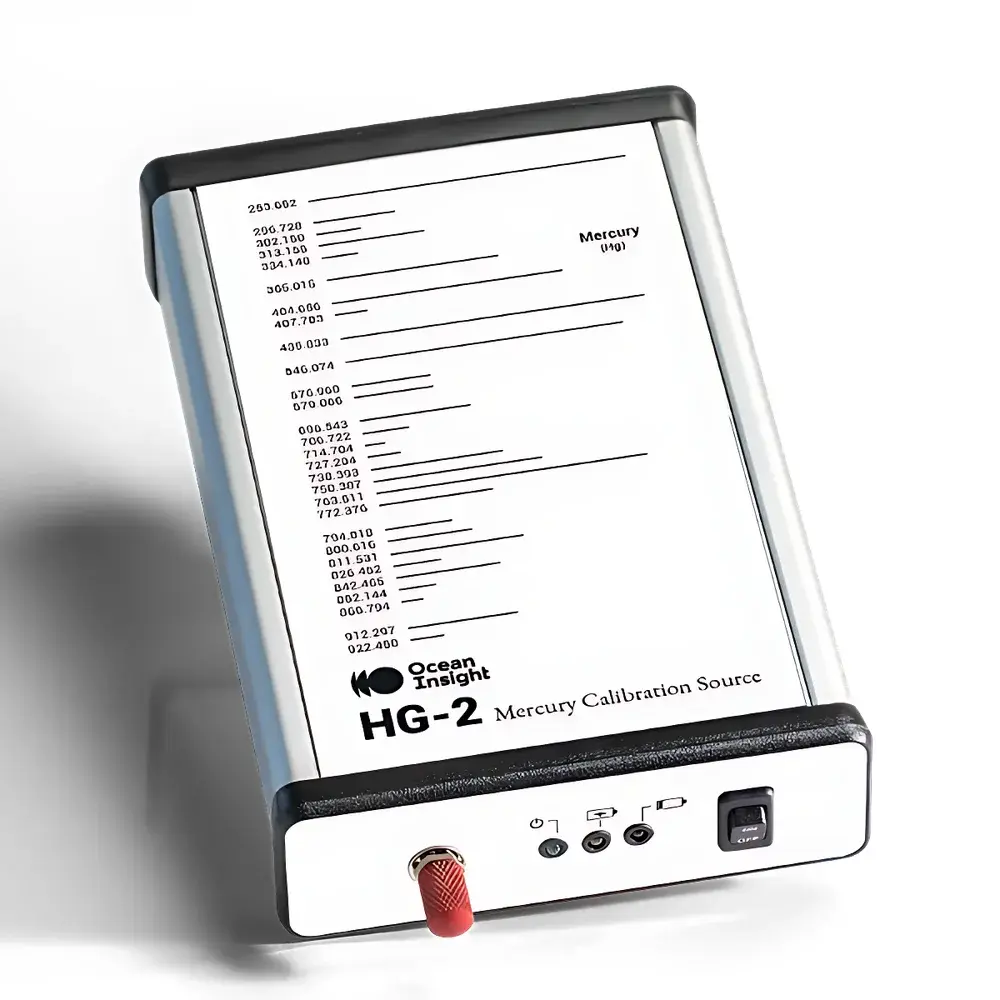
Ocean Optics Calibration Light Source – HG-2 Mercury Lamp Standard for UV-NIR Spectrometer Wavelength Validation
| Brand | Ocean Optics |
|---|---|
| Origin | USA |
| Manufacturer Type | Original Equipment Manufacturer (OEM) |
| Import Status | Imported |
| Model | HG-2 Calibration Light Source |
| Light Source Type | Low-Pressure Mercury Vapor Lamp |
| Illumination Mode | Internal Illumination Configuration |
| Dimensions | 12.6 × 7.0 × 2.6 cm |
| Weight | 180 g |
| Power Consumption | ≤2 A at 5 VDC (external supply or embedded Li-ion battery charging mode) |
| Battery | Rechargeable, integrated lithium-ion |
| Lamp Lifetime | 3,500 hours (typical) |
| Aperture Diameter | 3 mm |
| Amplitude Stability | <±0.5% over 60 s (after thermal stabilization) |
| Fiber Connector | SMA 905 |
| Spectral Range | 170–1700 nm (HG-2 variant) |
Overview
The Ocean Optics HG-2 Calibration Light Source is a precision-engineered, low-pressure mercury vapor lamp designed explicitly for high-fidelity wavelength calibration of spectrometers operating across the ultraviolet to near-infrared (UV-NIR) spectrum (170–1700 nm). It operates on the principle of atomic line emission: when electrically excited, mercury atoms emit discrete, narrowband spectral lines with well-documented vacuum wavelengths traceable to NIST standards. These emission features serve as immutable reference points for verifying and correcting spectrometer wavelength accuracy—critical for applications requiring regulatory compliance, inter-instrument comparability, or long-term data integrity. Unlike broadband sources, the HG-2 delivers sharp, stable atomic lines (e.g., 253.65 nm, 365.01 nm, 435.83 nm, 546.07 nm, 576.96/579.07 nm) whose positions are insensitive to ambient temperature or drive current fluctuations within specified operating limits. Its compact, battery-integrated design enables field-deployable calibration without reliance on mains power, supporting GLP-aligned workflows in mobile labs, cleanrooms, and instrument service environments.
Key Features
- Traceable atomic emission lines certified against NIST-referenced wavelength standards
- Integrated rechargeable lithium-ion battery and universal 5 VDC input—enables portable, off-grid calibration
- Thermally stabilized housing ensuring amplitude stability <±0.5% over 60 seconds post-startup
- SMA 905 fiber coupling optimized for minimal insertion loss and repeatable alignment
- 3 mm calibrated aperture for uniform irradiance delivery into spectrometer entrance optics
- Compact footprint (12.6 × 7.0 × 2.6 cm) and lightweight construction (180 g) for integration into OEM systems or benchtop calibration stations
- Lamp lifetime rated at 3,500 hours under nominal drive conditions—validated via accelerated life testing per IEC 62471
Sample Compatibility & Compliance
The HG-2 is compatible with all Ocean Optics spectrometers (e.g., Flame, Maya2000 Pro, QE Pro) and third-party CCD/CMOS-based optical spectrometers equipped with SMA 905 input interfaces. Its emission profile is especially effective for instruments configured with 300–3600 grooves/mm diffraction gratings; line visibility is enhanced with higher groove density gratings (e.g., 1200–3600 g/mm), where resolution permits clear separation of closely spaced doublets such as the 576.96/579.07 nm mercury pair. The device complies with IEC 61000-6-3 (EMC emission limits) and IEC 62471 (photobiological safety classification: Risk Group 1). It supports audit-ready calibration documentation per ISO/IEC 17025 and FDA 21 CFR Part 11 requirements when used in conjunction with Ocean Insight’s OceanView software with enabled electronic signature and audit trail modules.
Software & Data Management
When paired with OceanView v2.4+ or OceanInsight’s SpectraSuite software, the HG-2 enables automated wavelength calibration routines—including peak detection, centroid fitting, polynomial order selection (linear to 5th-order), and residual error reporting. Raw intensity data is exported in CSV or HDF5 format with embedded metadata (timestamp, serial number, lamp age, ambient temperature). Software-generated calibration reports include uncertainty budgets derived from line width, signal-to-noise ratio, and grating dispersion model parameters. All calibration events are logged with user ID, instrument ID, and digital signature—fully compliant with ALCOA+ principles (Attributable, Legible, Contemporaneous, Original, Accurate, Complete, Consistent, Enduring, Available) for regulated QC/QA environments.
Applications
- Factory and field recalibration of UV-Vis-NIR spectrometers prior to routine analysis
- Verification of wavelength accuracy in pharmaceutical dissolution testing (USP <711>)
- Validation of optical emission spectroscopy (OES) systems in metallurgical process control
- Reference standard for inter-laboratory comparison studies under ISO/IEC 17043
- Teaching laboratory use for demonstrating atomic spectra, Bohr model transitions, and grating resolution limits
- Supporting ASTM E275, ASTM E334, and ISO 13406-2 spectral characterization protocols
FAQ
How often should the HG-2 be used for wavelength calibration?
Typical practice is pre-analysis calibration for critical measurements; daily calibration is recommended for GMP-regulated environments. Drift monitoring via periodic verification using the 253.65 nm and 546.07 nm lines is advised between full calibrations.
Can the HG-2 be used with fiber-optic probes or integrating spheres?
Yes—provided the coupled fiber has NA ≤ 0.22 and core diameter ≥ 200 µm. For integrating sphere applications, ensure incident irradiance remains below 10 mW/cm² to avoid saturation or thermal artifact generation.
Is the lamp output affected by ambient temperature?
Minor shifts (<0.005 nm/°C) occur in mercury line positions due to thermal expansion of the quartz envelope; however, these are negligible within ±5°C of 25°C ambient and fall well within typical spectrometer pixel resolution limits.
Does the HG-2 require warm-up time before use?
Yes—allow 90 seconds after power-on for thermal equilibrium and spectral stabilization. Intensity reaches >95% of steady-state value within this period.
How is lamp aging tracked in compliance workflows?
OceanView software logs cumulative operating hours and flags calibration events exceeding 3,000 hours; replacement is recommended at 3,500 hours to maintain <±0.1 nm wavelength accuracy across primary lines.




