
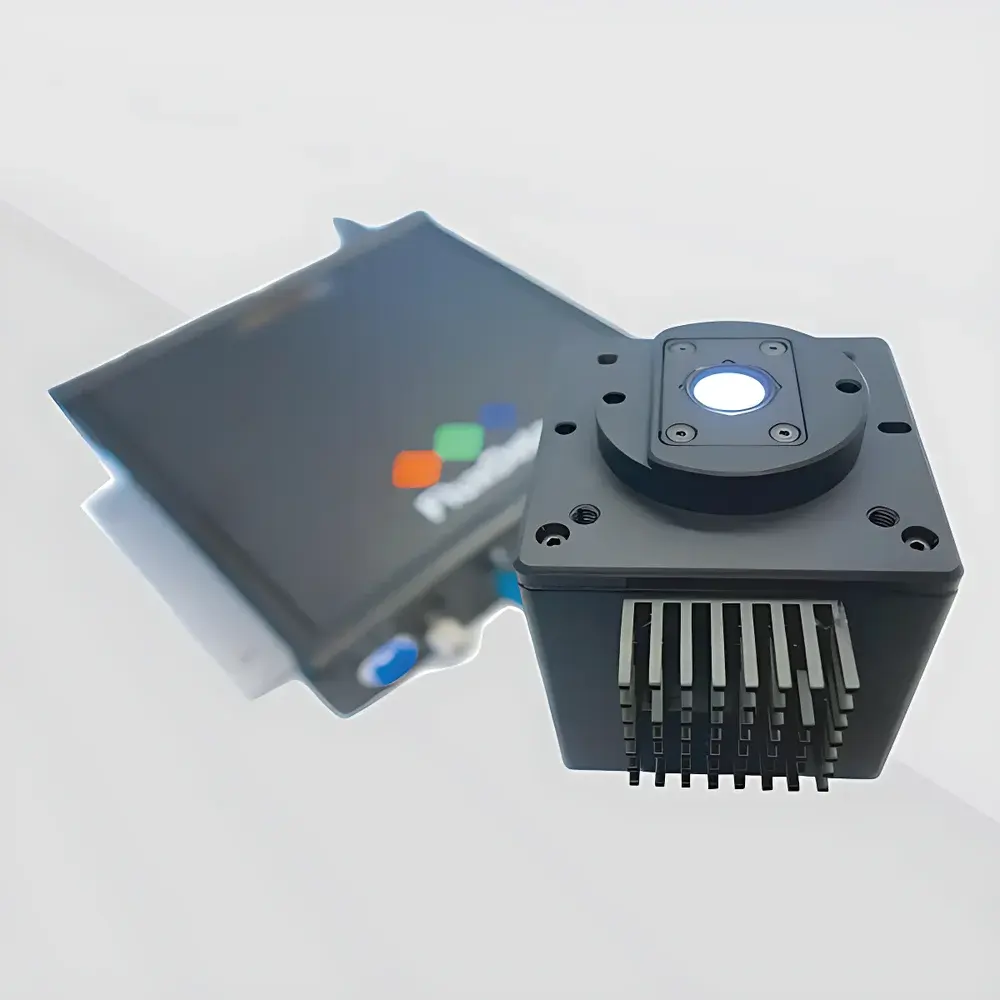
Ocean Optics FD-D8-M2 Non-Contact Industrial Spectrophotometer
| Brand | Ocean Optics |
|---|---|
| Origin | Shanghai, China |
| Manufacturer Type | Manufacturer |
| Product Category | Spectrophotometer |
| Instrument Type | In-Line |
| Optical Geometry | d/8° (Diffuse Illumination / 8° Viewing) |
| Light Source | Pulsed LED |
| Spectral Range | 400 nm – 700 nm |
| Repeatability | 0.01 ΔE*ab |
Overview
The Ocean Optics FD-D8-M2 Non-Contact Industrial Spectrophotometer is an in-line, d/8° geometry spectrophotometric measurement system engineered for high-speed, high-reproducibility color quality control in continuous manufacturing environments. It operates on the CIE-compliant diffuse illumination / 8° viewing principle—where light is uniformly diffused over a spherical integrating cavity and reflected radiance is collected at precisely 8° from the normal axis—enabling robust separation of specular-included (SCI) and specular-excluded (SCE) measurements per CIE Publication No. 15:2018. Designed for integration into automated production lines, the FD-D8-M2 eliminates physical contact with substrates during spectral acquisition, mitigating surface damage, contamination risk, and mechanical wear. Its core optical architecture features a 50 mm diameter integrating sphere with a sapphire-sealed measurement port, ensuring long-term stability under industrial particulate, thermal, and humidity fluctuations (operational range: 15–30 °C, RH <80%, non-condensing). The system delivers full spectral reflectance data (400–700 nm, 10 nm interval, FWHM ≈6 nm) and derived CIE L*a*b*, ΔE*ab, and spectral power distribution metrics with metrological traceability to NIST-certified standards.
Key Features
- Non-contact measurement with 2 × 2 mm spot size and 10 mm illumination diameter—ideal for fragile, hot, or moving surfaces including coated metals, polymer films, textiles, and printed packaging
- Sub-150 ms total measurement cycle time, supporting throughput exceeding 500,000 samples per day per unit
- Sapphire-protected optical window (Vickers hardness >2000 HV) resistant to abrasion, chemical exposure, and thermal shock
- Dual-mode optical configuration: factory-configurable for SCI (total reflectance) or SCE (surface appearance) measurement per ISO 7724-1 and ASTM E308
- Integrated TCP/IP server interface enabling direct machine-to-machine (M2M) data streaming to MES, SCADA, or custom QA dashboards without manual intervention
- External TTL trigger I/O (BNC, 5 V) for precise synchronization with conveyor motion, robotic positioning, or PLC-controlled sampling events
- Modular architecture: optically isolated probe (58.0 × 124.5 × 73.9 mm, 0.36 kg) decoupled from electronics module (206.8 × 35.7 × 169.5 mm, 1.93 kg), facilitating flexible line-side mounting and service accessibility
Sample Compatibility & Compliance
The FD-D8-M2 accommodates flat, curved, textured, and thermally dynamic substrates across automotive, electronics, food packaging, and pharmaceutical secondary packaging industries. Its fixed 0.5 ± 0.1 mm working distance ensures consistent geometric response without auto-focus mechanisms—reducing calibration drift and maintenance intervals. Measurement repeatability is validated per ISO 13655:2017 (Graphic technology — Spectral measurement and colorimetric computation for graphic arts images) using 100 consecutive readings on NIST-traceable white calibration tiles (σ ≤ 0.01 ΔE*ab). Inter-instrument agreement meets ISO 12647-2:2013 requirements (average inter-instrument difference: 0.12 ΔE*ab across 12 reference tiles; max deviation: 0.4 ΔE*ab across 40 units). The system supports GLP/GMP-aligned audit trails when integrated with compliant data acquisition software and satisfies FDA 21 CFR Part 11 electronic record requirements via timestamped, user-authenticated, immutable data logging.
Software & Data Management
The FD-D8-M2 communicates via native TCP/IP socket protocol, enabling seamless integration with LabVIEW, Python (PySerial/TCP), MATLAB, or proprietary SPC platforms. Included firmware supports real-time spectral transmission (raw 1024-channel intensity vectors), CIE XYZ, L*a*b*, and ΔE*ab calculations onboard—minimizing host processing latency. Calibration data (white/dark references, wavelength mapping) is stored internally with version-stamped metadata. USB 2.0 interface provides local firmware updates and diagnostic access. Software compatibility extends to Windows 7/10/11 (64-bit); no proprietary runtime dependencies are required. All spectral and colorimetric outputs conform to CIE 15:2018, ISO/CIE 11664 series, and ASTM E2214 standards for digital color data exchange.
Applications
- Real-time color deviation monitoring on high-speed printing presses (flexo, gravure, offset)
- In-line verification of paint, powder coating, and anodized finish consistency on automotive body panels
- Batch-to-batch color matching validation for medical device housings and diagnostic consumables
- Quality gate inspection of laminated labels, blister packs, and child-resistant packaging
- Process endpoint detection in dyeing, pigment dispersion, and ink formulation lines
- Automated reject sorting based on multi-point spatial color uniformity analysis (with synchronized multi-probe arrays)
FAQ
What does “d/8° geometry” mean in practice for industrial color measurement?
It denotes diffuse illumination over a spherical cavity with detection at 8° from the surface normal—ensuring measurement insensitivity to sample orientation, gloss variation, and minor topography, as specified in ISO 7724-1 and CIE 15:2018.
Can the FD-D8-M2 measure curved or textured surfaces reliably?
Yes—its fixed-focus, short-working-distance design and large illumination area (Ø10 mm) provide stable signal capture on moderately curved (R ≥ 25 mm) and micro-textured surfaces without repositioning or averaging artifacts.
Is NIST traceability provided with each unit?
Each FD-D8-M2 ships with a NIST-traceable white calibration tile and a certificate documenting spectral responsivity verification against NIST SRM 2010 and 2020 standards.
How is data security and audit compliance ensured?
When deployed with validated third-party acquisition software, the system supports role-based access control, electronic signatures, and immutable audit logs meeting FDA 21 CFR Part 11 and EU Annex 11 requirements.
What maintenance is required beyond routine calibration?
No optical alignment or lamp replacement is needed—the pulsed LED source exceeds 250 million cycles (>10 years at 10 Hz operation); only periodic sapphire window cleaning with isopropyl alcohol is recommended.





