
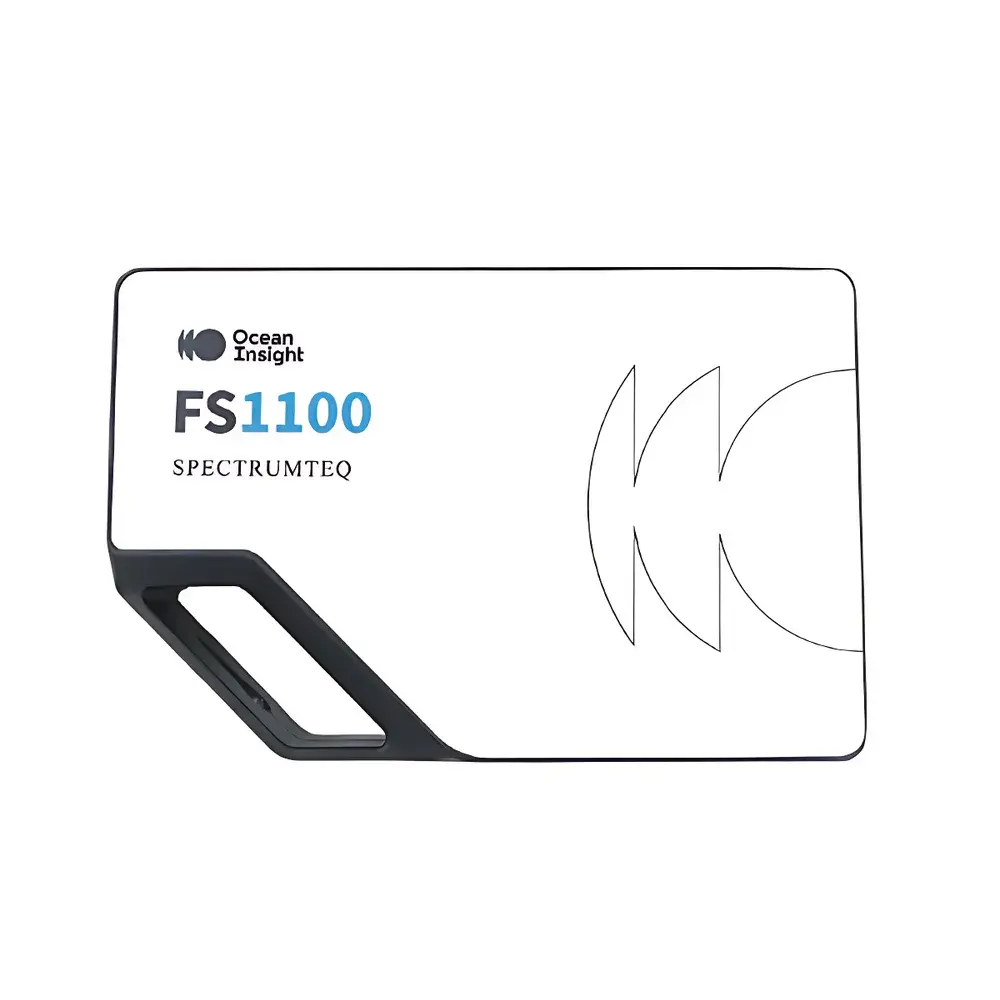
Ocean Optics FS1100 Handheld Field Spectroradiometer
| Brand | Ocean Optics |
|---|---|
| Origin | USA |
| Manufacturer Type | Original Equipment Manufacturer (OEM) |
| Import Status | Imported |
| Model | FS1100 |
| Spectral Range | 300–1100 nm |
| Detector Type | CCD |
| Optical Resolution (FWHM) | 1.3 nm |
| Signal-to-Noise Ratio | 450:1 |
| Dynamic Range | 8,000:1 |
| Stray Light | <0.05% at 600 nm |
Overview
The Ocean Optics FS1100 Handheld Field Spectroradiometer is a rugged, field-deployable fiber-optic spectrometer engineered for high-fidelity reflectance spectroscopy across the solar-illuminated spectral domain (300–1100 nm). Unlike laboratory-based spectrometers optimized for controlled illumination and stable sample positioning, the FS1100 is purpose-built for in situ terrestrial and aquatic surface characterization under ambient daylight conditions. Its optical architecture leverages a fixed-grating, slit-coupled CCD detector system operating on the principle of dispersed spectral irradiance measurement—enabling quantitative derivation of bidirectional reflectance distribution function (BRDF)-informed reflectance spectra when paired with calibrated reference panels (e.g., Spectralon®) and cosine-corrected fore-optics. The instrument’s spectral response is traceably aligned to NIST-traceable standards, supporting metrologically defensible data acquisition for environmental remote sensing validation, vegetation index derivation, and surface material identification.
Key Features
- Optimized optical path design with thermally stabilized CCD detector for consistent spectral fidelity across diurnal temperature fluctuations (operational range: 0–40 °C)
- Fixed 1.3 nm FWHM resolution—sufficient to resolve narrow absorption features critical for chlorophyll-a, water, and cellulose detection in vegetation and soil spectra
- High dynamic range (8,000:1) and low stray light (<0.05% @ 600 nm) ensure accurate quantification of both high-reflectance (e.g., snow, sand) and low-reflectance (e.g., deep water, organic soils) targets
- Integrated Android-compatible application and Windows-based Overture™ software enable real-time spectral preview, auto-exposure control, and on-device calibration management
- Low-power e-ink display with sunlight-readable interface extends battery life to >12 hours per charge under typical field duty cycles
- Modular fiber-optic coupling (SMA 905) supports interchangeable fore-optics—including cosine correctors, contact probes, and underwater housings—for multi-environment deployment
Sample Compatibility & Compliance
The FS1100 is designed for non-contact, non-destructive measurement of natural and anthropogenic surface materials under uncontrolled solar illumination. It accommodates heterogeneous, irregular, and spatially variable samples—including leaf canopies, soil horizons, sediment suspensions, coral surfaces, and painted or weathered infrastructure. Calibration protocols conform to ASTM E275–21 (Standard Practices for Describing and Measuring Performance of UV–VIS–NIR Spectrophotometers) and ISO 17123-8:2020 (Optics and photonics — Field procedures for testing geospatial imaging sensors — Part 8: Reflectance-based radiometric calibration). Data integrity meets GLP-aligned audit trail requirements via timestamped metadata embedding (GPS, UTC time, integration time, lamp status, calibration file ID) in all exported spectra (CSV, TXT, ASD-compatible .sig).
Software & Data Management
Overture™ desktop software provides full spectral processing capabilities including dark-current subtraction, reference normalization, spectral smoothing (Savitzky-Golay), derivative analysis, and index calculation (NDVI, EVI, NDWI, PRI). Raw data export supports interoperability with ENVI, Python (via seabreeze and numpy), and R (hyperSpec package). Android mobile app enables field-level QA/QC—live signal visualization, exposure optimization, batch metadata tagging (site ID, observer, notes), and encrypted Wi-Fi sync to cloud storage or local NAS. All firmware updates and calibration files are digitally signed and version-controlled to ensure traceability per FDA 21 CFR Part 11 Annex 11 principles.
Applications
- Validation of satellite and airborne hyperspectral sensor products (e.g., Sentinel-2, Landsat-9, PRISMA) through ground truth spectral libraries
- Time-series monitoring of vegetation phenology, stress physiology, and nutrient status using red-edge and near-infrared absorption features
- Quantitative assessment of soil organic carbon, iron oxide content, and moisture gradients via continuum-removed absorption depth analysis
- In situ water quality profiling—including chlorophyll-a concentration, CDOM, and suspended particulate matter—using above-water reflectance protocols (NASA SeaPRISM)
- Ecological habitat mapping in coastal zones, wetlands, and alpine tundra where portability and rapid deployment are operationally decisive
FAQ
What spectral calibration standards are supported?
The FS1100 ships with factory calibration against NIST-traceable tungsten-halogen and deuterium lamps; users may perform field recalibration using Ocean Insight’s CR-1 cosine receptor and certified 99% Spectralon® reference panel.
Is underwater spectral measurement possible?
Yes—when coupled with the optional waterproof fiber probe (IP68-rated) and pressure-compensated housing, the FS1100 supports submerged reflectance measurements down to 10 m depth following standard above-water correction protocols.
How is GPS synchronization handled?
Integrated GNSS module (GPS + GLONASS) timestamps each spectrum with sub-second UTC accuracy and embeds WGS84 coordinates directly into metadata headers without requiring external devices.
Can the FS1100 operate in continuous scanning mode?
Yes—via USB-C or Bluetooth LE, the device supports programmable scan sequences (up to 1,000 spectra per session) with variable integration times, ideal for transect-based ecological surveys or UAV-mounted deployments.
Does the system comply with data integrity requirements for regulatory submissions?
All spectral data files include immutable metadata hashes, electronic signatures, and revision-controlled calibration logs—fully compliant with ALCOA+ principles and suitable for inclusion in EPA, USDA, or ESA-funded research deliverables.





