
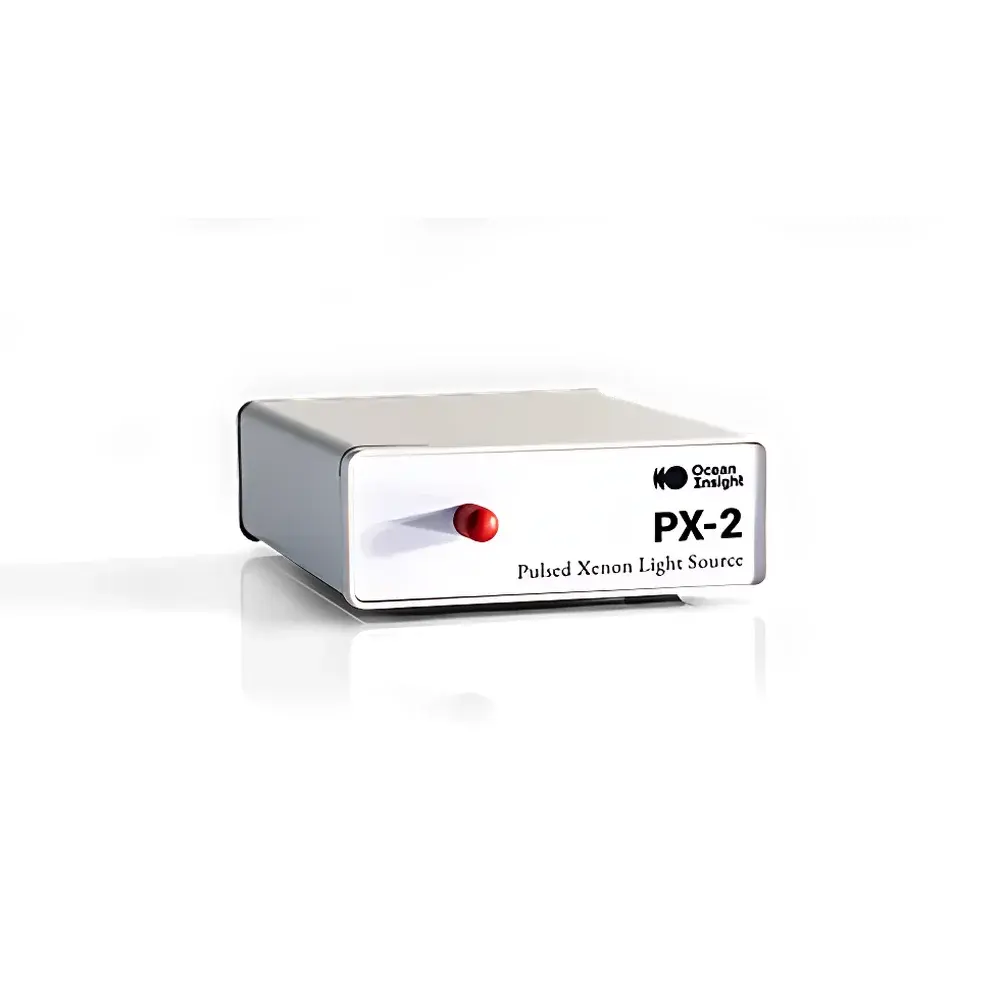
Ocean Optics HPX-2000 High-Power Continuous Xenon Light Source
| Brand | Ocean Optics |
|---|---|
| Model | HPX-2000 |
| Light Source Type | Xenon Lamp |
| Spectral Range | 185–2200 nm |
| Output Power | 35 W |
| Electrical Input | 60 W AC |
| Dimensions | 145 × 165 × 260 mm |
| Weight | 5000 g |
| Lamp Lifetime | ≥1000 h (typ. 2000 h) |
| Shutter Control | Integrated mechanical shutter with manual switch & TTL-compatible trigger (15-pin D-sub) |
| Filter Holder | Accepts 25 mm round or 25 × 25 mm square filters, up to 14 mm thick |
| Fiber Coupling | SMA 905 connector |
| UV-Optimized Operation | Requires UV-grade optical fiber for sub-300 nm applications |
Overview
The Ocean Optics HPX-2000 is a high-intensity, continuous-wave (CW) xenon arc lamp source engineered for demanding optical applications requiring broad-spectrum irradiance from deep ultraviolet through near-infrared wavelengths. Operating on the principle of high-pressure DC-excited gas discharge, the HPX-2000 employs a short-arc xenon lamp to generate stable, spatially uniform output across 185–2200 nm — a spectral span critical for fluorescence excitation, reflectance spectroscopy, photochemical reaction monitoring, and calibration of spectrometers and detectors. Unlike pulsed xenon sources (e.g., the PX-2), the HPX-2000 delivers steady-state illumination ideal for time-resolved intensity measurements, kinetic assays, and integration with scanning monochromators or imaging systems where temporal stability and low flicker are essential. Its 35 W effective radiant output—derived from a 60 W AC input—is optimized for coupling into optical fibers (SMA 905 interface), enabling flexible light delivery to sample compartments, flow cells, or custom optical benches.
Key Features
- Stable CW xenon arc emission with minimal intensity drift (<±1.5% over 1 hour at thermal equilibrium)
- Broadband spectral coverage from 185 nm (vacuum UV-capable with purge option) to 2200 nm, supporting multi-region analytical workflows
- Integrated mechanical shutter with dual control modes: front-panel toggle switch and TTL-compatible external triggering via 15-pin D-sub connector
- Dedicated filter holder accommodating standard 25 mm round or 25 × 25 mm square optical filters (up to 14 mm thickness), facilitating wavelength selection without external optics
- Modular lamp cartridge design enabling field-replaceable operation; users may either return the unit for professional lamp replacement or install pre-aligned spare modules
- Thermally managed housing with passive convection cooling, eliminating fan-induced vibration or acoustic noise—critical for interferometric or confocal configurations
- UV-optimized mechanical and optical architecture: quartz envelope transmits down to 185 nm; recommended use with solarization-resistant UV-grade silica fibers (e.g., Ocean Insight’s UV-VIS or UV-Vis-NIR bundles)
Sample Compatibility & Compliance
The HPX-2000 is compatible with liquid, solid, and gaseous samples when integrated into standard cuvette holders, integrating spheres, or custom illumination chambers. Its spectral continuity supports compliance with ASTM E308 (computing CIE tristimulus values), ISO 13406-2 (display luminance uniformity testing), and USP (spectrophotometer qualification under photometric accuracy protocols). For regulated environments, the device’s deterministic shutter timing and traceable lamp lifetime (loggable via internal hour meter) support GLP/GMP documentation requirements. While not intrinsically certified for Class I laser safety, its collimated output adheres to IEC 62471 Photobiological Safety classification for broadband lamps (Risk Group 2 for unfiltered UV exposure; mitigation via filtering or enclosure is advised per application-specific hazard analysis).
Software & Data Management
The HPX-2000 operates as a standalone hardware component with no embedded firmware or driver dependency. Shutter actuation is fully hardware-synchronized: TTL pulses (5 V CMOS logic, minimum 10 µs width) trigger precise open/close transitions with ≤5 ms mechanical latency—enabling tight synchronization with spectrometer acquisition (e.g., Ocean Insight’s QE Pro or Maya2000 Pro), camera gate signals, or electrochemical potentiostat triggers. Integration with third-party platforms (LabVIEW, Python via PyVISA, MATLAB Instrument Control Toolbox) is achieved using standard digital I/O lines. Lamp usage hours are tracked mechanically (non-volatile counter), supporting preventive maintenance scheduling aligned with ISO/IEC 17025 Clause 6.4.3 (equipment management). No proprietary software is required; configuration and logging are performed externally via user-defined scripts or DAQ systems.
Applications
- Fluorescence excitation profiling across protein tryptophan (280 nm), nucleic acid (260 nm), and quantum dot (350–600 nm) bands
- Reflectance and transmittance measurements of optical coatings, thin films, and photovoltaic materials per ASTM F739 and ISO 9050
- In situ photochemical reactor monitoring (e.g., TiO₂ photocatalysis, H₂O₂ decomposition) under controlled UV-vis irradiance
- Calibration of array detectors, FTIR accessories, and hyperspectral imagers requiring NIST-traceable spectral radiance standards
- Accelerated weathering studies in material science labs where broadband solar-simulated irradiance (per ASTM G155) is required without AM1.5G filtering
- Microscopy illumination for widefield epifluorescence when coupled with dichroic filter cubes and high-NA objectives
FAQ
Is the HPX-2000 suitable for vacuum UV (VUV) applications below 190 nm?
Yes — with nitrogen purging or vacuum coupling, the fused silica envelope transmits down to 185 nm. However, standard optical fibers absorb strongly below 200 nm; dedicated VUV fiber probes (e.g., MgF₂-clad) are required.
Can the HPX-2000 be synchronized with a gated CCD spectrometer?
Yes — its TTL-controlled shutter provides deterministic timing with sub-millisecond jitter, enabling lock-in detection schemes and background subtraction protocols.
What is the recommended maintenance interval for lamp replacement?
Lamp replacement is advised after 1000 hours of operation or upon measurable decline in UV output (>15% drop at 254 nm); typical service life extends to 2000 hours under stable thermal conditions.
Does the unit include radiometric calibration data?
No — absolute spectral irradiance calibration is application-dependent and requires separate NIST-traceable reference standards (e.g., Ocean Insight’s HL-3-CAL). The HPX-2000 is supplied with relative spectral power distribution (SPD) curves.
Is fan cooling available as an option?
No — the HPX-2000 relies exclusively on passive convection. Forced-air cooling would compromise mechanical stability and introduce particulate contamination risk in cleanroom or optical table environments.




