
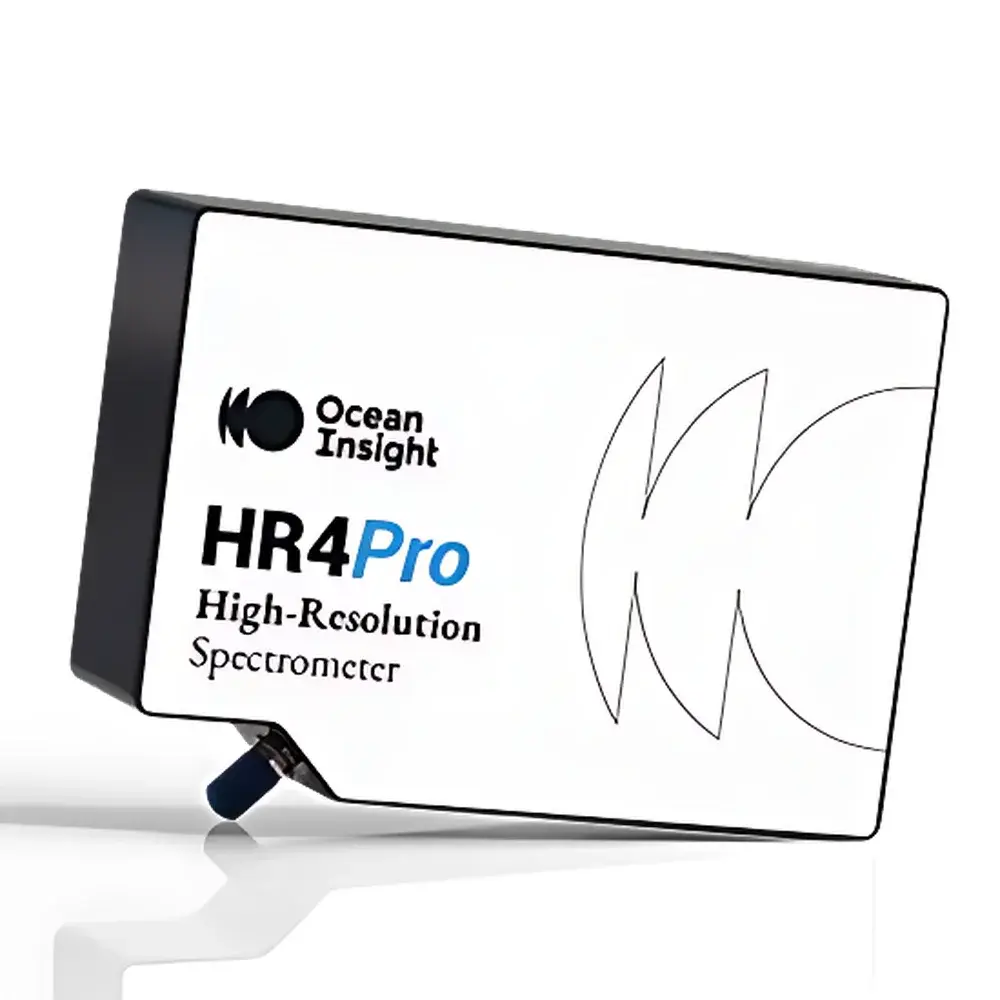
Ocean Optics HR4Pro High-Resolution Fiber Optic Spectrometer
| Brand | Ocean Optics |
|---|---|
| Origin | Shanghai, China |
| Manufacturer Type | Authorized Distributor |
| Product Origin | Domestic (China) |
| Model | HR4Pro |
| Spectral Range | 190 nm – 1100 nm |
| Detector | Linear Silicon CCD Array |
| Optical Resolution (FWHM) | 0.42 nm (typ.), 0.72 nm (typ.), 0.47 nm (typ.), 0.62 nm (typ.), ~0.66 nm (typ.), ~0.9 nm (typ.) |
| Sensitivity | 6 counts per photon (RMS dark noise) |
| Signal-to-Noise Ratio | 250:1 (full signal), 290:1 (full signal), 300:1 (full signal) |
| Dynamic Range | 2000:1 (single acquisition), 2500:1 (single acquisition), 1500:1 (single acquisition) |
| Stray Light | <0.05% at 600 nm, <0.10% at 435 nm |
| Integration Time | 3.8 ms – 10 s |
| Linearity | ±0.5% nonlinearity |
| Thermal Drift | 0.03–0.06 pixels/°C |
| Dimensions | 148.6 mm × 104.8 mm × 45.1 mm |
| Weight | 570 g |
| Interface | USB 2.0 (480 Mbps), RS-232 (2-wire), I²C |
| Slit Options | 5 µm, 10 µm |
| Grating Options | H13, H38, H48, HC1 |
| A/D Resolution | 14-bit |
| Fiber Coupling | SMA 905 |
Overview
The Ocean Optics HR4Pro High-Resolution Fiber Optic Spectrometer is an engineered optical measurement platform designed for precision wavelength characterization and spectral analysis in demanding laboratory, field-deployable, and industrial process environments. Based on the principle of Czerny-Turner optical architecture with optimized collimation and focusing optics, the HR4Pro delivers high spectral fidelity through a combination of low-aberration imaging, thermally stable mechanical design, and calibrated linear silicon CCD detection. Its core capability lies in resolving narrow spectral features—such as atomic emission lines, laser modes, or LED peak widths—with optical resolution down to 0.42 nm FWHM (full width at half maximum), depending on grating selection, slit width, and configuration. The instrument supports three pre-aligned spectral bands: UV-Vis (200–875 nm), Vis-NIR (350–1025 nm), and extended-range (200–1100 nm), enabling flexible deployment across diverse photonic applications without recalibration or realignment.
Key Features
- Thermal stability improved up to 10× over previous compact spectrometers—drift as low as 0.03 pixels/°C ensures consistent wavelength calibration during extended acquisitions or ambient temperature fluctuations.
- Modular optical configuration: interchangeable slits (5 µm or 10 µm), high-efficiency holographic gratings (H13, H38, H48, HC1), and optimized coatings enable tailored resolution/sensitivity trade-offs for specific use cases.
- High-speed spectral acquisition with integration times from 3.8 ms to 10 s—enabling time-resolved measurements of transient phenomena such as plasma decay, pulsed LED output, or laser ignition events.
- Robust electronic architecture featuring 14-bit analog-to-digital conversion, low-noise amplification, and RMS dark noise of only 6 counts—critical for low-light applications including fluorescence spectroscopy and weak emission line detection.
- Multi-interface connectivity: native USB 2.0 (480 Mbps), optional RS-232 (2-wire), and I²C serial bus support synchronized triggering and integration into automated test benches, OEM systems, or distributed sensor networks.
- Compact footprint (148.6 × 104.8 × 45.1 mm) and lightweight design (570 g) facilitate integration into portable analyzers, handheld devices, or space-constrained instrumentation racks.
Sample Compatibility & Compliance
The HR4Pro interfaces seamlessly with standard SMA 905 fiber-optic cables, supporting both free-space and fiber-coupled excitation/detection geometries. It is compatible with common light sources—including deuterium and tungsten-halogen lamps, pulsed and CW lasers, LEDs, and plasma emission sources—as well as sample interfaces such as cuvette holders, integrating spheres, and reflection probes. While not certified for regulated GMP or FDA 21 CFR Part 11 environments out-of-the-box, the spectrometer’s stable calibration traceability, reproducible dark current correction, and software-accessible metadata (including timestamp, integration time, and detector temperature) support GLP-compliant data capture when integrated with validated third-party acquisition platforms. Its stray light performance (<0.05% at 600 nm) meets ASTM E275 and ISO 17025 requirements for quantitative absorbance and reflectance measurements where spectral purity is critical.
Software & Data Management
Ocean Insight’s OceanView software provides full instrument control, real-time spectral visualization, and batch processing capabilities—including peak identification, spectral subtraction, baseline correction, and multivariate analysis (PCA, PLS). Raw spectral data is exportable in CSV, TXT, and HDF5 formats, preserving full metadata for audit trails and long-term archival. The SDK (available for Python, MATLAB, LabVIEW, C#, and C++) enables custom automation, embedded system integration, and compliance-ready logging—supporting timestamped spectra with hardware-trigger synchronization and configurable data buffering. For regulated environments, users may implement external audit trail mechanisms via file-system-level logging or integrate with LIMS platforms using standardized API calls.
Applications
- Atomic emission spectroscopy: Identification and quantification of elemental lines in plasma diagnostics, arc/spark sources, and flame analysis.
- Laser and LED characterization: Measurement of center wavelength, spectral bandwidth (FWHM), side-mode suppression ratio (SMSR), and temperature-dependent drift.
- Thin-film and photovoltaic analysis: Reflectance, transmittance, and absorption profiling for anti-reflective coatings, perovskite layers, and silicon wafer quality control.
- Gas-phase monitoring: Detection of narrow-band absorption features (e.g., O₂ A-band at 760 nm, NO at 226 nm) in environmental or combustion exhaust streams.
- UV curing and photopolymerization: Real-time tracking of monomer depletion and cross-linking kinetics via characteristic absorbance decay.
- Fluorescence lifetime precursor analysis: High-S/N spectral acquisition synchronized with pulsed excitation for time-gated spectral decomposition.
FAQ
What spectral resolution can I achieve with the HR4Pro?
Optical resolution depends on grating choice, slit width, and pixel binning. Typical FWHM values range from 0.42 nm to 0.9 nm; configurations with 5 µm slits and high-line-density gratings (e.g., HC1) yield sub-0.5 nm resolution.
Is the HR4Pro suitable for quantitative absorbance measurements?
Yes—when used with calibrated light sources and reference standards, its linearity (±0.5% NL) and low stray light (<0.05% at 600 nm) support Beer-Lambert law-based concentration calculations in UV-Vis spectroscopy.
Can I operate the HR4Pro in varying ambient temperatures?
Yes—the thermal drift specification (0.03–0.06 pixels/°C) and internal temperature monitoring allow for active wavelength recalibration or post-acquisition pixel-shift correction in non-climate-controlled settings.
Does the HR4Pro support external triggering?
Yes—it accepts TTL-level trigger signals via USB or RS-232, enabling precise synchronization with pulsed lasers, shutters, or motion stages for time-resolved or spatially resolved measurements.
What is the maximum frame rate at minimum integration time?
At 3.8 ms integration time and full-frame readout, the HR4Pro achieves up to ~220 spectra per second—subject to USB host controller latency and software overhead.
Related Products




