
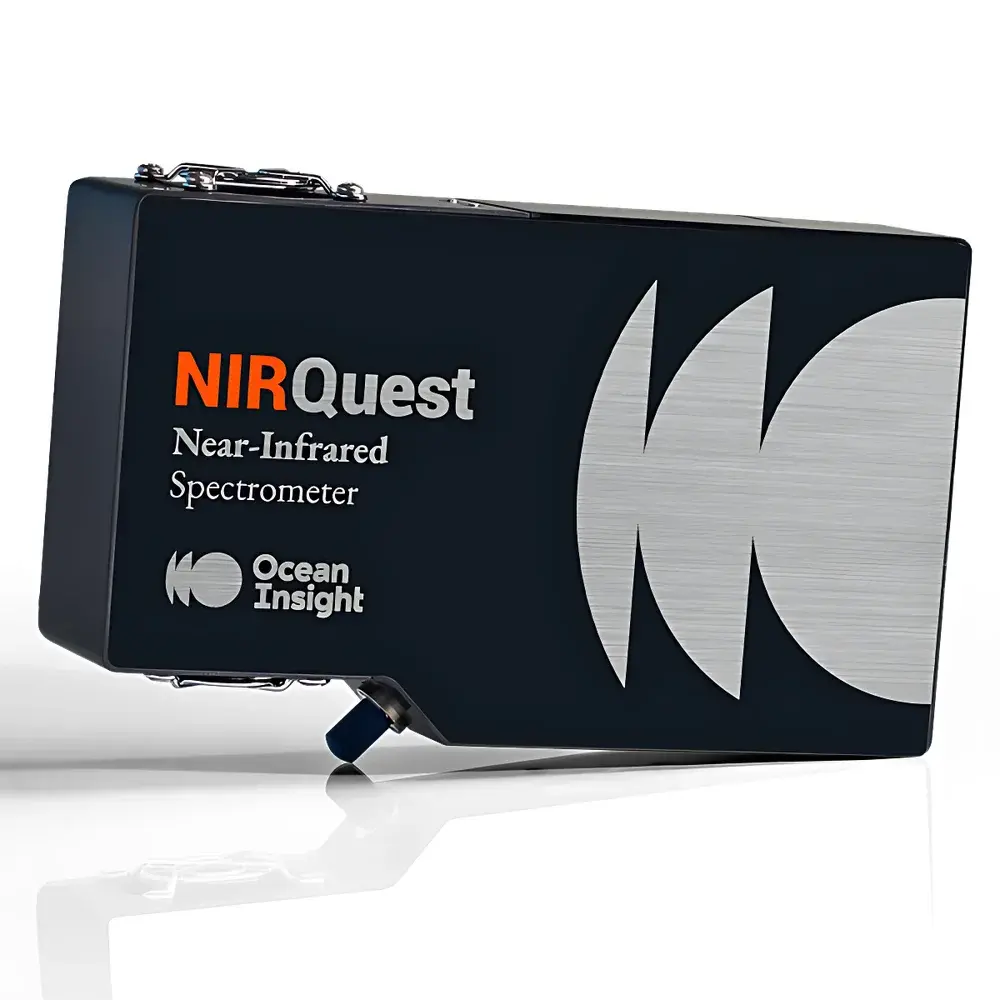
Ocean Optics NIRQuest+ High-Sensitivity Fiber Optic Near-Infrared Spectrometer
| Brand | Ocean Optics |
|---|---|
| Origin | Shanghai, China |
| Manufacturer Type | Original Equipment Manufacturer (OEM) |
| Regional Classification | Domestic (China) |
| Model | NIRQuest+ |
| Spectral Range | 900 nm – 2500 nm |
| Detector | InGaAs linear array |
| Resolution | 3.13 nm FWHM (typical), 5.47 nm FWHM (typical), 6.25 nm FWHM (typical) |
| Signal-to-Noise Ratio | >15,000:1 @ 100 ms integration |
| >13,000 | 1 @ 1000 ms integration |
| Dynamic Range | 7.5 × 10⁶ (system) |
| 10,000 | 1 (single acquisition) |
| Slit Width | 25 µm |
| Grating Options | GRATING_#NIR1, GRATING_#NIR2, GRATING_#NIR3 |
| Order-Sorting Filter | OF1-RG830 long-pass NIR filter (optional) |
| Dimensions | 182 × 110 × 47 mm |
| Weight | 1.18 kg (without power supply) |
| Integration Time | 1 ms – 12 s |
| Dark Noise | 6 RMS counts @ 100 ms |
| Fiber Connector | SMA 905 |
| Thermoelectric Cooling | -20 °C |
Overview
The Ocean Optics NIRQuest+ is a high-sensitivity, thermoelectrically cooled fiber optic near-infrared (NIR) spectrometer engineered for quantitative and qualitative analysis in the 900–2500 nm spectral region. Based on InGaAs linear array detector technology and optimized optical architecture—including enhanced throughput optics, precision-aligned gratings, and low-stray-light optical bench design—the NIRQuest+ delivers up to 2.5× higher sensitivity compared to its predecessor models. Its core measurement principle relies on dispersive spectroscopy: incoming light is collimated, diffracted by a ruled or holographic grating, and focused onto the InGaAs detector array, where photon flux is converted into digital intensity values per wavelength channel. The instrument operates under fixed-slit (25 µm), multiple grating configurations, and optional order-sorting filtering to suppress second-order artifacts—enabling robust, repeatable spectral acquisition across industrial, pharmaceutical, agricultural, and environmental applications requiring trace-level detection and rapid process feedback.
Key Features
- Thermoelectric cooling to –20 °C, reducing dark current and enabling stable, low-noise performance over extended integration periods
- Three preconfigured spectral ranges: NIRQuest+1.7 (900–1700 nm), NIRQuest+2.2 (900–2200 nm), and NIRQuest+2.5 (900–2500 nm)
- Optimized optical throughput via improved aperture design and anti-reflection coated optics, enhancing signal collection efficiency
- High dynamic range of 7.5 × 10⁶ (system-level) and 10,000:1 (single-scan), supporting both weak signal detection and high-intensity source characterization
- Configurable resolution options (3.13, 5.47, and 6.25 nm FWHM typical) achieved through interchangeable gratings and slit-compatible optical paths
- SMA 905 fiber coupling interface compatible with Ocean Insight’s full portfolio of broadband NIR light sources, integrating spheres, flow cells, and probe accessories
- Compact footprint (182 × 110 × 47 mm) and lightweight chassis (1.18 kg without PSU), facilitating OEM integration and portable field deployment
Sample Compatibility & Compliance
The NIRQuest+ supports direct fiber-coupled measurements from solid, liquid, and semi-solid samples—including powders, slurries, packaged goods, and biological tissues—when used with appropriate sampling interfaces (e.g., reflectance probes, transmission cuvettes, or diffuse reflectance contact probes). Its spectral coverage aligns with key molecular overtone and combination bands (e.g., C–H, O–H, N–H vibrations), making it suitable for ASTM E1655-compliant multivariate calibration workflows. The device meets CE marking requirements for electromagnetic compatibility (EN 61326-1) and safety (EN 61010-1). While not inherently 21 CFR Part 11 compliant, its data output format (ASCII, CSV, HDF5) and integration with Ocean Insight’s OceanView and OmniDriver SDK enable audit-trail-capable software implementations aligned with GLP and GMP laboratory practices when deployed within validated systems.
Software & Data Management
The NIRQuest+ is fully supported by Ocean Insight’s cross-platform OceanView spectroscopy software, which provides real-time spectral visualization, baseline correction, peak identification, and multivariate regression tools (PLS, PCA). Raw spectra are exported in vendor-neutral formats (CSV, ASCII, HDF5) for seamless import into MATLAB, Python (via seabreeze or oceanoptics-sdk), JMP, or Unscrambler. The OmniDriver SDK enables custom application development in C/C++, .NET, LabVIEW, and Python—supporting synchronous and asynchronous acquisition, hardware-triggered capture, and multi-device synchronization. All firmware updates and calibration files are digitally signed and version-controlled, ensuring traceability and reproducibility in regulated environments.
Applications
- Pharmaceutical Quality Control: Raw material identification (RMI), blend uniformity monitoring, tablet coating thickness analysis, and moisture content quantification per USP and Ph. Eur. 2.2.40
- Food & Agriculture: Non-destructive determination of moisture, protein, oil, and starch in grains, dairy, and meat products; ethanol and methanol quantification in fermentation streams
- Recycling & Polymer Sorting: Rapid classification of PET, PE, PP, and PVC based on spectral fingerprinting in sorting lines
- Biomedical Research: In vivo and ex vivo tissue oximetry, melanin/water/lipid ratio mapping, and non-invasive glucose monitoring feasibility studies
- Environmental Remote Sensing: Soil organic carbon estimation, vegetation health assessment (NDVI, PRI), and solar simulator spectral irradiance validation per IEC 60904-9
FAQ
What spectral resolution options are available, and how are they selected?
Resolution is determined by grating choice and optical configuration. Typical FWHM values are 3.13 nm, 5.47 nm, and 6.25 nm—each corresponding to a specific grating (GRATING_#NIR1/2/3) and calibrated during factory alignment.
Is the NIRQuest+ compatible with existing Ocean Insight accessories?
Yes—it uses standard SMA 905 connectors and maintains full mechanical and electrical compatibility with Ocean Insight’s NIR light sources, integrating spheres (e.g., ISP-REF), reflection probes (e.g., R400-7-UV-VIS), and temperature-stabilized sample holders.
How does thermoelectric cooling improve measurement stability?
Cooling to –20 °C reduces dark current by >90% versus uncooled operation, minimizing thermal drift and enabling consistent SNR across ambient temperature fluctuations and long-duration acquisitions.
Can the NIRQuest+ be integrated into automated production lines?
Yes—its TTL trigger input/output, USB 2.0 interface, and programmable integration time (1 ms – 12 s) support synchronized, high-throughput inline monitoring when paired with PLCs or machine vision controllers.
What calibration standards are provided with the instrument?
Each unit ships with NIST-traceable wavelength and radiometric calibration certificates, plus optional linearity and stray-light characterization reports upon request.




