
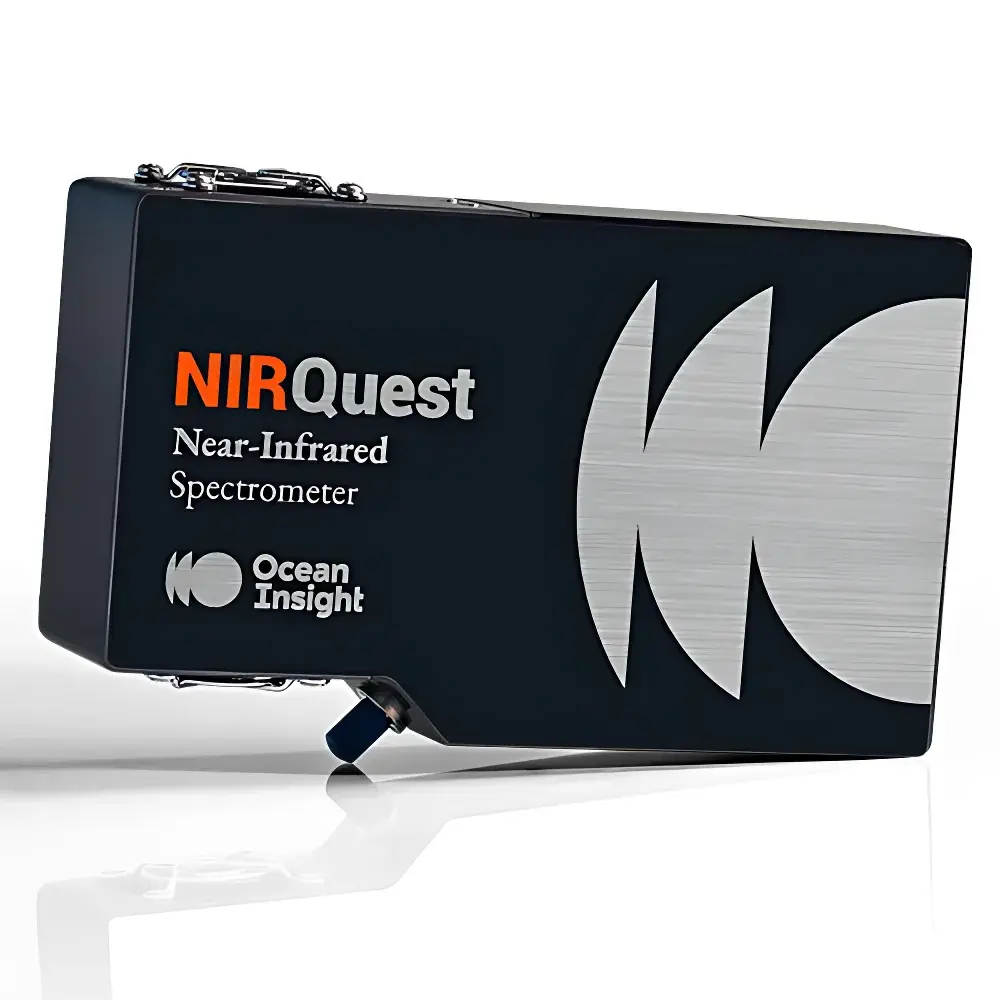
Ocean Optics NIRQuest+ High-Sensitivity Near-Infrared Spectrometer
| Brand | Ocean Optics |
|---|---|
| Origin | Shanghai, China |
| Manufacturer Type | Original Equipment Manufacturer (OEM) |
| Regional Classification | Domestic |
| Model | NIRQuest+ |
| Instrument Type | Portable |
| Operating Principle | Grating-Based Scanning Spectrometer |
| Wavelength Range | 900 nm – 2500 nm |
| Detector | Thermoelectrically Cooled InGaAs Linear Array |
| Slit Width | 25 µm |
| Optical Resolution (FWHM) | 3.13 nm (typ.), 5.47 nm (typ.), 6.25 nm (typ.) |
| Integration Time | 1 ms – 12 s |
| Dark Noise | 6–24 RMS counts (dependent on integration time) |
| Dynamic Range | 7.5 × 10⁴ (system) |
| 10,000 | 1 (single acquisition) |
| Signal-to-Noise Ratio | >15,000:1 @ 100 ms |
| >13,000 | 1 @ 1000 ms |
| Dimensions | 182 × 110 × 47 mm |
| Weight | 1.18 kg (without power supply) |
| Fiber Connector | SMA 905 |
| Order-Sorting Filter | OF1-RG830 Longpass NIR Filter (optional) |
| Grating Options | GRATING_#NIR1, GRATING_#NIR2, GRATING_#NIR3 |
Overview
The Ocean Optics NIRQuest+ is a thermoelectrically cooled, portable near-infrared (NIR) spectrometer engineered for high-sensitivity spectral acquisition across the 900–2500 nm range. Based on a fixed-grating scanning architecture with an InGaAs linear array detector, it delivers enhanced photon collection efficiency through optimized optical throughput, improved slit and collimator alignment, and low-noise electronics. Its core design targets applications requiring reliable detection of weak NIR signals—such as diffuse reflectance from heterogeneous solids, low-intensity transmission through turbid media, or rapid in-line monitoring under variable ambient conditions. The instrument operates without moving parts in its optical path, ensuring mechanical stability and long-term calibration retention. Thermal stabilization to –20 °C suppresses dark current generation, directly improving signal fidelity at extended integration times and enabling robust performance in environments where ambient temperature fluctuation would otherwise degrade measurement reproducibility.
Key Features
- Thermoelectric cooling to –20 °C for reduced dark current and improved signal-to-noise ratio (SNR), particularly critical for low-light and long-integration measurements.
- Enhanced optical bench design with precision-aligned 25 µm entrance slit and high-efficiency gratings (GRATING_#NIR1/2/3), yielding up to 2.5× higher responsivity compared to prior-generation NIRQuest models.
- Three preconfigured spectral ranges: NIRQuest+1.7 (900–1700 nm), NIRQuest+2.2 (900–2200 nm), and NIRQuest+2.5 (900–2500 nm), each optimized for specific application domains including pharmaceutical raw material verification and agricultural commodity analysis.
- Compact form factor (182 × 110 × 47 mm) and lightweight construction (1.18 kg) support field-deployable operation, integration into OEM systems, and benchtop QC workflows without sacrificing optical performance.
- Wide integration time range (1 ms – 12 s) accommodates both transient event capture and high-SNR averaging for trace-level quantitation.
- SMA 905 fiber coupling ensures compatibility with Ocean Insight’s full ecosystem of broadband NIR light sources, integrating spheres, probe accessories, and calibration standards.
Sample Compatibility & Compliance
The NIRQuest+ interfaces seamlessly with solid, liquid, and semi-solid samples via fiber-optic probes, contact reflectance tips, or transmission cells. Its broad spectral coverage supports established ASTM and ISO methods for moisture, protein, fat, and starch quantification in food and feed (e.g., ASTM E1655, ISO 12099). In regulated environments—including pharmaceutical manufacturing and clinical research—the system supports GLP/GMP-aligned data integrity when paired with compliant software platforms that enforce audit trails, electronic signatures, and secure user access control per FDA 21 CFR Part 11 requirements. Optional order-sorting filters (e.g., OF1-RG830) eliminate second-order diffraction artifacts, ensuring spectral accuracy required for quantitative chemometric modeling.
Software & Data Management
While the NIRQuest+ does not include proprietary chemometric software out-of-the-box, it is fully compatible with industry-standard spectral analysis environments including OceanView (for real-time visualization and basic processing), MATLAB, Python (via PyOcean or SciPy libraries), and commercial packages such as Unscrambler X, Pirouette, and CAMO’s SIMCA. Raw spectral data are exported in vendor-neutral formats (e.g., CSV, ASCII, HDF5), facilitating traceable import into LIMS or ELN systems. Firmware updates and configuration management are handled through Ocean Insight’s Device Configuration Utility, which maintains device metadata, calibration history, and spectral correction profiles in encrypted local storage.
Applications
- Pharmaceutical Quality Control: Identification and assay of active pharmaceutical ingredients (APIs), excipient verification, and blend uniformity monitoring using NIR diffuse reflectance.
- Agricultural & Food Analysis: Non-destructive determination of moisture, protein, oil, and starch content in grains, seeds, dairy powders, and processed meats.
- Recycled Polymer Sorting: Rapid classification of PET, HDPE, PP, and PVC based on characteristic C–H and O–H overtone absorption bands.
- Biomedical Research: Quantitative assessment of tissue composition—including lipid, water, and melanin concentrations—in ex vivo and intraoperative settings.
- Environmental Monitoring: Soil organic carbon estimation, vegetation health indexing (NDVI, PRI), and solar simulator spectral irradiance validation.
- Industrial Process Analytics: Real-time monitoring of fermentation endpoints (e.g., methanol in ethanol production) and polymer curing kinetics.
FAQ
What spectral resolution options are available for the NIRQuest+?
The NIRQuest+ offers three typical full-width-at-half-maximum (FWHM) resolutions depending on grating selection and slit configuration: ~3.13 nm, ~5.47 nm, and ~6.25 nm. Resolution is determined during factory configuration and cannot be altered post-purchase.
Is the NIRQuest+ suitable for use in regulated GxP laboratories?
Yes—when integrated with validated software platforms supporting 21 CFR Part 11 compliance (e.g., audit trail logging, role-based access, electronic signatures), the NIRQuest+ meets instrumentation requirements for analytical method validation under ICH Q2(R2) and USP .
Can I perform quantitative analysis directly with the included software?
OceanView provides baseline correction, smoothing, and peak identification but does not include built-in PLS or PCR modeling tools. Quantitative chemometrics require third-party or custom-developed software environments.
What is the recommended calibration frequency for routine use?
Wavelength calibration is stable over time due to the fixed-grating design; intensity calibration using NIST-traceable standards is recommended before critical measurement campaigns or after environmental shock or temperature excursion.
Does the NIRQuest+ support synchronization with external triggers or process controllers?
Yes—it features TTL-compatible trigger input/output ports for hardware-synchronized acquisition in automated lines or time-resolved experiments.




