
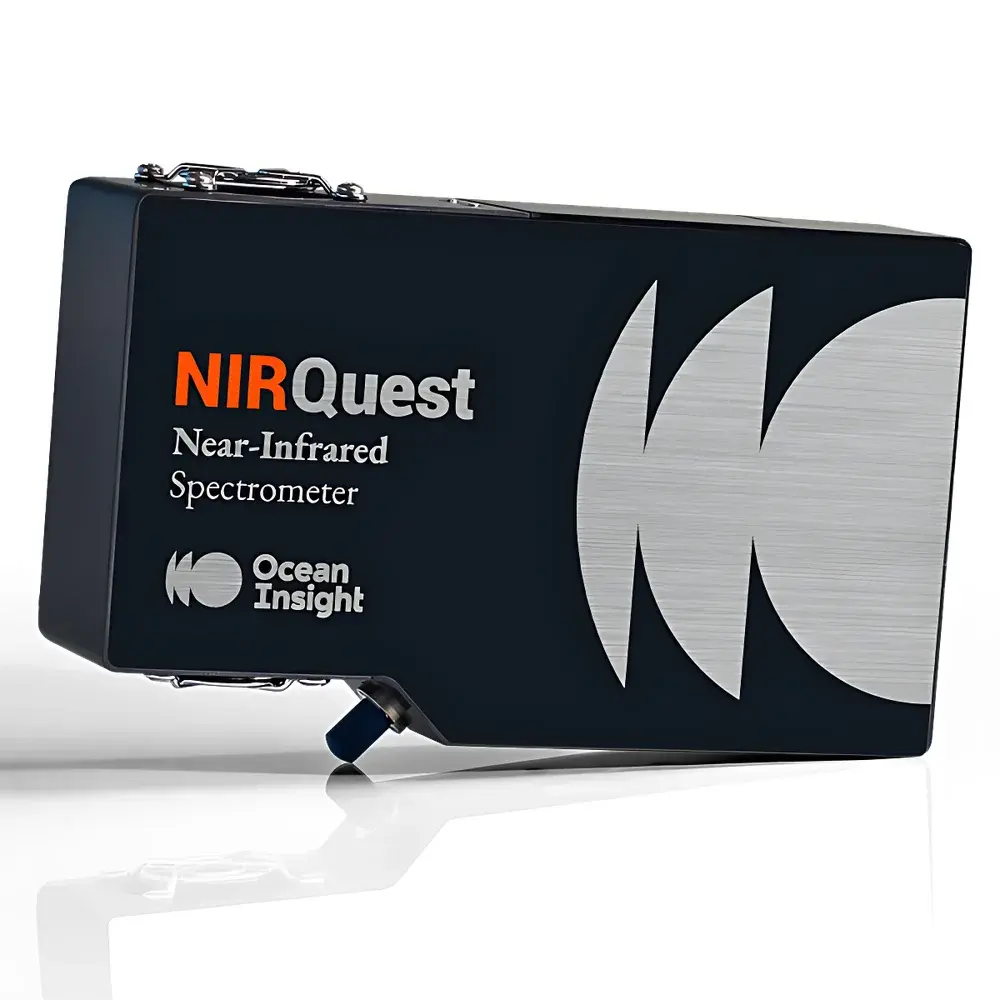
Ocean Optics NIRQuest Near Infrared Spectrometer
| Brand | Ocean Optics |
|---|---|
| Model | NIRQuest |
| Type | Laboratory Benchtop / Portable Fiber-Optic NIR Spectrometer |
| Wavelength Range | 900–1700 nm (standard), up to 2500 nm (optional configurations) |
| Detector | Hamamatsu InGaAs linear array (512 or 256 pixels) |
| Cooling | Thermoelectric (TEC), stabilized to ~30 °C below ambient |
| Optical Platform | Crossed Czerny-Turner |
| A/D Resolution | 16-bit USB interface |
| Integration Time | As low as 1 ms |
| Sampling Modes | Diffuse reflectance, transmission |
| Grating Options | Multiple groove densities for resolution/sensitivity trade-offs |
| Slit Options | 10, 25, 50, 100, or 200 µm width or fiber-coupled (no slit) |
| Interface | SMA 905 fiber port |
| Software Compatibility | SpectraSuite (with spectral acquisition, basic preprocessing, and export functions) |
| Compliance | Designed for GLP-aligned workflows |
Overview
The Ocean Optics NIRQuest is a laboratory-grade, fiber-optic coupled near-infrared spectrometer engineered for robust, reproducible spectral acquisition in the 900–2500 nm range. Based on a crossed Czerny-Turner optical architecture, it delivers high optical throughput and thermal stability critical for quantitative NIR analysis. Unlike Fourier-transform infrared (FT-IR) systems, the NIRQuest employs a fixed-grating, diode-array detection approach—enabling millisecond-scale spectral acquisition without moving parts. Its core detector is a thermoelectrically cooled Hamamatsu InGaAs linear array (512- or 256-pixel variants), operating at stabilized temperatures up to 30 °C below ambient to suppress dark current and ensure signal integrity during extended integrations. The instrument supports both diffuse reflectance and transmission measurement geometries via interchangeable fiber-optic probes and accessories, making it suitable for solid, semi-solid, and liquid sample interrogation in controlled lab environments or near-line process settings.
Key Features
- Thermoelectrically cooled InGaAs detector array with low dark current and high quantum efficiency across the SWIR region (900–2500 nm)
- Crossed Czerny-Turner optical design with high stray-light rejection and optimized f-number matching for maximum fiber coupling efficiency
- Multiple grating options enabling user-selectable resolution/sensitivity balance—e.g., 900–1700 nm (standard), 900–2100 nm, or 900–2500 nm configurations
- Configurable input slits (10–200 µm) or direct fiber coupling (SMA 905), supporting flexibility in spectral resolution and light throughput
- 16-bit USB 2.0 interface with hardware-triggered acquisition, enabling synchronization with external events (e.g., conveyor motion, pump cycles, or reaction triggers)
- Compact, ruggedized aluminum housing designed for benchtop stability and limited-space integration into analytical workstations
Sample Compatibility & Compliance
The NIRQuest accommodates diverse sample forms—including grains, powders, pellets, liquids, and slurries—via standardized Ocean Optics fiber-optic probes (e.g., bifurcated reflection probes, immersion transmittance cells, and integrating spheres). It meets fundamental requirements for method development under ISO 12099:2017 (animal feeding stuffs), ASTM E1655 (standard practices for NIR quantitative analysis), and USP <1119> (near-infrared spectroscopy for pharmaceutical applications). While not pre-certified for 21 CFR Part 11, its SpectraSuite software supports timestamped spectral logging, user-accessible metadata tagging, and CSV/ASCII export—facilitating traceability and alignment with GLP/GMP documentation protocols when deployed within validated laboratory information management systems (LIMS).
Software & Data Management
SpectraSuite is the native cross-platform application for real-time spectral acquisition, baseline correction, smoothing, and export. It provides raw intensity data with wavelength calibration coefficients embedded in header metadata. For advanced chemometric modeling, users typically export spectra to dedicated platforms such as CAMO Unscrambler, Thermo Fisher TQ Analyst, or open-source Python environments (e.g., scikit-learn, PyMca, or h5py for HDF5-based storage). The NIRQuest does not include embedded multivariate calibration tools; however, its consistent spectral fidelity, low noise floor (<0.05% RMS relative to full scale), and stable wavelength calibration (<±0.1 nm drift over 8 h at constant temperature) make it well-suited for PLS, PCR, and SVM model deployment in regulated and research contexts.
Applications
- Grain & agricultural commodity analysis: Moisture, protein, starch, and oil content quantification in wheat, corn, soy, and rice using calibrated PLS models
- Pharmaceutical QA/QC: Raw material identification (RMI), blend uniformity assessment, and tablet coating thickness monitoring
- Environmental monitoring: Detection of organic contaminants and metal complexes in aqueous matrices via characteristic overtone and combination bands
- Food & beverage quality control: Sugar concentration (Brix), alcohol content, and adulteration screening in juices, wines, and dairy products
- Chemical process analytics: Reaction endpoint determination and catalyst activity tracking in batch or semi-continuous reactors
FAQ
What wavelength ranges are available for the NIRQuest series?
Standard configurations cover 900–1700 nm, 900–2100 nm, and 900–2500 nm—each optimized with matched gratings and detector response curves.
Is the NIRQuest suitable for regulatory submissions?
It supports data integrity fundamentals (time-stamped acquisition, uneditable raw exports) but requires integration with validated third-party software and SOPs to meet FDA 21 CFR Part 11 or EU Annex 11 expectations.
Can I use my own chemometrics software with this spectrometer?
Yes—the instrument outputs calibrated spectra in standard text formats (CSV, ASCII) with wavelength and intensity columns, fully compatible with MATLAB, Python, R, and commercial chemometrics packages.
How is thermal stability achieved without liquid nitrogen cooling?
A multi-stage thermoelectric cooler (TEC) maintains the InGaAs detector at a setpoint up to 30 °C below ambient, minimizing dark current drift and enabling stable baselines over hours of operation.
Does the NIRQuest support remote triggering for automated sampling?
Yes—hardware TTL trigger inputs allow precise synchronization with external devices such as motorized stages, peristaltic pumps, or PLC-controlled sample handlers.
Related Products





