
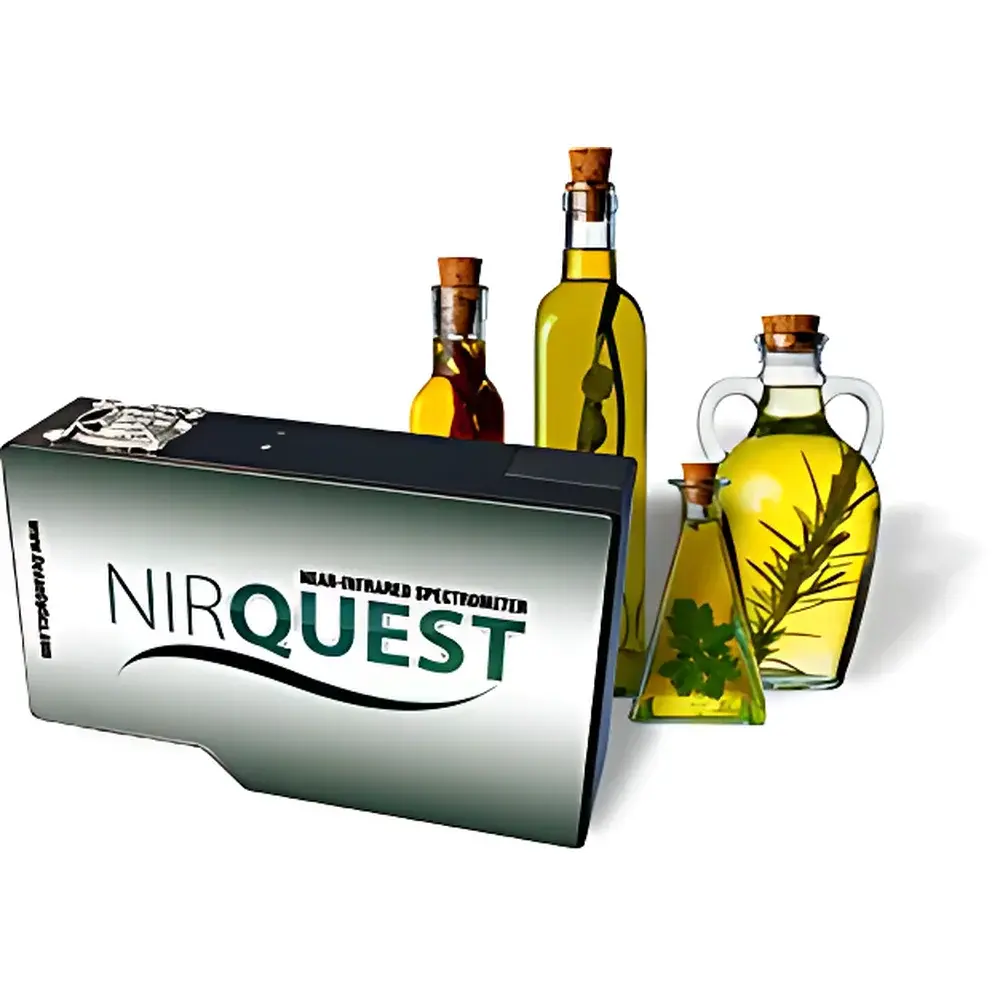

Ocean Optics NIRQuest Series Near-Infrared Spectrometer
| Brand | Ocean Optics |
|---|---|
| Origin | USA |
| Model | NIRQuest |
| Detector Options | 512-element or 256-element InGaAs array |
| Wavelength Range | 900–2500 nm |
| Optical Resolution (FWHM) | 3.1–11.0 nm (model-dependent) |
| Grating Options | NIR1, NIR2, NIR3 |
| Slit | SLIT-25 (25 µm) standard |
| Calibration Sources | AR-1 Argon (696–1704 nm), XE-1 Xenon (916–1894 nm) |
| Software | SpectraSuite (Windows/macOS/Linux) |
| Compliance | CE, RoHS, FDA 21 CFR Part 11 ready (with audit trail enabled) |
Overview
The Ocean Optics NIRQuest Series Near-Infrared Spectrometer is a modular, benchtop-grade dispersive spectrometer engineered for high-fidelity spectral acquisition in the 900–2500 nm range. Based on fixed-grating Czerny-Turner optical architecture and thermoelectrically cooled InGaAs photodiode array detectors, the NIRQuest platform delivers low-noise, high-stability performance essential for quantitative near-infrared analysis. Its design adheres to fundamental spectroscopic principles—light is collimated, dispersed by a ruled or holographic grating, and focused onto a linear InGaAs detector array, where photon-to-electron conversion yields digitally resolvable intensity-vs-wavelength spectra. The system’s compact footprint (140 × 86 × 35 mm), USB 2.0 interface, and 5 VDC power requirement enable seamless integration into laboratory workstations, process monitoring loops, and OEM instrumentation platforms. Unlike generic broadband detectors, NIRQuest models employ optimized optical benches with precisely aligned gratings and anti-reflection coated optics to minimize stray light and suppress second-order contributions—critical for accurate chemometric modeling in complex matrices.
Key Features
- Thermoelectric (TE)-cooled InGaAs detector arrays (512- or 256-element) for reduced dark current and enhanced signal-to-noise ratio (SNR) at ambient and elevated temperatures
- Multiple optical bench configurations pre-aligned with application-specific gratings: NIR3 (900–1700 nm), NIR2 (900–2050 nm), and NIR1 (900–2500 nm)
- Standard 25 µm entrance slit (SLIT-25); optional slits (10 µm, 50 µm) available for resolution/sensitivity trade-off optimization
- External hardware triggering support (TTL-compatible) for synchronized acquisition with external events—e.g., pump cycles, stage motion, or laser pulses
- Integrated longpass filter option (OF1-RG830, >830 nm cutoff) to suppress visible-order artifacts in 512-element configurations
- Factory wavelength calibration traceable to NIST-traceable emission line sources (AR-1 Argon, XE-1 Xenon)
Sample Compatibility & Compliance
NIRQuest spectrometers are routinely deployed in regulated environments requiring analytical rigor and documentation integrity. When paired with SpectraSuite software configured for audit trail logging and electronic signatures, the system supports compliance with FDA 21 CFR Part 11, ISO/IEC 17025, and GLP/GMP frameworks. The instrument’s mechanical stability (<0.05 nm/h thermal drift at 25 °C) and calibrated radiometric response ensure reproducible measurements across sample types—including transmission cells, fiber-coupled reflectance probes, integrating spheres, and flow-through cuvettes. Low-OH silica optical fibers (VIS-NIR grade) and custom probe assemblies extend compatibility to aqueous, particulate, and highly scattering samples common in pharmaceutical blend uniformity testing, agricultural grain moisture profiling, and polymer additive quantification. All units comply with CE marking requirements (EMC Directive 2014/30/EU, RoHS Directive 2011/65/EU).
Software & Data Management
SpectraSuite is a cross-platform (Windows, macOS, Linux) spectrometer control and data analysis application built on a modular architecture. It provides real-time spectrum display, dark/baseline correction, spectral averaging, peak identification, and export to CSV, TXT, or JCAMP-DX formats. For advanced users, the SDK (C++, Python, LabVIEW, MATLAB) enables full low-level register access and custom acquisition logic—essential for embedded process control or automated QA/QC workflows. SpectraSuite supports user-defined calibration curves and chemometric model import (PLS, PCR) via .csv coefficient tables. Optional audit trail modules log operator actions, parameter changes, and calibration events with timestamps and user IDs—meeting ALCOA+ (Attributable, Legible, Contemporaneous, Original, Accurate, Complete, Consistent, Enduring, Available) data integrity criteria required in regulated industries.
Applications
- Quantitative moisture analysis in pharmaceutical tablets and excipients (ASTM E1655-22 compliant methods)
- Protein and fat content determination in dairy and meat products using PLS regression models
- Laser diode characterization: wavelength stability, side-mode suppression ratio (SMSR), and temperature-dependent shift analysis
- Optical fiber attenuation and dispersion profiling in telecom-grade SMF-28 and multimode fibers
- Real-time reaction monitoring in continuous-flow synthesis (e.g., hydrogenation, esterification)
- Soil organic carbon and nitrogen mapping via field-deployable fiber-optic probes
- Identification of counterfeit polymers and recycled plastics using spectral fingerprinting libraries
FAQ
What is the typical optical resolution (FWHM) for each NIRQuest model?
NIRQuest512: ~3.1 nm (900–1700 nm); NIRQuest512-2.2: ~4.7 nm (900–2200 nm); NIRQuest256-2.1: ~8.0 nm (900–2100 nm); NIRQuest256-2.5: ~11.0 nm (900–2500 nm). Resolution varies with slit width and grating groove density.
Can NIRQuest be used for high-resolution atomic line analysis?
Yes—custom configurations with narrow slits (<10 µm), high-line-density gratings, and extended integration times achieve <0.25 nm FWHM, suitable for rare-earth emission lines and gas-phase molecular bands.
Is factory recalibration included with the Annual Service Package (ASP-NIR)?
Yes—ASP-NIR includes one annual wavelength recalibration using NIST-traceable sources, detector responsivity verification, mechanical inspection, and firmware update validation.
Are optical fibers and light sources included in the base price?
No—base pricing covers only the spectrometer head, USB cable, and 5 VDC power supply. LS-1 or HL-2000 tungsten halogen sources, VIS-NIR optical fibers, and OF1-RG830 filters are sold separately.
Does SpectraSuite support automated method execution for routine QC testing?
Yes—via scripting (Python/Lua) and batch acquisition templates, users can define pass/fail thresholds, auto-generate PDF reports, and trigger alerts upon specification deviation.




